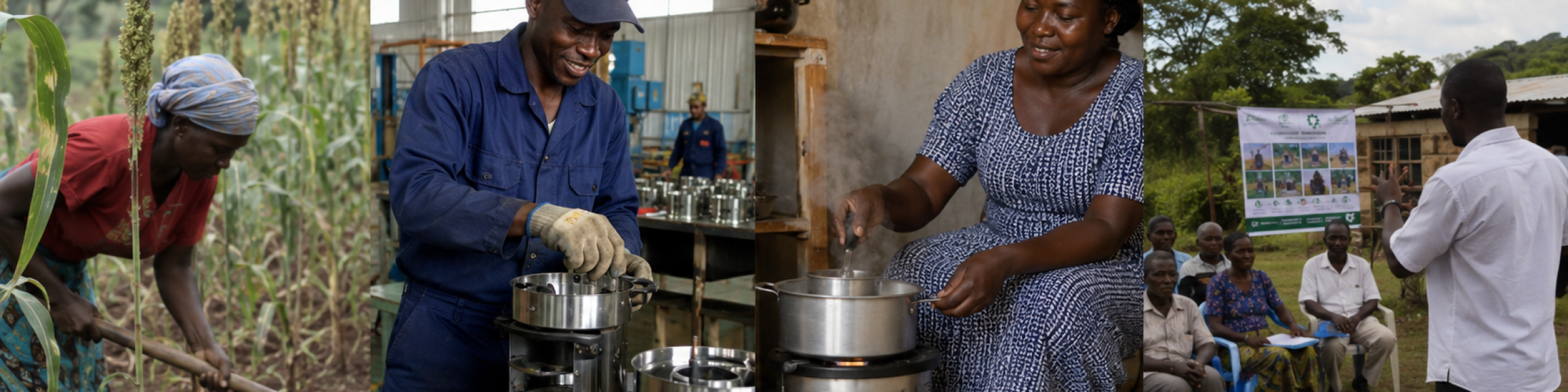
TRAINING MANUAL ON ENERGY CROPS & BIOENERGY ENTERPRISE DEVELOPMENT
This manual is the cornerstone training resource of the ELMECC Project, implemented in Kenya by Practical Action with support from Integral Media Limited. It has been developed through a rigorous process of needs assessment, field consultation, and iterative review drawing on the Giraffe Bioenergy gap analysis, the Business Development Services Presentation delivered at the Nakuru validation meeting on 31 March 2026, and the insights of trainers, farmers and cooperative leaders across five counties through various engagements.
Kenya faces a profound energy challenge. Over 74% of households still rely on solid biomass firewood and charcoal for cooking, contributing to deforestation, indoor air pollution, and carbon emissions. At the same time, Kenya imports more than KES 332.5 billion worth of petroleum products every year, a significant portion of which is used as cooking fuel in urban and peri-urban homes. The gap between local ethanol production capacity and national demand exceeds 200 million litres annually. This manual exists because smallholder farmers, youth agri-preneurs and rural cooperatives are not bystanders in this energy story, they are the solution.
The 10 modules in this manual are proposed for two interconnected purposes. Modules 1 to 5 provide comprehensive agronomic training in energy crop production: cassava, sugarcane, sorghum, and sweet sorghum, with introductions to the emerging crops of sugar beet and elephant grass. Modules 6 to 10 provide business development services training: enterprise formation, financial planning, market access, compliance, and digital tools. Together, they represent a complete pathway from subsistence farming to commercial bioenergy enterprise.
This manual has been contextualized for five counties Nairobi, Kisumu, Kajiado, Kilifi, and Nakuru, each with distinct climate conditions, market dynamics, and community needs. The anchor case throughout is Giraffe Bioenergy in Kilifi County, founded by Dr. Linda Davis, which provides a living proof of concept: cassava farmers, primarily women, can transition from subsistence production to certified, income-generating suppliers to an ethanol processing plant.
The manual integrates Gender Equality, Disability Inclusion, and Social Inclusion (GEDSI) principles throughout every module, not as an afterthought, but as structural features of how training is delivered, how assessments are conducted, and how certification is awarded. Youth and women are not target beneficiaries in name only; they are active co-designers of the economic systems this programme is building.
We dedicate this proposed manual to every farmer, cooperative leader and young agri-preneurs in Kilifi, Kajiado, Kisumu, Nakuru and Nairobi who has looked at their land and asked: what else is possible? This manual is our answer.
This manual serves four distinct groups, each of whom will engage with different sections according to their role in the bioenergy value chain.
|
Learner Group |
Recommended Modules |
|
Smallholder farmers (all five counties) |
Modules 1–5 (Energy Crops) + Module 7 (Financial Literacy basics) |
|
Youth agri-preneurs and cooperative leaders |
All 10 modules; particular emphasis on Modules 6–10 |
|
Processors, aggregators, and marketers |
Modules 1 (value chain overview), 5 (post-harvest), and Modules 6– 10 |
|
County mentors and extension officers |
All 10 modules; plus Assessment Framework and Certification sections |
Each of the 10 modules in this manual follows a consistent structure so that both self-learners and trainers can navigate content efficiently.
|
Section |
Purpose |
|
Module Overview |
A plain-language introduction explaining what the module covers, why it matters, and how long it takes. |
|
Learning Objectives |
Specific, measurable outcomes that participants should achieve. |
|
Core Content |
Detailed explanations, step-by-step instructions, examples, and county specific guidance. |
|
Practical Tools & Templates |
Ready-to-use tools: cashbooks, canvases, mapping sheets, and planning templates. |
|
Case Studies |
Real examples from the five project counties to ground learning in lived experience. |
|
Visual Descriptions |
Descriptions of diagrams and charts that can be drawn on a flipchart or produced digitally. |
|
Exercise |
A structured activity for individual or group application of the module content. |
|
Assessment |
A 10-question quiz and practical task to measure learning before certification. |
|
Bridge to Next Module |
A linking paragraph that connects the current module to the next in the sequence. |
This manual is written in plain English, but it is designed to be delivered in Kiswahili, Giriama (Kilifi), Dholuo (Kisumu), and Maa (Kajiado) by county mentors who have been trained on the content. For low-literacy participants, all exercises can be administered verbally. All assessment tools include an option for oral or pictorial administration. Trainers should adapt content language to the context without reducing the depth or accuracy of the information.
Each module is designed for a half-day training session of three to four hours, or for self-paced study over several days using the ELMECC Digital Hub Platform. The full 10-module programme requires a minimum of five days of face to face training, or eight to ten weeks of blended self-study and field mentoring.
KENYA'S ENERGY CONTEXT AND THE CASE FOR BIOENERGY
The Energy Challenge Kenya Faces
Kenya is one of Africa's most dynamic economies, yet it faces an energy paradox that holds back millions of its people. Despite significant investments in renewable electricity generation, from geothermal, wind, and solar, the majority of Kenyan households continue to cook with charcoal, firewood, and kerosene. According to Kenya's 2022 Energy Sector Report, approximately 74% of households in rural areas and 40% of households in urban centres rely on solid biomass as their primary cooking fuel. Only 26% of Kenyan households have reliable access to clean cooking solutions such as LPG, ethanol, or electric cooking.
This reliance on biomass comes at a serious cost. Indoor air pollution from wood smoke and charcoal causes over 21,000 premature deaths in Kenya annually, disproportionately affecting women and children who spend the most time near cooking fires. Charcoal production drives deforestation at a rate of approximately 50,000 hectares per year, contributing to soil erosion, reduced rainfall, and loss of biodiversity. The economic cost is equally significant: Kenya imports more than KES 332.5 billion worth of petroleum products annually, much of it used for cooking and transport fuels, representing a massive drain on foreign exchange reserves.
Kenya's bioethanol sector presents a compelling opportunity to address both the clean cooking gap and the import bill simultaneously. Bioethanol, alcohol fuel produced from energy crops such as cassava, sugarcane, and sorghum, is used directly as a liquid fuel in ethanol cookstoves designed to burn it at the appropriate concentration and purity. It produces no visible smoke, reduces cooking time, and costs less per meal than charcoal over time.
This opportunity is reinforced by national policy: under Kenya's National Cooking Transition Strategy, bioethanol is targeted to reach a 30% market share, alongside a 7% market share for sustainable biomass, by 2030. Achieving these targets will require a substantial scale-up in domestic feedstock production and processing capacity, positioning farmers and processors who enter the sector now to benefit from this projected growth.
The current annual demand for fuel ethanol in Kenya is estimated at 300–400 million litres. Domestic production capacity, however, falls significantly short: Kenya produces only around 100–150 million litres per year, leaving a supply gap of more than 200 million litres that is either unmet or filled by expensive imports. This gap is the commercial opportunity at the heart of the ELMECC programme. Companies such as Specter International and the African Clean Fuels Company (ACFC) are actively seeking reliable, quality feedstock supply from smallholder farmers and organised cooperatives.
Giraffe Bioenergy in Kilifi County demonstrates what is possible at scale: the facility is designed to produce between 15 and 45 million litres of bio-ethanol annually using cassava as the primary feedstock, operating on a zero-waste model whereby by-products become animal feed and organic fertilizer, and the plant itself is powered by solar energy and biogas generated from processing waste.
The Role of Agriculture in Kenya's Energy Transition
The link between agriculture and the clean energy economy is not peripheral, it is structural. Most of every litre of ethanol sold by Spectre International begins with a farmer who planted, tended, harvested, and delivered energy crops. Most of the briquette sold in Kenyan markets begins with biomass, agricultural residues such as sorghum stalks, cassava peels, and maize cobs; forestry residues; sawdust; charcoal dust; and other organic materials, that someone decided was worth collecting and processing rather than discarding or burning in the open.
Smallholder farmers across Kenya's arid and semi-arid lands (ASALs) cultivate some of the most resilient crops in the world: drought-tolerant cassava in coastal and low-rainfall areas, and sweet sorghum and sugarcane in lake regions and highland valleys. These are not only food security crops; they are energy security crops. We recognize that the transition from subsistence to commercial bioenergy farming is not simply an agricultural question. It is a question of business skills, market access, financial literacy and institutional support, all of which this manual directly addresses.
Challenges and Opportunities in Biomass and Bioenergy Development
Kenya's biomass sector holds significant potential, but realizing it requires navigating real constraints. Challenges include inconsistent feedstock supply and quality, limited aggregation and storage infrastructure, low farmer awareness of bioenergy markets, and financing gaps for both producers and processors. At the same time, the opportunities are substantial: growing domestic demand for clean cooking fuels, the potential for new income streams from crops and residues previously treated as waste, and increasing private-sector investment in processing capacity. A realistic approach to bioenergy development treats these challenges and opportunities as two sides of the same transition, not as separate issues.
Balancing Food Security with Energy Crop Production
Energy crop production must be pursued in a way that safeguards, rather than undermines, food security. This can be achieved through several approaches: prioritizing crops and residues that do not directly compete with food production (e.g. using agricultural residues, or dedicating marginal or underutilized land to energy crops); promoting intercropping and rotation systems that combine food and energy crops on the same land; and ensuring that farmers retain the flexibility to allocate land between food and energy uses based on household needs and market conditions. Guidance in this manual is designed to support farmers in making these trade-offs deliberately, rather than defaulting to energy crops at the expense of household food supply.
Agro-Ecological Zone Mapping and Crop Suitability
Kenya's diverse agro-ecological zones (AEZs), from humid highlands to arid and semi-arid lowlands, support different combinations of energy crops and biomass resources. Matching crop choice to agro-ecological conditions (rainfall, temperature, soil type, and altitude) is essential to achieving good yields and long-term sustainability. For example, cassava performs well in low-rainfall coastal and semi-arid zones, while sugarcane and sweet sorghum are better suited to higher-rainfall lake-basin and highland-valley zones. AEZ mapping tools, where available, can help farmers, extension officers, and investors identify which energy crops and biomass resources are most viable in a given area before committing land and resources.
Matching Local Biomass Resources with Technologies and Markets
The viability of a bioenergy enterprise depends on aligning three factors: the biomass resources available locally, the processing technologies suited to that resource, and the markets able to absorb the resulting product. A mismatch in any one of these, for example, a technology requiring a feedstock volume the local area cannot reliably supply, or a product for which there is no accessible market, undermines the whole value chain. This manual encourages farmers, cooperatives, and investors to assess local resource availability and market demand together before selecting a technology or business model.
Policy Alignment Across Levels
Kenya's bioenergy sector operates within a layered policy environment, from global commitments (such as those under international climate agreements) and regional frameworks (such as East African Community energy and agriculture initiatives), through to national strategies (including Kenya's Bioenergy Strategy and National Cooking Transition Strategy) and county-level plans and bylaws. Coherent alignment across these levels, so that national targets are reflected in county planning and local practice, is critical to creating an enabling environment for energy crop and biomass enterprises to grow sustainably.
The ELMECC programme operates across five counties, each representing a different node in Kenya's bioenergy ecosystem.
|
County |
Role in Value Chain |
Key Context |
|
Kilifi |
Primary production (cassava); anchor for Giraffe Bioenergy model |
Coastal climate, 600–1,000mm rainfall; high cassava suitability; women-led farming; CBSD disease risk; RPT seedling programme |
|
Kisumu |
Production and aggregation (sugarcane, sweet sorghum); lake region hub |
High humidity and rainfall; sugarcane belt; proximity to Spectre International plant; youth agribusiness potential |
|
Kajiado |
ASAL production (sorghum, drought-tolerant varieties); pastoralist transition |
Semi-arid; 400–700mm rainfall; Maasai community focus; drought resilience priority; emerging bioenergy market |
|
Nakuru |
Mixed production and logistics hub (sugarcane, cassava); highland processing |
Highland climate; diverse agro-ecology; strong SACCO network; proximity to Nairobi markets; potato competition for land |
|
Nairobi |
Market and consumption hub; youth enterprise incubation |
Urban; consumer market for ethanol cookstoves; youth agripreneur ecosystem; digital platform access; aggregation logistics |
ENERGY CROPS MODULES: 1–5
|
|
|
ENERGY CROPS MODULES: 1–5 |
|
|
MODULE 1: INTRODUCTION TO BIOENERGY VALUE CHAINS
Module Overview
Duration: 1–2 hours (half-day session) or self-paced over 3 days via Elmecc-hub.or.ke
Target audience: All participants, smallholder farmers, youth agri-preneurs, cooperative leaders, processors, aggregators
Module Gap Response: This module addresses Gap 5 from the Giraffe Bioenergy Training Needs Assessment, specifically, the need for early, clear introduction to what contract farming looks like and how market actors relate to farmers.
By the end of this module, participants will be able to:
• Define bioenergy and explain the difference between bioethanol, biogas, and briquettes.
• Name at least three energy crops grown in their county and explain why they are suitable.
• Describe the five stages of the bioenergy value chain and identify at least two entry points for their own enterprise.
• Name three major market actors in Kenya's bioethanol sector and what each one buys.
• Explain in simple terms what a supply agreement is and why it is different from selling to a broker in a market.
1.1 What Is Bioenergy? Understanding the Basics
Bioenergy is energy in the form of fuel, heat, or electricity that comes from recently living plant or animal material. This material is called biomass. Unlike fossil fuels such as petroleum or coal, which are formed from ancient organic matter over millions of years, bioenergy uses crops and organic waste that are part of the current carbon cycle. When a cassava plant grows, it absorbs carbon dioxide from the atmosphere. When that cassava is converted to ethanol and burned as cooking fuel, the carbon released is the same carbon the plant absorbed making the cycle effectively carbon-neutral when managed sustainably.
In Kenya, bioenergy takes three main forms that are directly relevant to this programme:
|
Form of Bioenergy |
Description and Relevance |
|
Bioethanol (fuel ethanol) |
Liquid alcohol produced by fermenting and distilling the sugars or starches in energy crops like cassava, sugarcane, and sorghum. Used directly in ethanol cookstoves. This is the primary product focus of the ELMECC programme. |
|
Biogas |
Gas (mainly methane) produced by the anaerobic decomposition of organic waste, animal dung, food waste, cassava peels, or sugarcane bagasse. Used |
|
|
for cooking and electricity generation at household and enterprise level. Giraffe Bioenergy uses biogas from processing waste to power its own plant. |
|
Briquettes |
Compressed blocks of carbonized agricultural residue, sorghum stalks, bagasse, charcoal dust, used as a substitute for wood charcoal. Relevant particularly in Nakuru and Kajiado where residue from sorghum harvests is abundant. |
1.2 Energy Crops: What They Are and Where They Grow
An energy crop is any plant cultivated primarily or partially for its energy value, its sugars, starches, or cellulose, rather than solely for food or fibre. This section presents the general agronomic and technical characteristics of the main energy crops relevant to Kenya's bioenergy sector.
Primary Energy Crops
Cassava (Manihot esculenta) is a starchy root crop that thrives in tropical and sub-tropical climates with moderate rainfall between 500 and 1,000 mm per year. It is highly drought-tolerant and can grow on relatively poor soils, making it well suited to low-rainfall and marginal-soil areas. Cassava's tubers contain between 25 - 35% starch, which can be fermented into ethanol at a yield of approximately 200–250 litres per tonne of fresh root.
Sugarcane (Saccharum officinarum) is the world's largest bioenergy crop by volume. It is high in sucrose, up to 14% of fresh weight, which converts to ethanol at yields of 60–85 litres per tonne of cane. Sugarcane performs best where there is proximity to processing facilities and established agronomic knowledge, factors that make it the most economically attractive energy crop in Kenya's main commercial sugarcane-growing regions e.g the lake basin and Western Region. The entire cane plant is useful: the juice is fermented for ethanol, while the bagasse (fibre residue) can be burned for energy or pressed into briquettes.
Sorghum (Sorghum bicolor) and Sweet Sorghum (Sorghum bicolor var. saccharatum) are drought-resistant grains well suited to semi-arid areas. Grain sorghum is processed for starch-based ethanol, while sweet sorghum produces a juice similar in sugar content to sugarcane, enabling direct fermentation. Sweet sorghum has a much shorter growing cycle (3–4 months versus 12–18 months for sugarcane), making it attractive for smallholders who need faster cash flow cycles. Sorghum is also valuable in livestock-keeping areas, as it can be grown as a food-and-fuel crop without competing with livestock water requirements during dry seasons.
Emerging Energy Crops
Sugar beet (Beta vulgaris) is a temperate root crop with very high sugar content (14–20% of fresh weight), producing ethanol yields comparable to sugarcane. It performs best in cooler highland areas with more reliable rainfall. It is currently treated as an emerging option and is not yet covered in the core agronomy modules; farmers in suitable highland areas should monitor ongoing variety trials by the Kenya Agricultural and Livestock Research Organization (KALRO).
Elephant grass (Napier grass, Pennisetum purpureum) is a tall, fast-growing perennial grass that can yield between 20–40 tonnes of dry biomass per hectare per year. It has two main applications: as a biomass feedstock for briquette production, and as a trap crop in push-pull pest management systems for sorghum and maize, which reduces the need for chemical pesticides. Module 4 covers this pest management application in detail.
ELMECC Programme Examples
The following illustrates how these crops are applied within the ELMECC programme's five counties.
- Kilifi County: Cassava is the primary bioenergy crop grown as an ethanol feedstock for Giraffe Bioenergy's Kilifi processing plant.
- Nakuru County: Cassava is also grown here as an energy crop option; sugar beet is being piloted in Nakuru's highland areas; elephant grass is used for briquette production.
- Kisumu and Kajiado: Sorghum and sweet sorghum are grown in Kisumu's lake-basin areas and in Kajiado's semi-arid zones.
- Kajiado County: Sorghum is promoted as a food-and-fuel crop; elephant grass is used for briquette production and as a push-pull trap crop.
1.3 The Five-Stage Bioenergy Value Chain
A value chain is the complete sequence of activities through which a product passes from raw material to end consumer, with value being added at each stage. Understanding the full value chain helps every participant, farmer, aggregator, processor, distributor, or marketer, identify where they fit, what contribution they make, and where the greatest economic opportunities lie.
Bioenergy value chains generally follow a common pattern, but the exact sequence of stages varies depending on the product, the scale of the enterprise, and the local market structure. Not every value chain includes a distinct aggregation stage, and some involve direct producer-to-processor or producer-to-market linkages, skipping intermediary steps entirely. The framework below should therefore be read as a flexible guide, not a fixed sequence that applies uniformly to every bioenergy value chain:
|
Stage |
Activities |
Key Actors |
Example Applications |
|
1. Feedstock/Resource Supply |
Seed/seedling procurement, land preparation, soil testing, fertilizer, water access |
Research institutions, seedling nurseries, agrodealers, extension services |
Certified cassava seedling distribution; improved sorghum variety supply |
|
2. Production or Generation |
Planting, crop management, pest and disease control, irrigation, soil health |
Smallholder farmers, youth agripreneurs, farmer groups |
Cassava, sugarcane, and sorghum production by smallholder farmers |
|
3.Collection/Aggregation (where applicable) |
Collection from farms, quality sorting, weighing, transport to processing facilities |
Aggregators, cooperatives, group leaders, logistics providers |
Farmer cooperative collection points; company-run collection centres |
|
4.Processing/Conversion |
Fermentation, distillation (ethanol); pressing, carbonising (briquettes); digestion (biogas) |
Processing companies, cooperatives, small-scale processors |
Ethanol distillation plants; briquette pressing operations |
|
5. Distribution |
Bulk transport, storage, wholesale supply to retailers and institutional buyers |
Distributors, wholesalers, logistics providers |
Fuel depots; regional wholesale networks |
|
6. Market/End Use |
Retail, end-consumer use (ethanol cookstoves, industrial use), export |
Retailers, cooperatives, urban distributors, industrial buyers |
Ethanol cookstove retailers; industrial fuel buyers |
Note: Not all value chains pass through every stage. Some producers sell directly to processors (skipping Aggregation), while some processors sell directly to end consumers (skipping Distribution). Trainers and enterprise planners should map the actual stages relevant to their specific crop, product, and local market context.
|
Visual Description: Value Chain Flow Diagram Draw this on a flipchart as six connected boxes from left to right, each with an upward arrow labelled "Value Added": [FEEDSTOCK/RESOURCE SUPPLY] → [PRODUCTION OR GENERATION] → [COLLECTION/AGGREGATION] → [PROCESSING/CONVERSION] → [DISTRIBUTION] → [MARKET/END USE] Below each box, write the names of 2–3 relevant local actors. Draw a dotted feedback arrow from MARKET/END USE back to FEEDSTOCK/RESOURCE SUPPLY, labelled "Market demand signals." Use green for PRODUCTION OR GENERATION, amber for PROCESSING/CONVERSION, and blue for MARKET/END USE. Where a value chain in the local context skips a stage (e.g. no separate aggregation step), note this on the diagram with a direct arrow bypassing that box, rather than forcing every value chain into all six stages. Use of green for PRODUCTION OR GENERATION, amber for PROCESSING/CONVERSION, and blue for MARKET/END USE remains as in the original scheme. |
1.4 Key Market Actors in Kenya's Bioethanol Sector
Understanding who buys what, at what price, and under what conditions is essential knowledge for any farmer entering the commercial bioenergy market. Below are the most important market actors operating in ELMECC counties.
|
Market Actor |
What They Buy and Offer |
|
Spectre International |
One of Kenya's largest ethanol producers, with operations connected to sugarcane and sorghum supply chains in western Kenya. Spectre purchases biomass feedstock primarily sugarcane juice and sorghum grain from cooperatives and aggregators under formal supply agreements. They require KEBS-compliant quality and consistent delivery schedules. |
|
African Clean Fuels Company (ACFC) |
ACFC operates clean cooking fuel distribution networks across East Africa. They are active buyers of ethanol for cookstove fuel and interested in expanding their supply base in ELMECC counties. Farmers who supply ACFC do so through registered aggregator cooperatives. |
|
East African Breweries Limited (EABL) |
EABL is the largest buyer of grain sorghum in Kenya, purchasing high-quality sorghum grain from farmers in Kisumu and surrounding regions for use in beer production. While this is a food/beverage market rather than a bioenergy market, it represents a premium grain price that farmers can access to build capital before entering dedicated bioenergy supply chains. |
|
Giraffe Bioenergy |
Giraffe Bioenergy is the anchor buyer in the ELMECC Kilifi model. The company purchases fresh cassava roots from registered smallholder farmers, primarily women, at a guaranteed price, provided quality and delivery schedule requirements are met. Giraffe provides RPT seedlings, training, and agronomic support in exchange for a preferred supply arrangement. This is the closest model to a complete farmer-buyer partnership operating in the ELMECC counties. |
1.5 County-Specific Value Chain Entry Points
Each county in the ELMECC programme has a different energy crop profile, market connection, and set of opportunities. Participants should understand their own county context before moving into the detailed agronomy of Modules 2–5.
|
County |
Primary Crop(s) and Value Chain Entry Points |
|
Kilifi |
Cassava is the primary bioenergy crop, with Giraffe Bioenergy as the anchor buyer. Entry points: (1) Certified cassava producer supplying Giraffe fresh roots; (2) Nursery operator producing RPT cassava seedlings; (3) Aggregator managing collection from 50–100 farmers in a cooperative structure. |
|
Kisumu |
Sweet sorghum and sugarcane are the primary crops, with Spectre International and EABL as anchor buyers. Entry points: (1) Sugarcane out grower in existing sugarcane schemes; (2) Sweet sorghum producer for ethanol or grain markets; (3) Aggregator and logistics coordinator for bulking to processing point. |
|
Kajiado |
Sorghum (grain and sweet varieties) is the primary crop given semi-arid conditions. Entry points: (1) Sorghum producer using drought-tolerant varieties; (2) Cooperative |
|
|
aggregator managing seasonal supply to Nairobi-based processors; (3) Briquette maker using sorghum stalk residue. |
|
Nakuru |
Sugarcane and cassava are viable; mixed production with strong logistics. Entry points: (1) Sugarcane farmer or out grower; (2) Cassava producer for Nairobi ethanol market; (3) Aggregation and logistics enterprise connecting to multiple buyers. |
|
Nairobi |
Primarily a market and enterprise hub rather than a production county. Entry points: (1) Aggregation and distribution enterprise; (2) Youth agripreneur managing farmer cooperative supply chains from rural counties; (3) Retail distributor for ethanol cookstoves and fuel. |
1.6 Case Study: Kilifi, Cassava to Ethanol
CASE STUDY: Giraffe Bioenergy, A Kilifi Food-and-Fuel Model
Location: Kilifi County, coastal Kenya
Founder: Dr. Linda Davis | Anchor buyer for ELMECC Kilifi farmers
Background: Giraffe Bioenergy operates a "food and fuel" model in Kilifi County, using cassava as the primary feedstock for clean cooking ethanol. The company was founded with a deliberate gender lens: the majority of out grower farmers supplying Giraffe are women smallholders, many of whom had previously grown cassava solely for household food consumption.
Production System: Giraffe uses Rapid Propagation Technology (RPT) to develop disease-resistant, high-yield cassava seedlings certified free of Cassava Brown Streak Disease (CBSD) and Cassava Mosaic Disease (CMD). These RPT seedlings are distributed to registered out growers, who must use them as their only planting material, no recycled cuttings from previous seasons.
Zero-Waste Model: Processing cassava into ethanol generates significant by-products. At Giraffe, these byproducts are not wasted: cassava peels and pulp are dried and sold as animal feed; the ethanol distillation residue (vinasse) is processed into organic fertilizer and returned to farmers. The processing plant is powered by a combination of solar panels and biogas generated from organic waste, meaning the plant consumes no grid electricity.
Farmer Outcomes: Women farmers who have been in the Giraffe out grower programme for two or more seasons report income increases of 40–80% compared to their pre-programme cassava sales to local markets. The combination of certified seedlings, agronomic training, guaranteed market, and fair price has been transformative for households in Kilifi's coastal lowland communities.
Scale: The plant is designed to produce 15–45 million litres of bio-ethanol annually at full capacity, equivalent to providing clean cooking fuel for approximately 300,000–900,000 households.
1.7 Exercise: Map Your County Value Chain
Module 1 Exercise, Individual and Group Activity
Time required: 45 minutes
Materials: Large paper or flipchart, markers in three colours
Step 1, Individual (10 minutes): On your paper, write down the name of one energy crop that grows in your county. Draw a simple box for each of the five value chain stages: Inputs, Production, Aggregation, Processing, and Market.
Step 2, Fill in what you know (15 minutes): In each box, write down: (a) one activity that happens at that stage; (b) one actor (person, company, or organisation) you know of that operates at that stage in your county.
Step 3, Group sharing (15 minutes): Share your value chain with the group. Identify: (a) Which stages are missing actors in your county? (b) Which stage offers the best business opportunity for you personally?
Step 4, Reflection (5 minutes): Write down one thing you learned about the value chain that you did not know before today.
Instructions: Answer all 10 questions. A score of 6/10 or higher is required to pass this module.
• What is bioenergy? Give one example of a bioenergy product used in Kenya for cooking.
• Name two energy crops grown in your county and explain why they are suitable.
• What are the five stages of the bioenergy value chain? List them in order.
• At which stage of the value chain do they operate?
• What is the annual ethanol supply gap in Kenya, and why does it matter for farmers?
• Explain the difference between bioethanol and biogas. Give one use for each.
• What is an aggregator and why are they important in the value chain?
• What makes the Giraffe Bioenergy model different from a simple farm-to-market system?
• What is a supply agreement? Give two things it should include.
• Name one entry point into the bioenergy value chain that is available in your county.
Bridge to Module 2
Now that you understand where energy crops fit in the bioenergy value chain and who buys them the next critical question is: how do you grow them well? Module 2 covers the practical agronomy of cassava, sugarcane, and sorghum, from land preparation and certified seedlings to planting techniques, intercropping, and crop management. The quality of your crop at harvest determines whether a buyer like Giraffe Bioenergy or Spectre will accept it and at what price.
MODULE 2: CROP ESTABLISHMENT AND AGRONOMY
Module Overview
Duration: 2–5 hours (full day with field practical) or self-paced over 2 days
Target audience: Smallholder farmers, youth agripreneurs, cooperative leaders, county extension officersGap Response: This module directly responds to Gap 4 (quality assurance of seedlings and inputs) and introduces the companion crop risks flagged by Giraffe Bioenergy's training needs assessment.
• Identify suitable land and prepare it correctly for energy crop production.
• Recognize certified planting material and explain why it is essential for cassava, sugarcane, and sorghum.
• Demonstrate correct planting techniques, spacing, and timing for each energy crop.
• Identify at least two beneficial intercropping combinations and explain their agronomic value.
• Identify at least one harmful companion crop and explain the risk it poses.
2.1 Land Selection and Preparation
The first and most important decision in crop establishment is selecting the right piece of land. Many farmers make the mistake of planting energy crops on marginal land that they consider too poor for food crops. While cassava and sorghum are tolerant of poor soils, this tolerance does not mean they thrive on exhausted, waterlogged, or rocky ground. Selecting good land from the beginning reduces input costs, increases yield, and improves the quality of your harvest all of which affect your income.
When selecting land for energy crop production, look for the following characteristics:
|
Land Characteristic |
What to Look For |
|
Drainage |
Well-drained soils that do not flood after heavy rains. Waterlogged soils cause root rot in cassava and crown rot in sugarcane. Test drainage by digging a 30cm hole after rain and checking if water drains away within 2 hours. |
|
Slope and erosion risk |
Gentle slopes (less than 15%) are ideal. Steep slopes require terracing or ridging before planting. Kilifi and Nakuru have areas with significant slope; always establish anti-erosion structures first. |
|
Soil texture |
Sandy-loam to loam soils are best for cassava. Clay loam soils suit sugarcane. Sorghum tolerates a wide range of textures. Avoid heavy clay soils for cassava, they compact, restricting root expansion. |
|
Previous crop history |
Avoid land where cassava has been grown continuously for more than two seasons without rotation soil-borne diseases accumulate. For sugarcane, avoid land with a history of maize without soil health restoration. |
|
Sun exposure |
All three primary energy crops require full sun (6+ hours per day). Avoid planting under large trees or in shaded valleys. |
Land preparation should be determined by the crop being grown, soil type, climate, topography, drainage conditions, erosion risk, previous land use, and available resources, not by region or county alone. The same county can contain multiple soil types, slopes, and microclimates, so farmers and extension officers should assess these site-specific factors directly rather than assuming a single method applies uniformly across a county.
Ripping and tillage depth in particular are crop-specific, not region-specific: different energy crops have different root architectures and moisture requirements, and tillage depth should be matched to the crop being planted regardless of where it is being grown.
The table below sets out recommended land preparation approaches based on soil and site conditions, and the crops they are typically suited to. Farmers should identify which conditions match their own land and apply the corresponding guidance.
|
Soil/Site Condition |
Recommended Land Preparation Method |
Typically Relevant Crops |
|
Sandy or light coastal/lowland soils, moderate rainfall |
Light ripping or ploughing to 25–30cm depth. Avoid over-tillage, which increases erosion risk on sandy soils. Create mounds or ridges 30cm high where soils are prone to waterlogging during heavy rains. Clear weeds by hand or with herbicide 2 weeks before planting. |
Cassava |
|
Heavier soils, flood-prone low-lying areas |
Deep ploughing (30–40cm), suited to crops needing a deep root system. Install drainage furrows in low-lying areas prone to flooding. Disc harrow after ploughing to break soil clods. |
Sugarcane |
|
Semi-arid areas, low and erratic rainfall, slope |
Minimum tillage to preserve soil moisture and organic matter. Where planting on slopes, create zai pits (30cm diameter, 20cm deep, spaced 70cm × 70cm) that fill with rainwater and concentrate moisture at the planting point. Avoid tillage that increases surface evaporation. |
Sorghum, sweet sorghum |
|
Sloped terrain (gradient greater than 8°), highland areas |
Terrace construction before any planting, on any slope exceeding 8°, regardless of county. Deep plough (30–40cm) for deep-rooted crops; standard plough for shallow-rooted crops. Apply organic matter (compost or well-rotted manure) during ploughing at 5–10 tonnes/ha. |
Sugarcane (deep plough), cassava (standard plough) |
|
Confined/urban spaces, limited land access |
Container and raised-bed production for small-scale urban farming. Ensure good drainage in raised beds. Soil mix: 40% topsoil, 40% compost, 20% coarse sand. |
Suitable smaller-footprint crops and demonstration plots |
Note: These conditions can occur in any county. Farmers should assess their own soil type, slope, drainage, and crop choice against this table, rather than relying on county identity alone to select a land preparation method.
2.2 Certified Planting Materials: Why This Matters
The decision about which planting material to use is, for cassava farmers in Kilifi in particular, the single most important decision in the entire farming cycle. Cassava Brown Streak Disease (CBSD) and Cassava Mosaic Disease (CMD) are both transmitted through infected planting material meaning that if you plant a cassava cutting taken from a diseased plant, the disease is already in your new crop before the first leaf emerges. Symptoms may not appear until 3–6 months after planting, by which time you have invested months of labour, inputs, and land.
What is RPT (Rapid Propagation Technology)?
RPT is a tissue-culture-based method developed by KALRO (Kenya Agricultural and Livestock Research Organization) to produce large numbers of disease-free, genetically uniform cassava seedlings quickly. Starting from a single healthy plant, RPT laboratories can produce thousands of certified plantlets in 6–8 weeks by culturing meristematic tissue (growing tips) in sterile conditions.
RPT seedlings are: (1) Certified free of CBSD and CMD at the time of production; (2) Genetically uniform, consistent performance across the season; (3) Higher-yielding than local varieties, by an average of 30–50% in Kilifi trials.
Giraffe Bioenergy provides RPT-certified planting material to all registered out growers. Farmers who use uncertified cuttings, including cuttings from their own previous season, risk losing their entire crop to disease and will not receive support from Giraffe's input credit scheme.
For sugarcane, certified seed cane must be sourced from KALRO-approved nurseries or licensed sugarcane seed cane producers. Planting uncertified seed cane risks introducing sugarcane smut and ratoon stunting disease, which spread through the cane's root system and cannot be eliminated once established without destroying the entire ratoon.
For sorghum, KALRO has released several improved varieties specifically suited to ELMECC counties: Serena and Hageen Dura 1 for grain production; Sugar graze for sweet sorghum ethanol feedstock. These varieties are certified by the Kenya Seed Company and available through registered agrodealers.
How to Verify Certified Planting Material
• Ask the agrodealers or nursery for the KALRO certification tag or seed certificate. This tag includes a batch number, variety name, production date, and certifying officer's signature.
• For RPT cassava seedlings, look for the distinctive tissue-culture appearance: small, uniform plants in polythene bags with clean white roots. Reject any seedlings with yellowing leaves, twisted shoots, or visible mosaic patterns on the leaves.
• For sorghum seed, check the seed packet for the Kenya Seed Company logo, variety name, and germination rate (should be 85% or higher).
• Never buy planting material from a fellow farmer unless that farmer can show you written proof that the material is from a certified source.
2.3 Planting Techniques by Crop
Cassava Planting (Kilifi, Nakuru)
The following is the step-by-step process for establishing a cassava crop using RPT seedlings or certified stem cuttings.
• Land Preparation: Plough or hand-till to a depth of 25–30cm. Rake to remove large stones and roots. On slopes, create mounds 30cm high and 60cm wide, spaced 1m apart.
• Seedling preparation: If using RPT seedlings in polythene bags, harden them off for 7–10 days before planting by placing them in partial shade outdoors. If using stem cuttings, cut sections of 25–30cm length from healthy, fully mature stems. The cut surfaces should show white or cream-colored wood, brown or hollow centres indicate disease.
• Planting spacing: The standard spacing for cassava grown as an ethanol feedstock is 1 metre between plants within the row, and 1 meter between rows (1m × 1m), giving a plant population of 10,000 plants per hectare. This maximizes root yield per hectare while allowing adequate light and air circulation.
• Planting technique: Dig a planting hole 30cm deep. Place the RPT seedling (still in polythene bag, remove the bag just before planting) into the hole and firm soil around it. If using stem cuttings, insert the cutting at a 45° angle into the soil so that at least two nodes (leaf attachment points) are buried. The top of the cutting should have at least two nodes above ground.
• Timing: Planting should be timed according to the crop, local agro-ecological conditions and the availability of adequate soil moisture. In rain-fed systems, farmers should generally plant at or shortly after the reliable onset of the appropriate rainy season, which varies across regions, as a general guide, this typically provides 6 - 8 weeks of reliable rainfall during crop establishment before rains reduce. In irrigated systems, planting may take place throughout the year, subject to water availability, crop requirements, and other local conditions. In all systems, avoid planting during peak rainy periods when the risk of waterlogging is high.
• Select certified seed cane stools from KALRO-approved sources. Choose stems that are 8–12 months old, healthy, free of discolouration, and have clearly visible nodes.
• Cut seed cane into setts (pieces) of 45–60cm length, each with at least 3 nodes. Treat setts with a 0.1% fungicide solution (Mancozeb or Iprodione) to prevent soil-borne disease infection.
• Open furrows 25–30cm deep and 100–150cm apart (row spacing for out grower production). Place setts end-toend in the furrow at a slight overlap (about 5cm overlap between setts).
• Cover setts with 5–8cm of soil. Do not bury deeper, deep planting delays sprouting and weakens first shoots.
• Apply basal fertilizer (CAN or NPK 23:23:0) along the furrow at 50–80kg/ha before covering. Do not allow fertilizer to touch seed cane directly keep 10cm separation.
• Timing: Plant sugarcane in Kisumu between April and June (long rains onset). In Nakuru, the September–October window suits sugarcane establishment for the highland conditions.
Sorghum Planting (Kajiado, Kisumu)
• Prepare seedbed with minimum tillage (Kajiado) or standard ploughing (Kisumu). If using zai pits in Kajiado, dig pits 1–2 weeks before expected rainfall, fill with 2kg of compost per pit and wait.
• Treat certified sorghum seed with a dry fungicide dressing (Thiram or Captan) immediately before planting to protect against soil-borne fungi.
• Planting spacing: 75cm between rows × 25cm between plants within the row for grain sorghum (yielding approximately 50,000 plants/ha). For sweet sorghum grown for juice, reduce to 60cm × 20cm to increase stalk density.
• Planting depth: 3–5cm in sandy soils; 2–3cm in heavier loam soils. Deeper planting in Kajiado's sandy soils is acceptable (up to 7cm) if soil is very dry.
• Timing: Plant grain sorghum at the onset of rains (April in most areas; March in Kisumu lake region). Sweet sorghum for juice production should be planted 90–100 days before the planned harvest date for the processing facility.
2.4 Intercropping: Beneficial Combinations
Intercropping means growing two or more crops simultaneously on the same piece of land. For bioenergy crop farmers, intercropping serves multiple purposes: it provides food security income while the main energy crop matures, it improves soil health, and it can reduce pest and weed pressure on the main crop.
|
Intercrop Combination |
Benefits |
|
Cassava + Beans (common bean or climbing bean) |
Beans fix atmospheric nitrogen in the soil, reducing fertilizer requirements for cassava. Beans mature in 90 days while cassava takes 9–18 months, giving the farmer a food/income crop during the waiting period. Beans do not compete significantly for light because cassava provides a light canopy in early growth. |
|
Cassava + Green Grams (Vigna radiata) |
Green grams are highly drought-tolerant and nitrogen-fixing. They mature in 65–70 days and can be harvested twice before cassava canopy closes. Particularly suitable in Kilifi where green grams are also a food crop. |
|
Cassava + Maize (first season only) |
Maize can be intercropped with cassava during the cassava's first 60 days when canopy is not yet established. Maize provides food and income, but must be harvested before its root competition can reduce cassava yield. Do not intercrop maize with cassava beyond the first season. |
|
Sorghum + Cowpeas |
Cowpeas fix nitrogen, suppress weeds with a spreading canopy, and provide a grain legume for household food. Sorghum and cowpeas have compatible root systems and moisture requirements. Particularly appropriate for Kajiado. |
|
Sugarcane + Soybeans (first ratoon period) |
Soybeans can be grown in the inter-row spaces during the first 4–6 months of a new sugarcane crop. They fix nitrogen, which benefits subsequent sugarcane growth. Must be harvested before cane canopy closes completely. |
2.5 Companion Crops That Harm Cassava
WARNING: Harmful Companion Crops, Cassava
Giraffe Bioenergy's training needs assessment specifically flagged that some Kilifi farmers are inadvertently reducing cassava yields by planting harmful companion crops in the same field.
Cayenne Pepper (Capsicum annuum): Cayenne pepper planted alongside cassava competes aggressively for nutrients, particularly potassium and phosphorus, which are both critical for cassava root development. Cayenne has an allelopathic effect, it releases root chemicals that suppress the growth of neighboring plants. Farmers who grow cayenne for household income should maintain a minimum separation of 3 metres between cayenne and cassava rows.
Sweet Potato: Sweet potato vines spread rapidly and can smother young cassava plants in the first 60 days. The two crops also share common pests (whitefly) and the fungal disease Cercospora. Do not intercrop sweet potato with cassava.
Tobacco: Tobacco is a heavy feeder that depletes soil nitrogen, potassium, and organic matter. Cassava grown immediately after tobacco shows consistently lower yields in Kilifi field trials. Observe a minimum 2-season gap between tobacco and cassava on the same field.
Instructions: Answer all 10 questions. A score of 6/10 or higher is proposed.
• What soil conditions should you look for when selecting land for cassava?
• What is RPT and why is it important for cassava farmers?
• How do you prepare a cassava stem cutting for planting? What length should it be?
• What is the recommended cassava planting spacing in the?
• Name one crop that can be safely intercropped with cassava and explain one benefit.
• Why should you never plant cayenne pepper close to cassava?
• What is the recommended sorghum planting spacing for sweet sorghum grown for juice?
• How do you verify that a cassava seedling is RPT-certified?
• What land preparation technique is recommended for Kajiado's semi-arid conditions?
• What is a sett, and how should it be treated before planting?
Bridge to Module 3
Module 2 has given you the knowledge to establish your energy crops on the right land, with the right planting material, using correct techniques. But crops do not grow in isolation, they respond to the soil environment around them. Module 3 explores soil health and climate-smart agriculture: how to maintain and improve your soil, conserve water, and adapt your farming practices to climate variability. Healthy soil is the foundation of consistent, quality yields.
MODULE 3: SOIL HEALTH AND CLIMATE-SMART AGRICULTURE
Duration: 3–6 hours (half-day session + 1-hour field practical on composting)
Target audience: Smallholder farmers, cooperative leaders, county extension officers
Gap Response: This module addresses knowledge gaps in soil fertility management, water resource management, and climate-adaptive agricultural practices identified through bioenergy sector training needs assessments.
Learning Objectives
By the end of this module, participants will be able to:
- Explain what soil health is, what causes soil degradation, and the main practices used to restore and maintain healthy soil.
- Identify general soil types relevant to energy crop production and describe their implications for crop choice and management.
- Construct a compost heap using locally available materials, following a step-by-step process, and explain when compost is preferable to synthetic fertilizer.
- Describe at least three climate-smart agriculture practices and explain how each contributes to resilient energy crop production.
- Define water harvesting, distinguish it from soil and water conservation, and identify techniques suited to their own farming context.
What is soil health?
Soil health refers to the continuing capacity of soil to function as a living ecosystem that sustains plants, animals, and humans. Healthy soil supports crop growth not only through its physical and chemical properties (structure, nutrient content, pH) but also through the biological activity within it, the bacteria, fungi, earthworms, and other organisms that cycle nutrients, build soil structure, and suppress disease-causing organisms.
What leads to unhealthy soil?
Soil health declines through a combination of natural and human-driven processes, including:
- Loss of organic matter, through repeated cropping without replenishment, crop residue removal or burning, and lack of organic inputs.
- Erosion, from wind and water carrying away fertile topsoil, particularly on sloped or bare land.
- Compaction, from heavy machinery, livestock trampling, or repeated tillage at the same depth, which restricts root growth and water infiltration.
- Nutrient depletion, from continuous cropping without adequate replacement of nutrients removed at harvest.
- Salinization and poor drainage, particularly in irrigated or low-lying areas without adequate water management.
- Loss of soil biodiversity, often linked to the overuse of synthetic agrochemicals and the absence of organic matter to sustain soil organisms.
How to improve soil health?
Soil health can be rebuilt and maintained through a combination of practices covered in detail later in this module:
- Composting (Section 3.3) to restore organic matter and biological activity.
- Mulching to reduce erosion, moderate soil temperature, and conserve moisture.
- Crop rotation to break pest and disease cycles and balance nutrient use.
- Minimum tillage to protect soil structure and reduce erosion and organic matter loss.
- Integrated soil fertility management (Section 3.4), which combines organic and inorganic inputs based on soil testing and crop need.
3.2 Soil Types and Their Suitability for Energy Crops
Kenya's national soil information follows internationally recognized classification systems. The Kenya Natural Resource Atlas identifies 23 major soil groups nationally. The soil types most commonly associated with agricultural production and most relevant to energy crop farmers, include Ferralsols, Vertisols, Acrisols, Lixisols, Luvisols, Nitisols, Andosols, Cambisols, Fluvisols, Arenosols, and Regosols.
The table below summarizes the general characteristics of these soil types and their typical suitability for energy crop production. Farmers should confirm their specific soil type through local extension services or soil testing, since more than one type can occur within a single farm or county.
|
Soil Type |
General Characteristics |
Suitability for Energy Crops |
|
Ferralsols |
Deeply weathered, well-drained, often red in colour; typically low in organic matter and phosphorus; found in humid tropical and sub-tropical areas |
Suited to cassava, which tolerates low phosphorus; sugarcane requires compost/fertilizer amendment |
|
Vertisols ("black cotton soils") |
High clay content; crack when dry, waterlog and become sticky when wet; high inherent fertility but difficult to work |
Suited to sugarcane on ridges with good drainage management; challenging without ridging/drainage infrastructure |
|
Acrisols |
Acidic, low base saturation, often found on old, weathered landscapes; moderate to low natural fertility |
Suitable for acid-tolerant crops such as cassava; benefits from liming and organic matter addition |
|
Lixisols |
Similar to Acrisols but with higher base saturation in the subsoil; moderate fertility |
Generally suitable for a range of energy crops with standard fertility management |
|
Luvisols |
Fertile, well-structured soils with clay accumulation in the subsoil; good water-holding capacity |
Good general suitability for cassava, sorghum, and sugarcane |
|
Nitisols |
Deep, well-structured, fertile red soils; high organic matter potential; good physical properties |
Among the most productive soils for energy crops, including cassava and sugarcane, with minimal amendment |
|
Andosols |
Derived from volcanic ash; light, fertile, high water-holding capacity, but can fix phosphorus |
Good for a range of crops; may need phosphorus management |
|
Cambisols |
Moderately developed soils with good structure; variable fertility depending on parent material |
Generally versatile; suitability depends on specific site fertility and drainage |
|
Fluvisols |
Young soils formed from river/lake sediments; often fertile but may be prone to flooding |
Suited to sugarcane and other crops where drainage is managed; flood risk requires attention |
|
Arenosols |
Sandy, well-drained, but low in nutrients and water-holding capacity |
Suited to drought-tolerant, low-input crops such as cassava; requires organic matter to improve moisture and nutrient retention |
|
Regosols |
Weakly developed, shallow soils, often on eroded or newly exposed land |
Limited suitability without significant soil-building inputs (compost, mulch, cover cropping) |
Farmers and extension officers should treat this table as a general guide. Local soil testing remains the most reliable way to confirm suitability for a specific energy crop.
3.3 Composting: Methods and Step-by-Step Construction
Compost is one of the most cost-effective soil amendments available to smallholder farmers. Unlike synthetic fertilisers, compost improves soil structure, increases microbial activity, and releases nutrients slowly over 3–6 months. A well-made compost heap costs little beyond labour and time.
Common Composting Methods
- Heap composting: organic material is piled above ground in alternating layers and turned periodically. This is the most widely used method among smallholders and is described step-by-step below.
- Pit composting: material is layered in a dug pit rather than above ground; useful in hot, dry areas where a pit helps retain moisture, but requires good drainage to avoid waterlogging.
- Trench composting: material is buried directly in trenches between planting rows, decomposing in place and enriching the soil where crops will be planted; requires less turning but takes longer to mature.
- Vermicomposting: composting using earthworms to accelerate decomposition, producing a nutrient-rich product; requires more management but yields high-quality compost in a shorter time.
The heap method is described in detail below as it is the most accessible and widely applicable for smallholder farmers; the same core principles (balancing greens, browns, moisture, and aeration) apply across all methods.
Materials Required for a Compost Heap
A good compost heap requires three categories of materials: "Greens," "Browns," and "Activators." Greens are nitrogen-rich materials (fresh plant material, food waste, green leaves, fresh manure). Browns are carbon-rich materials (dry straw, dried leaves, crop stalks and residues). Activators are materials that accelerate decomposition (fresh animal manure, especially cow or chicken dung, soil, and water).
Step-by-Step Compost Construction
- Choose a shaded site (under a tree or shade net) close to a water source and accessible for turning. Shade prevents the heap from drying out too quickly.
- Layer 1, Brown base: Lay a 15cm layer of dry, coarse material directly on the ground. This base layer allows air to circulate from below.
- Layer 2, Green layer: Add a 10cm layer of green material (fresh plant cuttings, kitchen waste, fresh weeds, but not weeds that have gone to seed, as seeds survive composting and spread weeds).
- Layer 3, Activator: Spread a thin layer (3–5cm) of fresh animal manure, or a shovelful of old compost or garden soil. This introduces the microbial population that drives decomposition.
- Water: Sprinkle water over the heap until moist throughout, as moist as a wrung-out sponge, not dripping wet. Too much water excludes oxygen and causes slow, smelly anaerobic decomposition.
- Repeat layers: Continue alternating brown, green, and activator layers until the heap is 1–1.5 metres high, approximately 1.5m wide and 1.5m long, large enough to generate heat but manageable for turning.
- Cover: Cover the completed heap with dry grass or old sacks to retain moisture and moderate temperature.
- First turn (Day 14): Turn the heap with a fork or spade, moving material from the outside to the centre and vice versa. Check moisture, add water if dry, add more brown material if soggy.
- Second turn (Day 28): Turn again. The heap should now generate significant heat (warmth felt at the centre). This heat kills weed seeds and pathogens.
- Third turn (Day 42) and maturity check (Day 56–70): By 81 - 0 weeks, mature compost is dark brown-black, smells earthy, and original materials are no longer recognizable. Spread mature compost at 5–10 tonnes per hectare before planting.
Field Practical: Compost Heap Construction
Each participant group (4 - 6 people) constructs one compost heap at the training venue or a nearby demonstration plot.
Materials to prepare: dry straw/crop residue (one wheelbarrow), fresh green cuttings (one wheelbarrow), fresh cow or chicken manure (1 bucket), water (20 litres), garden soil (1 shovelful).
Time required: 30 - 40 minutes.
Observation: The trainer marks the heap with the construction date. At the Module 3 follow-up visit (Day 14), participants return to observe the first turn, check temperature, and assess moisture.
GEDSI note: Ensure compost turning activities are accessible for participants with physical limitations, provide chairs for observation and allow modified participation in physical components.
Why Compost Instead of Synthetic Fertilizer?
Both compost and synthetic fertilizer have a role in soil fertility management, and the two are not mutually exclusive. Key differences:
|
Factor |
Compost |
Synthetic Fertilizer |
|
Cost |
Low, mainly labour, uses local materials |
Recurring cash cost, subject to price volatility |
|
Nutrient release |
Slow-release over months, improves long-term fertility |
Fast-acting, but does not build long-term soil structure |
|
Soil structure |
Improves structure, water-holding capacity, and microbial life |
No direct structural benefit; can degrade structure if overused |
|
Application |
Requires bulk material, labour, and time to produce |
Precise, easy to apply, immediately available |
|
Best use |
Building long-term soil health and resilience |
Correcting specific, immediate nutrient deficiencies |
For most smallholder energy crop farmers, compost should form the foundation of soil fertility management, with synthetic fertilizer used selectively to address specific deficiencies identified through soil testing, an approach covered further under Integrated Soil Fertility Management (Section 3.4).
3.4 Climate-Smart Agriculture Practices
Climate-smart agriculture combines practices that increase productivity, build resilience to climate variability, and reduce environmental impact. The following practices are central to sustainable energy crop production.
Mulching
Mulching means covering the soil surface around plants with organic material, dry grass, crop residue, or leaves. It is one of the most powerful and underused soil management practices, particularly in areas where soil moisture loss through evaporation limits production.
Benefits include: reduction of soil evaporation by 30–50%; suppression of weed growth; moderation of soil temperature; gradual decomposition into organic matter; and reduced soil erosion during heavy rain. Apply mulch at a depth of 5–10cm around energy crops, keeping it 10–15cm from the plant stem to prevent crown rot and discourage termites.
Crop Rotation
Crop rotation means growing different crops in sequence on the same land across seasons. It breaks pest and disease cycles, improves soil nutrient balance (legumes add nitrogen; cereals consume it), and reduces the build-up of soil-borne pathogens. A general rotation principle for energy crop systems: alternate a nutrient-demanding crop (e.g. sugarcane, cassava) with a nitrogen-fixing legume (e.g. cowpeas, beans, soybean) at least once every 2–3 seasons.
Minimum Tillage
Minimum tillage reduces the frequency and intensity of soil disturbance, helping preserve soil structure, organic matter, and moisture. It is especially valuable in areas prone to erosion or moisture stress, though tillage requirements remain crop-specific (see Section on Land Preparation).
Drought-Tolerant Crop Selection
Selecting crop varieties bred or naturally adapted for drought tolerance, such as certain cassava and sorghum varieties, reduces production risk in areas with unreliable rainfall. Farmers should consult county extension services or KALRO for locally recommended drought-tolerant varieties.
Agroforestry
Integrating trees and shrubs into farming systems provides shade that reduces crop canopy temperature and evapotranspiration, improves soil structure through root systems and leaf litter, and can provide additional income (timber, fruit, fodder) or nitrogen fixation (with certain tree species). Agroforestry is particularly valuable for buffering energy crops against heat and moisture stress.
Efficient Irrigation
Where irrigation is used, efficiency matters as much as access. Practices include: applying water directly to the root zone (e.g. drip irrigation) rather than flood irrigation, to reduce losses to evaporation and runoff; scheduling irrigation based on crop growth stage and soil moisture rather than a fixed routine; and using harvested rainwater (see Section 3.5) as a supplementary irrigation source, applied efficiently rather than allowed to run off or evaporate.
Integrated Pest Management (IPM)
IPM combines cultural, biological, and where necessary, chemical methods to manage pests while minimizing chemical use and environmental impact. This is covered in detail in Module 4.
Weather-Informed Farming
Timely, localized weather information allows farmers to make better-informed decisions on planting, irrigation, and harvest timing. Farmers should be encouraged to access county or national meteorological service updates, weather alert SMS services where available, and to plant based on actual rainfall conditions (e.g. after a defined threshold of rainfall has fallen) rather than calendar dates alone.
Integrated Soil Fertility Management
Integrated soil fertility management combines organic inputs (compost, manure, crop residues) with judicious use of mineral fertilizer, guided by soil testing, to maintain both immediate crop nutrition and long-term soil health. This approach avoids over-reliance on either organic or synthetic inputs alone and should be tailored to the specific soil type and crop (see Section 3.2).
3.5 Water Harvesting Techniques
What is water harvesting?
Water harvesting is the deliberate collection, storage, and management of rainwater or runoff for productive use, rather than allowing it to be lost to evaporation or surface runoff. In semi-arid areas, and during dry spells in higher-rainfall areas, water harvesting can be the difference between a successful crop and crop failure.
Techniques and Their Suitability
|
Technique |
Description |
Suitability/Application |
|
Zai pits |
Small planting pits (30cm diameter, 20cm deep, spaced 70cm × 70cm), filled with 2kg of compost or manure before the rains. Water is channeled into the pits rather than running off, and held near the root zone. |
Effective in sandy, low-rainfall soils; increases water infiltration by up to 60%; well suited to deep-rooted crops such as sorghum during establishment |
|
Water pans |
Excavated, often lined, depressions that collect and store surface runoff for later use, including supplementary irrigation. |
Suited to areas with defined rainy seasons and available land/labour for excavation; supports irrigation during dry spells |
|
Roof water harvesting |
Collection of rainwater from roof surfaces via gutters into storage tanks or containers. |
Suited to homesteads and peri-urban/urban production, including container and raised-bed systems |
|
Small dams/farm ponds |
Constructed impoundments that capture and store runoff at a larger scale than water pans. |
Suited to group/cooperative-level investment where sufficient catchment and land are available |
Suitability depends on local rainfall pattern, catchment area, soil type, and available labour or capital for construction. Farmers should assess these factors, ideally with extension support, before selecting a technique.
3.6 Soil and Water Conservation Techniques
Distinct from primary water harvesting (which actively collects and stores water for use), soil and water conservation techniques primarily slow water movement across land, reducing erosion and improving in-situ infiltration.
Terracing and Contour Ridging
On sloped land, terraces and contour ridges slow the downhill flow of water, allowing it to infiltrate the soil rather than carrying topsoil away. Contour ridges are earthen ridges built across the slope, following the contour line (the line of equal elevation), typically at intervals of 10–20 metres depending on slope steepness. These are generally recommended on slopes greater than 5–8°, particularly for deep-rooted crops such as sugarcane.
Tied Ridges
Tied ridges are a system of furrows closed off at regular intervals by small earth dams ("ties"), forming a grid of water-holding basins across the field. This is a form of in-situ rainwater harvesting: water is held within the basins after rain and remains available to crops during dry spells between rain events, rather than being transported and stored separately as with water pans or dams.
- What is soil health, and name two factors that contribute to unhealthy soil.
- Name three practices that can be used to improve soil health.
- List the three layers of a compost heap in the correct order, and name one other composting method besides heap composting.
- How moist should a compost heap be, and how do you test this?
- When should you do the first turn of a compost heap, and why?
- Give two reasons why compost might be preferred over synthetic fertiliser, and one situation where synthetic fertiliser may still be needed.
- What is mulching, and name three benefits it provides for energy crops?
- Why should you rotate crops rather than growing the same crop on the same land every season?
- Name three climate-smart agriculture practices (other than composting and mulching) and briefly explain what each involves.
- Define water harvesting in your own words.
- What is a zai pit, and what soil/rainfall conditions is it best suited to?
- Name two other water harvesting techniques besides zai pits, and describe a situation where each would be appropriate.
- What is the difference between water harvesting and soil/water conservation techniques such as terracing?
- What is a tied ridge, and why is it considered a form of in-situ water harvesting?
Healthy soil and well-established crops are your first line
of defense against pests and disease. Module 4 explores the specific pests,
diseases, market risks, and climate risks that energy crop
farmers face, and provides an integrated management approach, including risk
identification, classification, and adaptation planning ,that minimizes
chemical use while protecting yield, quality, and farm resilience.
MODULE 4: PEST, DISEASE, AND RISK MANAGEMENT
Duration: 1–4 hours Gap Response: Gap 4, verifying input authenticity; understanding IPM. Also introduces push-pull pest management using elephant grass.
Pest: A living organism, insect, mite, rodent, bird, or other animal, that feeds on, damages, or otherwise reduces the yield and quality of a crop. Pests cause damage directly through feeding, boring, or physical destruction of plant tissue.
Disease: An abnormal condition in a plant caused by a pathogen (fungus, bacterium, virus, or nematode) or, less commonly, by non-living factors such as nutrient deficiency. Diseases disrupt the plant's normal physiological function and are often spread by a vector (an organism, frequently an insect pest, that transmits the pathogen from one plant to another).
Risk: The possibility of loss, damage, or reduced income arising from an uncertain future event, whether biological (pest or disease outbreak), climatic (drought or flood), or market-related (price collapse or buyer default). Risk management is the practice of identifying these threats in advance and putting mitigation measures in place before they occur.
Why the distinction matters: A pest is an organism you can usually see and act against directly (hand-picking, trapping, targeted spraying). A disease is caused by a pathogen you often cannot see directly, symptoms show up on the plant after infection has already occurred, so disease management relies far more heavily on prevention (clean planting material, resistant varieties, sanitation) than on after-the-fact treatment. Several of the diseases below are spread by pests (see CMD and CBSD, both transmitted by whitefly), which is why pest control and disease control are interconnected rather than separate jobs.
4.2 Pest Identification by Crop
|
Crop |
Pest |
Identification and Impact |
|
Cassava |
Cassava Mealybug (Phenacoccus manihoti) |
White, waxy cottony masses on growing tips and undersides of leaves. Severe infestations cause "bunchy top", stunted leaves clustered at the shoot tip. Can reduce yield by 40–80% in Kilifi if untreated. |
|
Cassava |
Whitefly (Bemisia tabaci) |
Tiny white insects under leaves; fly in a white cloud when disturbed. Whiteflies are the primary vector for both CMD and CBSD (see Section 4.3), meaning they spread disease from infected to healthy plants. Most destructive during dry periods. |
|
Sorghum |
Sorghum Stem Borer (Busseola fusca) |
Young caterpillars bore into the stem after the whorl stage; "dead heart" (dead central shoot while the plant is young) or "white ear" (dried-up head) are diagnostic signs. Can destroy 50% of yield in Kajiado without management. |
|
Sorghum |
Head Bug (Eurystylus oldi) |
Small brown bugs feeding on sorghum grain at the soft dough stage. Grain shows dark spots and shrivels. Worst during humid conditions. High significance for EABL quality specifications. |
|
Sugarcane |
Termites (Macrotermes sp.) |
Feed on seed cane and ratoon stools at the base; crop appears to wilt and die in patches. More severe on sandy soils and during dry conditions. |
|
Sugarcane |
Sugarcane Aphid (Melanaphis sacchari) |
Yellow-green aphids in dense colonies on leaf undersides; honeydew secretion promotes sooty mould growth. Serious in Nakuru highlands. |
4.3 Disease Identification by Crop
|
Crop |
Disease |
Identification and Impact |
|
Cassava |
CMD (Cassava Mosaic Disease) |
Distorted, yellow-green mosaic pattern on leaves; twisted and reduced leaf size. Yield loss 20–80% depending on variety and infection timing. Transmitted through infected cuttings and by whitefly. Prevention is the only cure, there is no in-field treatment once a plant is infected. |
|
Cassava |
CBSD (Cassava Brown Streak Disease) |
Brown, corky patches inside the root (only visible when cut); yellow streaks on leaf midribs. Roots become inedible and unusable for ethanol. At epidemic levels in Kilifi, the reason RPT (Rapid Propagation Technique) seedlings are mandatory. |
|
Sorghum |
Sorghum Smut (Sporisorium sorghi) |
Black, dusty masses of fungal spores replace grain in the head. Infected heads produce no grain. Seed treatment with fungicide before planting is the primary control. |
|
Sugarcane |
Sugarcane Smut (Sporisorium scitamineum) |
Black, whip-like growth from the cane tip. Infected plants produce thin, unproductive tillers. Transmitted through infected seed cane. Prevented through use of certified, disease-free seed cane. |
4.4 Integrated Pest Management (IPM)
Integrated Pest Management (IPM) is an approach to pest control that combines multiple methods to reduce pest damage below economically damaging levels while minimizing chemical use and protecting the environment. The IPM hierarchy moves from prevention as the first priority to chemical control only as a last resort.
|
Approach |
Methods |
|
Clean planting material |
Source cassava cuttings only from KALRO/RPT-certified nurseries; source sugarcane seed cane and sorghum seed only from certified, disease-tested suppliers. This is the single most effective disease control measure, since CMD, CBSD, and both smuts are all seed- or cutting-borne. |
|
Resistant varieties |
Plant CMD/CBSD-tolerant cassava varieties where available; use smut-resistant sorghum and sugarcane varieties recommended by KALRO for the target county. |
|
Field sanitation |
Rogue (uproot and destroy) infected plants as soon as symptoms are identified, do not leave them in the field or compost them on-site. Clean tools between fields to avoid mechanical spread of smut spores. |
|
Vector control |
Since whitefly transmits both CMD and CBSD, controlling whitefly populations (see Section 4.2 and the IPM table) is itself a disease control measure, not just a pest control one. |
|
Seed treatment |
Treat sorghum seed with a registered fungicide before planting to prevent smut infection. |
Because diseases cannot be treated once established in the plant the way a pest infestation can be sprayed, disease management is built almost entirely around prevention, sanitation, and vector control rather than curative action.
|
Approach |
Methods |
|
Clean planting material |
Source cassava cuttings only from KALRO/RPT-certified nurseries; source sugarcane seed cane and sorghum seed only from certified, disease-tested suppliers. This is the single most effective disease control measure, since CMD, CBSD, and both smuts are all seed- or cutting-borne. |
|
Resistant varieties |
Plant CMD/CBSD-tolerant cassava varieties where available; use smut-resistant sorghum and sugarcane varieties recommended by KALRO for the target county. |
|
Field sanitation |
Rogue (uproot and destroy) infected plants as soon as symptoms are identified, do not leave them in the field or compost them on-site. Clean tools between fields to avoid mechanical spread of smut spores. |
|
Vector control |
Since whitefly transmits both CMD and CBSD, controlling whitefly populations (see Section 4.2 and the IPM table) is itself a disease control measure, not just a pest control one. |
|
Seed treatment |
Treat sorghum seed with a registered fungicide before planting to prevent smut infection. |
|
Quarantine and monitoring |
Inspect all new planting material on arrival before introducing it to the field; isolate and monitor any material of uncertain origin for at least one growth cycle before scaling up. |
|
Timely reporting |
Report suspected disease outbreaks, especially CBSD given its epidemic status in Kilifi, to the county agriculture office or Practical Action county coordinator promptly so spread can be contained. |
4.6 Push-Pull for Sorghum Stem Borer (Kajiado, Kisumu)
The push-pull system is a proven biological pest management strategy for sorghum stem borer, developed by ICIPE in Kenya and highly relevant for Kajiado and Kisumu farmers. The system works by planting a "push" crop (Desmodium, a leguminous cover crop) between sorghum rows to repel stem borer moths with its volatile chemicals, and a "pull" crop (elephant grass / Napier grass) on the field borders to attract moths away from the sorghum and trap them. Parasitic wasps also breed in Desmodium, attacking stem borer larvae.
The push-pull system reduces stem borer damage by 80–90% in field trials, eliminates the need for insecticide in many cases, and because Desmodium is nitrogen-fixing, also improves soil fertility. Elephant grass on the borders provides an additional biomass crop for briquette production.
4.7 Detecting Counterfeit Inputs
How to Identify Counterfeit Pesticides and Fertilizers
Counterfeit agricultural inputs are a serious problem in Kilifi, Kajiado, and remote parts of Kisumu. Using counterfeit pesticides can result in crop failure, health risks, and produce rejection by buyers.
1. Check the PCPB number: All legitimate pesticides in Kenya must be registered with the Pest Control Products Board (PCPB). The registration number (e.g., PCPB(TP)CR4567) must appear on the label. Verify the number on the PCPB website or by phone.
2. Check consistency: Legitimate pesticides have consistent colour, texture, and smell within a product line. Diluted or adulterated products often appear lighter in colour, less viscous, or smell different from the genuine product.
3. Buy from registered agrodealers: Purchase inputs only from agrodealers licensed by the County Department of Agriculture. Ask to see the dealership licence. Avoid purchasing from mobile traders, informal markets, or individual sellers who cannot show source documentation.
4. Report suspected counterfeits: Suspected counterfeit, unregistered, adulterated, or illegally sold pesticides should be reported to the nearest County Agriculture Office or directly to the Pest Control Products Board (PCPB) for investigation and appropriate action.
PCPB contact details:
• By phone: +254 720 480 904 or +254 735 778 743
• By email or online complaint form: via the PCPB official contact page (oprs.pcpb.go.ke)
• In writing, or through the Board's official social media channels
The County Agriculture Office can assist with documentation and guidance on how to forward a complaint to PCPB, but PCPB is the body responsible for investigating and acting on counterfeit input cases. Many counterfeit operations have been shut down through farmer reporting.
4.8 Risk Identification and Classification
Beyond biological pests and diseases, farmers face several other categories of risk that can affect income even when the crop itself is healthy. Recognizing which category a risk falls into helps determine the right mitigation approach.
|
Risk Category |
Definition |
Examples |
|
Climatic risk |
Loss arising from weather events outside the farmer's control |
Drought causing crop failure; flooding causing waterlogging; erratic or delayed rainfall affecting planting windows |
|
Biological risk |
Loss arising from pests, diseases, or other living organisms |
Mealybug outbreak; CBSD epidemic; termite damage to seed cane |
|
Market risk |
Loss arising from price movements or buyer behaviour |
Price drop at harvest; buyer/processor default on payment; oversupply in a local market |
|
Input quality risk |
Loss arising from counterfeit, adulterated, or substandard inputs |
Counterfeit pesticide causing crop damage; uncertified seedlings carrying disease |
|
Financial risk |
Loss arising from the farmer's own cost and cash-flow exposure |
Rising input costs eroding margins; inability to access credit for timely input purchase |
4.9 Risk Profiling and Management Plan
A simple risk profile helps a farmer or extension officer move from "knowing a risk exists" to "having a plan for it." For each risk, work through the following steps:
- Identify the specific risk (e.g., "sorghum crop failure due to missed rains in Kajiado").
- Assess likelihood, how probable is this risk in the target county and season (low / medium / high)?
- Assess impact, if it occurs, how severe is the loss (low / medium / high)?
- Prioritise, risks that are both high-likelihood and high-impact should be addressed first.
- Assign a mitigation strategy, see the table below for county-relevant examples.
- Assign responsibility, who monitors this risk and who acts if it materializes (farmer, cooperative, Practical Action county coordinator)?
- Monitor and review, revisit the risk profile each season, since risk levels shift with weather patterns, market conditions, and input availability.
Risk Profile and Mitigation Table
|
Risk Type |
Example |
Likelihood / Impact |
Mitigation |
|
Climatic , drought |
Sorghum crop fails in Kajiado due to missed rains |
High / High |
Drought-tolerant varieties; zai pits; agricultural insurance (see Module 7); replanting windows (sweet sorghum can be replanted within 30 days of rain return) |
|
Climatic , flooding |
Kisumu cassava/sugarcane waterlogged for 5+ days |
Medium / High |
Ridging; drainage furrows; avoid flood-prone land; have an off-season income source |
|
Biological , disease/pest outbreak |
CBSD epidemic in Kilifi cassava |
High / High |
Certified RPT seedlings only; roguing infected plants; whitefly (vector) control; prompt reporting (see Section 4.5) |
|
Market , price drop |
Cassava fresh root price falls at harvest |
Medium / Medium |
Collective selling through cooperative (reduces individual price exposure); pre-agreed supply contracts; processing as an alternative (drying cassava to chips) |
|
Market , buyer default |
Processor fails to pay on delivery |
Low / High |
Written supply contracts (Module 8); partial prepayment as a contract term; use of a cooperative as a negotiating buffer; notify Practical Action county coordinator |
|
Input quality |
Counterfeit seedlings or pesticide |
Medium / High |
Buy from KALRO/RPT nurseries; verify PCPB certification; report suspected counterfeits to the County Agriculture Office or PCPB directly (see Section 4.7) |
- A farmer shows you a cassava leaf with a distorted, yellow-green mosaic pattern. Is this a pest problem or a disease problem, and how can you tell? What are the likely consequences if left unmanaged?
- Explain why CBSD is harder for a farmer to detect at the point of harvest than CMD, and why this makes RPT seedlings mandatory in Kilifi rather than optional.
- A young sorghum plant shows a dead central shoot. What is this symptom called, which pest is responsible, and at what growth stage does the damage typically occur?
- Rank the five levels of IPM from first priority to last resort, and explain why chemical control is placed last rather than first.
- Why is whitefly control considered both a pest management action and a disease management action? Use CMD or CBSD in your answer.
- Describe the push-pull system for sorghum stem borer: what role does Desmodium play, what role does elephant grass play, and what additional benefit does each provide beyond pest control?
- You are buying pesticide from an unfamiliar trader at a local market and the product looks slightly lighter in colour than usual. What three checks should you carry out before purchasing, and where do you report it if you suspect it is counterfeit?
- A processor has failed to pay a farmer group for a cassava delivery. Classify this risk, and describe two mitigation measures that should have been in place beforehand.
- Using the risk profiling steps in Section 4.9, walk through how you would assess and prioritise the risk of drought for a Kajiado sorghum farmer versus the risk of buyer default for a Kisumu sugarcane cooperative.
- What is the difference between reporting a suspected counterfeit pesticide to the County Agriculture Office and reporting it to PCPB, and why should a farmer ultimately expect PCPB, not the county office, to investigate?
You have grown your crop well, managed pests, diseases, and risk, and it is now approaching maturity. Module 5 focuses on the critical final stage of production: knowing when and how to harvest, and how to handle, store, and transport your crop so that it meets buyer quality specifications. This is where income is either protected or lost.
MODULE 5: HARVESTING, STORAGE, AND POST-HARVEST HANDLING
Module Overview
Duration: 1–4 hours
Gap Response: Gap 5, processor quality expectations, cassava 48–72-hour rule, and buyer specifications. Introduces the Farmer Lists aggregation tool.
5.1 Maturity Indicators by Crop
|
Crop |
Maturity Indicators |
|
Cassava |
9–18 months from planting (variety-dependent; ELMECC RPT varieties typically ready at 9–12 months). Indicators: leaves begin to yellow and drop; stems become woody; expose a test root, root should be white/cream, firm, and starchy throughout. For Giraffe Bioenergy: harvest at 12–15 months for maximum starch yield. |
|
Sugarcane |
12–18 months from planting. Indicators: leaves dry from the base upward; cane becomes difficult to bend without snapping; juice tastes very sweet; Brix meter reading above 18° Brix. Buyers specify a minimum Brix level, confirm with buyer before harvest. |
|
Grain Sorghum |
90–120 days from planting. Indicators: grain is hard and does not dent with a fingernail; grain colour has reached full intensity; leaf and stalk begin to dry. Cut a head and thresh by hand, all grains should fall freely. |
|
Sweet Sorghum |
90–100 days for juice extraction; stalk should be at full stem diameter and just beginning to flag (produce a seed head). Juice sugar content peaks just as the flag emerges. Harvest immediately, delay reduces sugar content by 1–2% per day. |
5.2 The Cassava 48–72 Hour Rule
CRITICAL: Cassava Deteriorates Within 48–72 Hours of Harvest
Cassava roots undergo a rapid deterioration process called Post-Harvest Physiological Deterioration (PPD) that begins within 24–48 hours of harvesting. PPD is triggered by wounding (cutting the root from the plant) and oxygen exposure, causing vascular streaking (blue-brown discoloration from the vascular tissue outward) that makes the root inedible and unusable for ethanol processing.
Giraffe Bioenergy requires delivery of fresh cassava within 48 hours of harvest. Roots showing more than 5% discoloration will be rejected at the collection point.
What PPD looks like: cut a fresh cassava root in half. A healthy root is white/cream throughout. A root
showing PPD has blue-brown streaking from the cut surface inward
, spreading from the vascular strands. Even slight streaking reduces ethanol yield by concentrating nonfermentable compounds.
Managing the 48–72-hour window: (1) Harvest only what can be delivered within 24–36 hours; (2) Do not wash roots before transport, washing accelerates PPD; (3) Transport in covered vehicles or shade-protected loads; (4) Do not pile fresh roots more than 50cm deep, pressure and heat accelerate PPD; (5) For longer supply chains, waxing (applying molten paraffin wax to cut surfaces) can extend the PPD window to 7–10 days, ask Giraffe Bioenergy for technical guidance on this.
|
Crop |
Correct Harvesting Technique |
|
Cassava |
Use a cassava harvesting fork (jembe with long tines) to loosen soil around the plant before pulling. Pull stem upward, do not yank sideways as this snaps roots. Remove roots individually, cutting the stalk 5–10cm from the root head. Stack in shade immediately, never leave in direct sun. Harvest in the early morning or late afternoon to minimize heat stress. |
|
Sugarcane |
Cut with a sharp cane knife (panga) at ground level, the lower the cut, the better the ratoon sprouting. Remove dry trash (outer leaves) from the cut stem immediately. Do not strip green leaves at harvest , this is done at the processing point to preserve moisture. Do not bruise the cut stool, this damages ratoon buds. |
|
Sorghum (grain) |
Cut the head with 20–30cm of stalk attached using a sharp knife or sickle. Tie in small bundles (10–15 heads per bundle). Hang bundles in a well-ventilated structure (sorghum drying rack) for 7–10 days before threshing to reduce moisture content below 14%. |
|
Sweet sorghum (juice) |
Harvest within 24 hours of planned pressing/delivery. Cut stalks at ground level; strip leaves in the field (add leaves to compost or mulch). Transport upright in bundles to processing point, lying down in a truck and stacking causes bruising and juice loss. |
5.4 Quality Standards for Buyers
|
Buyer / Market |
Quality Specification |
|
Giraffe Bioenergy (cassava) |
Fresh roots; no PPD discolouration (less than 5%); roots 2–5kg each preferred; no rot, no fungal infection; delivered within 48 hours; no soil or debris loading (payment by weight, soil adds to loading weight but not accepted). |
|
Spectre International (sorghum) |
Grain sorghum: maximum 13% moisture; minimum 98% purity (minimum dust and foreign matter); no moulds; correct variety as specified in contract. |
|
EABL (sorghum) |
Premium quality: 12% or below moisture; no visible mould; variety-specific (Serena or approved equivalent); clean, dust-free grain in certified bags. |
|
(ethanol , indirect) |
Ethanol purity minimum 99.5% (determined at processing stage, but feedstock quality directly affects ethanol yield); cassava starch content minimum 25%; no contamination by pesticide residue (residue testing at processor level). |
For cassava, the key principle is: do not store. The 48–72-hour rule means that cassava should move directly from field to collection point to processor with no intermediate storage. If weather or transport delay occurs, cassava can be stored briefly (12–24 hours) in a cool, ventilated shade structure on raised wooden pallet, never on the ground, where soil moisture accelerates PPD.
For grain sorghum, long-term storage is appropriate and important for price negotiation. Properly dried sorghum (below 13% moisture) can be stored in clean, sealed polypropylene bags in a ventilated, rat-proof structure for 4–6 months. Do not use metallic silos for sorghum unless equipped with hermetic sealing, moisture condensation inside unsealed metallic silos ruins grain quality.
For sugarcane, crushed immediately or delivered to processor within 24 hours of harvest. Sucrose inversion (conversion of sucrose to non-fermentable glucose and fructose) begins within 6–8 hours of cutting in hot weather, reducing ethanol yield.
5.6 Farmer Lists Tool for Aggregation
Farmer Lists, Aggregation Planning Tool
The Farmer List is a simple record-keeping tool that each farmer completes at or after harvest. It is submitted to the cooperative aggregator or county mentor to enable coordinated collection planning.
Farmer List Fields: Farmer Name | County | Village | Phone Number | Crop Harvested | Quantity Available (kg) | Quality Grade (A/B/C) | Storage Location | Planned Delivery Date | Intended Buyer
How aggregators use Farmer Lists: Once 10–20 Farmer Lists are collected from a village, the aggregator can plan a single truck run that collects from multiple farmers in sequence, reducing per-farmer transport cost. The aggregator uses the quality grade column to know which farms to visit first (Grade A cassava must be delivered fastest) and which farmers may need additional sorting before delivery.
Digital version: The Farmer List can be completed on the Elmecc-hub.or.ke platform (Module 10) or sent via WhatsApp to the aggregator in a standardized format.
• What is Post-Harvest Physiological Deterioration (PPD) in cassava and how quickly does it begin?
• What does PPD look like when you cut a cassava root in half?
• What are three things a farmer can do to manage the 48–72 hour delivery window?
• What is the minimum Brix level for sugarcane at harvest?
• How should grain sorghum be stored to maintain quality for 4–6 months?
• At what moisture level should sorghum grain be stored?
• What quality standard does Giraffe Bioenergy apply to cassava roots at the collection point?
• Why should sweet sorghum stalks be harvested and pressed within 24 hours?
• What is a Farmer List and how does it help the cooperative aggregator?· What is the correct way to harvest cassava to minimize root breakage?
Bridge to Module 6
You now have the agronomic foundation to grow, manage, harvest, and deliver quality energy crops. But growing crops well is only the first half of the journey. Module 6 begins the Business Development Services section of this manual, starting with the fundamental question: are you farming as a business, or farming as a way of life? Understanding this distinction, and choosing the commercial path, changes everything about how you plan, invest, and earn.
|
|
|
BUSINESS DEVELOPMENT SERVICES MODULES: 6–10 |
|
|
Core Principle (BDS, Nakuru Validation, March 2026)
"Farming is a Business. Produce what the market needs."
A business opportunity exists where demand exceeds limited supply and profit can be made. The BDS modules train participants to: identify and act on bioenergy opportunities in their county; run profitable, compliant farm or processing enterprises; access finance, manage risk, and build market relationships; use digital tools to grow their businesses sustainably.
MODULE 6: ENTERPRISE FORMATION AND STRUCTURING
Module Overview
Duration: 4–5 hours
Gap Response: This module directly addresses Gap 1 , the subsistence-to-commercial farming mindset shift identified as the primary gap in the Giraffe Bioenergy training needs assessment.
GEDSI Integration: Cooperative governance examples include women leaders; disability inclusion in meeting design; youth participation quotas in bylaws.
6.1 Farming as a Business: Opening the Mindset
The most powerful shift that this programme can enable is not technical, it is mental. The difference between a subsistence farmer and a commercial farmer is not the size of the land, the number of crops, or even the yield. It is how the farmer thinks about what they are doing.
A subsistence farmer plants what the family has always planted, in the way it has always been planted, and sells whatever is left over after household consumption at whatever price the nearest market offers that day. A commercial farmer is a supply chain actor who makes deliberate decisions about what to produce, how much, at what quality, for which buyer, at what price, delivered on what date.
|
Subsistence Mindset |
Commercial Mindset |
|
Plant what you know, where you have always planted it |
Plant what the market demands, where it grows best |
|
Sell surplus at the roadside for whatever price is offered |
Sell under a written supply agreement at an agreed price |
|
Keep cash from sales in the house; spend when needed |
Record every income and expense; plan for the next season |
|
React to crop failure as misfortune |
Plan for climate risk with insurance and savings |
|
Farming is what we do to eat |
Farming is a business that generates income for family investment |
This comparison is not a judgement on how farmers have worked in the past. It is a recognition that the bioenergy market, with its quality standards, delivery schedules, and pricing mechanisms, requires commercial mindset farmers. A buyer like Giraffe Bioenergy or Spectre International cannot build a reliable processing operation on a supply base of subsistence farmers. But they absolutely can and do, build on a supply base of commercially-oriented smallholders who deliver quality, on time, in the right quantity.
Group Discussion Activity: "What makes a farmer a business person?" Ask participants to list, in groups of 4–6, all the activities they already do as farmers. Then go through the list together and identify which activities are business activities (making decisions to earn income) and which are subsistence activities (doing it for household use). Most farmers are surprised to discover how many business activities they already perform. The insight is: the commercial farmer does the same activities with market intent.
6.2 Income Comparison: Subsistence vs. Commercial Cassava (Worked Example)
|
Farm Scenario |
Subsistence Approach |
Commercial Approach |
|
Land |
1 acre |
1 acre |
|
Variety |
Local variety (yield: 5–8 t/ha) |
KALRO RPT variety (yield: 15–25 t/ha) |
|
Market |
Local roadside market |
Giraffe Bioenergy supply contract |
|
Price received |
KES 3,000–5,000/tonne |
KES 8,000–12,000/tonne |
|
Gross income per acre |
KES 6,000–12,000 |
KES 36,000–72,000 |
|
Cost of inputs (estimated) |
KES 2,000–3,000 |
KES 8,000–12,000 (incl. RPT seedlings) |
|
Net income per acre |
KES 3,000–9,000 |
KES 24,000–60,000 |
|
Time to market |
18–24 months (local variety) |
9–12 months (RPT variety) |
This comparison is not theoretical; it reflects actual outcomes documented in Giraffe Bioenergy's out grower programme in Kilifi. The critical drivers of the difference are: certified planting material (RPT vs. local); market channel (direct supply contract vs. roadside sale); and business management (cost tracking, planned delivery vs. opportunistic selling).
Before registering or formalizing their enterprise, participants must understand the different structures available to them and choose the one most appropriate to their situation.
|
Enterprise Form |
Description, Advantages and Registration |
|
Individual farm business |
A single farmer operating their farm as a business. Low complexity; simple registration (county business permit + KRA PIN). Limited negotiating power with buyers. Most suitable for farmers who are testing the commercial model before joining a group. Minimum capital requirement from SACCOs is easier for individuals initially. |
|
Farmer group (unregistered) |
An informal group of 5–30 farmers who collectively manage inputs, selling, and record-keeping. No formal registration required. Practical for communities just beginning to organize. Limitation: cannot open a bank account or sign a contract in the group's name. |
|
Cooperative society |
A formally registered group under the Cooperative Societies Act (Cap. 490, Kenya). Can open a bank account, sign contracts, receive collective payments, and apply for group loans from SACCOs. Requires minimum 10 members, a constitution/bylaws, elected officials, and registration with the Department of Cooperatives (fee: approximately KES 8,000–15,000). This is the recommended structure for groups ready to supply buyers like Giraffe or Spectre. |
|
Youth agribusiness enterprise |
A business registered under the Business Registration Service (BRS) as a sole proprietorship, partnership, or limited company. Particularly relevant for youth agripreneurs involved in aggregation, logistics, or processing. Additional options: MSEA (Micro and Small Enterprises Authority) registration for access to government programmes. |
|
Women's group enterprise |
Women's group registration under the Department of Social Development. Provides access to the Women Enterprise Fund (WEF) and other gender-specific financing instruments. Can operate as a cooperative subsidiary or independently. |
6.4 Cooperative Formation: Step-by-Step
• Identify and convene founding members (minimum 10 adults; recommend 20–40 for bioenergy cooperatives to achieve aggregation volumes).
• Elect a steering committee: Chairperson, Vice Chairperson, Secretary, Treasurer, and two committee members.
• Draft bylaws (constitution): the bylaws must cover membership admission criteria, contribution requirements, governance procedures, dividend policy, dispute resolution, and dissolution procedures. ELMECC county mentors can provide a model bylaws template.
• Open a cooperative bank account: requires two signatories (Chairperson + Treasurer); all cooperatives must have a bank account before formal registration.
• Apply for registration: submit the application form, bylaws, list of founding members, minutes of constitution meeting, and fee (KES 8,000–15,000) to the County Cooperatives Office or Department of Cooperatives Headquarters.·Obtain KRA PIN for the cooperative entity (required for formal tax compliance and to sign supply contracts).
• Formalize supply relationships: once registered, the cooperative can negotiate and sign supply contracts with processors, an action individual farmers cannot take on the same commercial terms.
6.5 The Business Model Canvas, Simplified Farmer Version
Simplified Farmer Business Model Canvas (6 Questions)
This simplified canvas is designed for smallholder farmers at their first exposure to business thinking. Each participant completes their own canvas during the session.
1. WHAT DO I PRODUCE? (Your product/service)
Example: "I produce fresh cassava roots for ethanol processing."
2. WHO BUYS IT? (Your customers)
Example: "Giraffe Bioenergy collection point, 5km from my farm."
3. WHAT DOES IT COST ME TO PRODUCE? (Key costs)
Example: "Land preparation KES 3,000; RPT seedlings KES 4,000; weeding labour KES 2,000; total KES 9,000/season."
4. WHAT IS MY INCOME? (Revenue)
Example: "15 tonnes × KES 10,000/tonne = KES 150,000 per season."
5. WHAT DO I NEED TO PRODUCE? (Key resources)
Example: "1 acre of land; RPT seedlings; tools; labour; water."
6. WHO HELPS ME? (Key partners)
Example: "Giraffe Bioenergy (seedlings, training, market); county mentor; cooperative members."
6.6 GEDSI Integration in Enterprise Formation
The ELMECC programme recognizes that bioenergy enterprises can perpetuate inequality if GEDSI (Gender Equality, Disability Inclusion, and Social Inclusion) is not deliberately built into governance structures from the beginning.
|
GEDSI Dimension |
How to Embed It in Your Enterprise |
|
Gender equality |
Cooperative bylaws should specify that women may hold any leadership position including Chairperson and Treasurer. Financial benefits (dividends, credit access) should be shared equally regardless of gender. Target at minimum 40% women in any leadership committee. If your cooperative's current leadership is all-male, it is not ELMECC-compliant. |
|
Youth participation |
Cooperatives should have a designated Youth Representative on the steering committee. Young people aged 18–35 should be eligible for reduced membership fee rates. Consider a youth sub-committee responsible for digital record keeping and social media. |
|
Disability inclusion |
Meeting venues must be accessible (no steps, adequate seating). Meeting times must not exclude participants who use public transport. Oral and sign-language communication options must be available for members with hearing or vision impairments. Do not assume physical disability means reduced decision-making capacity. |
|
Social inclusion |
Minority and Marginalised community members (e.g., Endorois pastoralists in Kajiado; fishing communities in Kisumu) must be explicitly invited and welcomed. Meetings must not be held at times, places, or in languages that systematically exclude any group of potential members. |
• What is the fundamental difference between subsistence and commercial farming?
• Using the Kilifi cassava example, what is the approximate net income difference between subsistence and commercial production per acre?
• What is a cooperative society and what are three advantages over an informal group?
• How many founding members are required to register a cooperative in Kenya?
• List the six questions of the Simplified Farmer Business Model Canvas.
• What government body must you register with to form a cooperative?
• Give one example of how gender equality should be embedded in cooperative bylaws.
• What is the Kenya Women Enterprise Fund and who can access it?
• What does it mean to say a farmer is a "supplier, producer, business owner, and income earner"?
• Describe one way to include a person with a disability meaningfully in a cooperative's activities.
Bridge to Module 7
Enterprise formation gives you a structure. Module 7 fills that structure with numbers. Understanding your costs, setting the right price, managing cash flow, and accessing finance are the skills that separate enterprises that survive from those that do not. This module is the most financially detailed in the programme; take your time with the worked examples.
MODULE 7: COSTING, PRICING, AND FINANCIAL PLANNING
Module Overview
Duration: 5–6 hours (with worked exercises)
Gap Response: This module directly addresses Gap 3, agricultural financing and insurance, identified as the most under-addressed gap across all ELMECC programme documents.
GEDSI: All worked examples include both male and female farmer scenarios. Insurance discussions address gender-specific access barriers.
Every farming enterprise has costs. Understanding the difference between fixed and variable costs is the foundation of financial management. Fixed costs are costs that you pay regardless of how much you produce; they do not change with the size of your harvest. Variable costs are costs that increase as you produce more and decrease as you produce less.
|
Cost Category |
Examples in an Energy Crop Enterprise |
|
Fixed costs |
Land lease/rent payment (per season); farm tools (jembe, panga, wheelbarrow , one-time purchase, depreciated over 3–5 years); water pump or irrigation installation; cooperative membership fee; certification costs. |
|
Variable costs |
Certified seedlings or seed (required every season); fertiliser and compost (applied per hectare per season); hired weeding labour (per session); transport from farm to collection point; packaging (bags); pesticides applied only when pests are present. |
7.2 Worked Farm Enterprise Budgets
Cassava, Kilifi County (1 Acre, Giraffe Bioenergy Supply)
|
Cost Item |
KES Amount |
|
Land preparation (tractor hire or labour) |
3,500 |
|
RPT cassava seedlings (4,000 plants at KES 2.50 each) |
10,000 |
|
Fertiliser (DAP 1 bag + CAN 1 bag) |
5,200 |
|
Compost application (labour) |
1,200 |
|
Weeding (3 rounds × KES 1,500/round) |
4,500 |
|
Pest control (IPM , minimal chemical cost) |
800 |
|
Harvesting labour |
2,500 |
|
Transport to Giraffe collection point |
1,500 |
|
Total variable cost |
29,200 |
|
Expected yield (RPT variety, managed field) |
7–10 tonnes/acre |
|
Price (Giraffe Bioenergy contract) |
KES 10,000/tonne |
|
Gross revenue (8 tonnes average) |
80,000 |
|
Net profit (revenue minus cost) |
KES 50,800 |
Sorghum, Kajiado County (1 Acre, Sweet Sorghum for Juice)
|
Cost Item |
KES Amount |
|
Land preparation (minimum tillage , labour only) |
2,000 |
|
Certified sweet sorghum seed (Sugar graze) |
1,800 |
|
Basal fertiliser (CAN 1 bag) |
2,400 |
|
Zai pit digging (labour) |
2,500 |
|
Weeding (2 rounds) |
2,400 |
|
Harvesting and bundling |
1,800 |
|
Transport to pressing point |
2,000 |
|
Total variable cost |
14,900 |
|
Expected yield (fresh stalks) |
8–12 tonnes/acre |
|
Price (juice contract) |
KES 5,000–7,000/tonne |
|
Gross revenue (10 tonnes at KES 6,000) |
60,000 |
|
Net profit |
KES 45,100 |
Setting the right price for your crop is one of the most important and most misunderstood aspects of commercial farming. Many farmers accept whatever price a buyer offers because they do not know their own costs and therefore do not know where their floor price is.
Your floor price is the minimum price at which you can sell your crop and still cover all your costs (including a reasonable return for your own labour). Selling below the floor price means you are effectively losing money on every sale.
Formula for calculating your floor price:
|
Floor Price Calculation Floor Price = (Total Variable Costs + Fixed Cost Allocation + Labour Valuation) ÷ Total Yield
Example (Kilifi cassava, 1 acre):Total costs: KES 29,200 |
Own labour (150 hours × KES 100/hour): KES 15,000
Total with labour valuation: KES 44,200
Expected yield: 8 tonnes
Floor price per tonne: KES 44,200 ÷ 8 = KES 5,525/tonne
This means: selling your cassava at below KES 5,525 per tonne means you are earning less than KES 100/hour for your own labour. Giraffe Bioenergy pays KES 10,000/tonne, giving you a margin of KES 4,475/tonne above your floor price.
7.4 Simple Bookkeeping: The Cashbook Template
A cashbook is a simple written record of all money that comes in (income) and all money that goes out (expenses) from your farm business, in the order that transactions happen. Keeping a cashbook does four important things: it tells you how much money your farm is actually making; it helps you plan for upcoming expenses; it provides evidence of your business activity for SACCO loan applications; and it allows you to compare your actual performance with your plan.
|
Date |
Description |
Money In (KES) |
Money Out (KES) |
Balance (KES) |
|
01/04/2026 |
Opening balance |
5,000 |
|
5,000 |
|
03/04/2026 |
RPT seedlings purchased |
|
10,000 |
-5,000 |
|
05/04/2026 |
SACCO loan received |
15,000 |
|
10,000 |
|
10/04/2026 |
Fertiliser purchase |
|
5,200 |
4,800 |
|
15/04/2026 |
Weeding labour paid |
|
1,500 |
3,300 |
|
02/07/2026 |
Cassava sale , 3 tonnes to Giraffe |
30,000 |
|
33,300 |
|
05/07/2026 |
Transport cost |
|
1,500 |
31,800 |
|
10/07/2026 |
Loan repayment |
|
5,000 |
26,800 |
The most significant gap in the current ELMECC training materials is the absence of practical guidance on how to access agricultural finance. Understanding profit calculation and maintaining a cashbook are necessary skills, but they are insufficient without knowledge of where money comes from to fund the next season. Below is a comprehensive guide to the financing options available to ELMECC participants.
|
Financing Option |
How It Works and How to Access |
|
SACCOs (Savings and Credit Cooperatives) |
SACCOs are member-owned financial institutions that offer savings accounts and low-interest loans to members. Agricultural SACCOs in Kenya offer crop loans at 1–2% per month (compared to 5–8% for commercial bank overdrafts). To access a SACCO loan, you must: (1) join the SACCO and contribute savings for a minimum |
|
|
of 3–6 months; (2) build savings to a level where you are eligible for a loan (typically 3× your savings amount); (3) present your cashbook and farm budget to the loans committee as evidence of repayment capacity. ELMECC county mentors can connect farmers with agricultural SACCOs in each county. |
|
County Revolving Funds |
Most ELMECC counties, Nakuru, Kisumu, Kilifi, operate revolving funds managed by the County Department of Agriculture. These funds provide small grants and subsidized loans (at 5% per annum or below) for farm input purchases. Application requires: a farm business plan; proof of land ownership or lease; KRA PIN; completed application form from the county agriculture office. Funds are typically disbursed in January–February (before long rains) and July–August. |
|
Kenya Youth Agribusiness Strategy (KYAS) |
The national KYAS programme provides grants (up to KES 50,000) and loans to youth farmers aged 18–35 who are engaged in commercial agriculture. Application is through the relevant county directorate. ELMECC Enterprise Certificate holders are eligible applicants, the certificate signals completed training. |
|
DigiFarm Mobile Credit |
DigiFarm (by Safaricom/Vodacom) offers mobile credit for agricultural input purchase, repayable after harvest. The credit limit is based on digital transaction history and increases with each successfully repaid loan. Interest rate is approximately 4.5% for a 90-day facility. Access via the DigiFarm app on any MPesa-enabled phone. Repayment discipline is critical; one default significantly reduces future credit limits. |
|
Agricultural Insurance (Index-Based) |
APA Insurance and UAP Old Mutual both offer index-based agricultural insurance in Kenya. Unlike traditional insurance (which requires loss assessment at the farm level), index-based insurance pays out automatically when rainfall data from a weather station in the area falls below a trigger threshold. Premiums range from KES 500–2,500 per acre per season depending on the county and crop. Claim payment is automatic and typically within 2–3 weeks of a trigger event. Contact your county SACCO or APA Insurance county agent for enrolment. |
7.6 Full 9-Block Business Model Canvas (Processors and Aggregators)
Full Strategyzer Business Model Canvas, 9 Blocks
This full canvas is for youth agripreneurs, processors, and aggregators who have completed costing, pricing, and market mapping so that all 9 blocks can be filled with real data.
1. VALUE PROPOSITION: What unique value do you deliver to customers? What problem do you solve? (Example: "Reliable, quality-graded cassava supply within 48 hours of farmer harvest, in volumes that allow processor scheduling.")
2. CUSTOMER SEGMENTS: Who are your most important customers? (Example: "Giraffe Bioenergy; aggregators in Nairobi.")
3. CHANNELS: How do you reach and deliver to customers? (Example: "Refrigerated truck delivery; WhatsApp Business for order coordination; Yakazi platform for discovery.")
4. CUSTOMER RELATIONSHIPS: What type of relationship do customers expect? (Example: "Long-term supply contract; regular quality reporting; monthly review meeting.")
5. REVENUE STREAMS: How do you make money? (Example: "Per-tonne supply fee; aggregation margin of KES 500–1,000/tonne; by-product sales, cassava peels as animal feed.")
6. KEY RESOURCES: What assets are most important? (Example: "Collection vehicle; cold room facility; farmer network of 50+ registered out growers; Giraffe supply contract.")
7. KEY ACTIVITIES: What activities are most important? (Example: "Quality grading; logistics coordination; farmer training and registration; record keeping.")
8. KEY PARTNERSHIPS: Who are your most important partners? (Example: "KALRO for certified seedlings; SACCOs for farmer credit; Giraffe Bioenergy as anchor buyer.")
9. COST STRUCTURE: What are the most important costs? (Example: "Vehicle fuel and maintenance; cold storage electricity; driver labour; farmer payment; packaging.")
• What is the difference between a fixed cost and a variable cost? Give one example of each.
• Using the Kilifi cassava budget, what is the gross revenue from 8 tonnes at KES 10,000/tonne?
• How do you calculate your floor price? Show the formula.
• What is a cashbook and what are four things it helps you do?
• What is a SACCO and what are two things you must do to qualify for a SACCO loan?
• Describe index-based agricultural insurance and explain when it pays out.
• What is the Digi Farm mobile credit facility and how is the credit limit determined?
• Name three government financing options available to ELMECC youth agripreneurs.
• What is the floor price for Kilifi cassava based on the worked example in this module?
• What is the 9-block Business Model Canvas and which audience in ELMECC should use it?
Bridge to Module 8
You now know what it costs to produce and what price you must receive. Module 8 equips you to go to the market and secure that price, through collective selling, negotiation skills, and a properly structured supply contract. Understanding the market is not enough: you need the skills and the legal structure to operate in it confidently.
MODULE 8: MARKET ACCESS AND AGGREGATION
Module Overview
Duration: 2–5 hours
Gap Response: Gap 5, annotated contract farming; protecting farmers in supply relationships.Tools: Buyer Mapping Sheet; Supply Chain Drawing Exercise; Customer Mapping Template.
|
Buyer Type |
What They Buy and What They Require |
|
Industrial processors (Spectre, ACFC) |
Large volumes; consistent quality to factory specification; reliable delivery schedule; prefer cooperative or registered supplier organisations; pay by bank transfer 7–30 days after delivery. |
|
Ethanol distributors () |
Purchase from certified ethanol processors (indirect buyer for farmers); interested in expanding supply base via aggregator networks; quality standards are very high (purity, pesticide residue testing). |
|
Grain merchants and traders |
Purchase grain sorghum and cassava chips; may pay cash on delivery; usually do not offer price guarantees; useful for immediate cash needs but generally pay below processor prices. |
|
Institutions (schools, hospitals, prisons) |
Purchase dried/processed crop products; require KEBS compliance certificates; payments through government procurement processes (can be delayed 60–90 days); offer stable volumes. |
|
Export buyers |
Purchase cassava flour, dried chips, or starch for regional markets (Rwanda, DRC, Tanzania); require SGS certification and phytosanitary certificates; premium prices but higher quality requirements and longer payment terms. |
8.2 Why Groups Sell Better: The Mathematics of Collective Selling
Individual farmers selling directly to processors face three significant disadvantages compared to organized cooperatives: volume (most processors require minimum deliveries of 5–20 tonnes per load to justify their collection logistics costs); quality consistency (a single farmer's crop varies in quality across the field and across seasons, while a well-managed cooperative sorts and grades before aggregation); and negotiating power (a buyer negotiating with one farmer who has 2 tonnes can set the price entirely; a buyer negotiating with a cooperative that has 50 tonnes has far less leverage).
The Collective Selling Advantage, Numerical Example
Individual farmer in Kilifi: 2 tonnes cassava; roadside sale; price KES 7,000/tonne; total income = KES 14,000.Transport cost (individual): KES 1,500 per trip. Net income = KES 12,500.
Cooperative (25 farmers, average 2 tonnes each = 50 tonnes total):
Price negotiated directly with Giraffe Bioenergy: KES 10,000/tonne.
Transport cost (shared truck, 50 tonnes): KES 12,000 total = KES 480 per farmer.Each farmer's income on 2 tonnes: KES 20,000 – KES 480 = KES 19,520.
Difference per farmer: KES 19,520 – KES 12,500 = KES 7,020 more per 2 tonnes.
On a 10-tonne crop, this difference becomes KES 35,100 per farmer per season.
8.3 Buyer Mapping Sheet Exercise
Buyer Mapping Sheet, Template
Each participant completes this sheet for their county before the collective selling session.
BUYER NAME | CROP NEEDED | MINIMUM VOLUME | PRICE OFFERED (KES/tonne) | DISTANCE FROM FARM | PAYMENT TERMS | CONTACT PERSON | NOTES
Example rows:
Giraffe Bioenergy | Cassava | 1 tonne min | 10,000 | 15km | 14 days from delivery | James Mwangi 0722XXX | RPT variety only
Local trader | Cassava | No minimum | 5,000 | 2km | Cash on delivery | Mary Chai | Any variety
After completing the sheet, participants circle their best buyer and explain their choice to the group: Why that buyer? What conditions must be met? What is the risk?
8.4 Negotiation Skills for Farmers
Negotiation is the process of reaching an agreement that both parties find acceptable. For farmers, effective negotiation with buyers is the difference between a price that covers costs and earns profit, and a price that leaves them working at a loss.
The most common mistake Kenyan smallholders make in buyer negotiations is accepting the first price offered without any counter-proposal. This happens because farmers do not know their floor price (covered in Module 7), feel unequal to the buyer due to scale difference, fear that pushing back will lose the sale, and lack confidence in the quality of what they are delivering.
|
Negotiation Principle |
How to Apply It in Practice |
|
Know your floor price before you sit down |
Calculate your total cost + desired margin before the meeting. Write it on paper. Never negotiate without knowing the number below which you will not go. |
|
Let the buyer make the first offer |
Ask: "What price are you currently paying for this quality?" Listen actively. Do not accept immediately even if the first offer is good, asking for better gives you information. |
|
Justify your price with quality |
"Our cassava is delivered within 36 hours of harvest; all roots are Grade A; our cooperative is KALRO-compliant, we believe that justifies KES 10,500/tonne." |
|
Negotiate terms beyond price |
If price cannot move, negotiate payment timing (shorter payment cycles improve cash flow), transport cost sharing, advance payment on signed contracts, or technical support in return for exclusive supply. |
|
Know when to walk away |
If the buyer will not meet your floor price after negotiation, politely decline and look for another buyer. Accepting a loss is not a negotiation win. |
8.5 Annotated Sample Supply Contract
The following is a sample cassava supply contract with each key clause annotated for farmers and cooperative leaders. This contract format is based on Giraffe Bioenergy's out grower agreement structure. Participants should read it carefully, identify red flags in their own contracts, and never sign a supply agreement without understanding every clause.
|
Contract Clause |
What It Means for You and What to Watch For |
|
1. Parties: "This agreement is between [Buyer] and [Cooperative/Farmer]" |
Ensure your full legal name (or cooperative registered name) is correct. If it is wrong, the contract may be unenforceable. Never sign on behalf of a cooperative unless you are an authorized signatory per the cooperative's registration documents. |
|
2. Quantity: "Seller will deliver a minimum of X tonnes per delivery, Y times per season, for a total annual volume of Z tonnes." |
Red flag: if you cannot realistically produce the committed quantity, you will be in breach of contract. Only commit to a volume you can reliably deliver even in a below-average season. |
|
3. Quality: "Cassava roots must be delivered within 48 hours of harvest; maximum 5% PPD discolouration; minimum starch content 25%; no soil or debris." |
These are the buyer's rejection criteria. If your delivery does not meet them, the buyer can refuse to accept or can apply a price discount. Understand exactly what each criterion means before signing. |
|
4. Price mechanism: "The price shall be KES X per tonne, reviewed quarterly/annually based on [index]." |
Red flag: vague price review mechanisms allow buyers to reduce the price unilaterally. Push for a clear formula or a minimum guaranteed price floor. |
|
5. Delivery: "Farmer/cooperative is responsible for delivery costs to [collection point]." |
Check who pays for transport. If you pay, include transport in your cost calculation. Negotiate for the buyer to share or cover transport where possible. |
|
6. Payment terms: "Payment will be made within [X] days of delivery and quality acceptance." |
Red flag: payment terms longer than 30 days create cash flow problems for small farmers who need to buy inputs for the next season. Negotiate for 7–14-day payment terms. |
|
7. Dispute resolution: "Disputes shall be resolved by mutual |
Make sure there is a clear process. "Mutual negotiation" alone is insufficient, ensure an independent arbitrator (county cooperative officer, ELMECC programme coordinator) is named. |
|
negotiation, then arbitration by [body]." |
|
|
8. Contract duration and termination: "This agreement is valid for [period] and may be renewed by mutual consent." |
A one-season contract gives you flexibility. A multi-year contract offers price certainty but locks you in. Read termination clauses carefully, some contracts allow buyers to terminate with no notice. |
• Name three buyer types in Kenya's bioenergy market and what each requires.
• Using the collective selling example, what is the income difference per farmer per 2-tonne cassava sale?
• What is your floor price and why must you know it before a buyer negotiation?
• List three negotiation strategies from this module.
• In a supply contract, what does a vague price review mechanism mean for the farmer?
• What are the Giraffe Bioenergy quality criteria for cassava delivery?
• Complete the Buyer Mapping Sheet for two buyers in your county.
• What is the difference between negotiation and collective bargaining?
• What should a dispute resolution clause in a supply contract include?
• Name two red flags to watch for in a cassava supply contract.
Bridge to Module 9
Module 8 has prepared you to negotiate and sign contracts with buyers. Module 9 ensures that when you sign those contracts, you and your enterprise meet all legal, quality, and safety requirements. Non-compliance can result in product rejection, fines, or loss of operating licences, all of which undermine the market relationships you have built.
MODULE 9: COMPLIANCE, STANDARDS, AND LICENSING
Module Overview
Duration: 2–4 hours
Gap Response: Gap 4, quality assurance systems, certification bodies, and how farmers verify input quality.GEDSI: OHSA workplace audit includes accessibility audit for persons with disabilities.
9.1 Business Registration Requirements
|
Registration Type |
Where and How |
|
County Business Permit |
Issued by the County Government Revenue Department. Required for any person operating a commercial enterprise. Cost: KES 2,000–8,000/year, depending on business size. Required documents: KRA PIN certificate; national ID; business name. |
|
KRA PIN Registration |
Register at itax.kra.go.ke or any KRA service centre. Free. Required for all individuals earning income from commercial activity. PIN is needed for all formal transactions, bank accounts, SACCO loans, government fund applications, and supply contracts. |
|
Business Name Registration (sole proprietorship/partnership) |
Register with the Business Registration Service (BRS) at ecitizen.go.ke. Cost: KES 950. Provides a legal business name separate from your personal name. |
|
Cooperative Society Registration |
Apply to the Department of Cooperatives (County or National level). Cost: KES 8,000–15,000. Required documents: constitution/bylaws; list of founding members; minutes of founding meeting; bank account details. Processing time: 3–6 months. |
|
MSEA Registration (micro/small enterprise) |
Register with the Micro and Small Enterprises Authority. Provides access to MSEA enterprise development funding. Online or at county MSEA offices. |
The Kenya Bureau of Standards (KEBS) is the national standards body responsible for establishing, maintaining, and promoting quality standards for goods produced, imported, and sold in Kenya. For ELMECC farmers and processors, the most relevant KEBS standards are:
|
Standard |
What It Covers |
|
KS EAS 38: Cassava Products |
Moisture content (max 14% for dried cassava chips); starch content; contamination limits; labelling requirements for cassava flour and chips. Relevant for any farmer selling dried cassava rather than fresh roots. |
|
KS 2534: Grain Sorghum |
Moisture content (max 13%); purity (98% minimum); test weight; absence of specific grain diseases. Required for sorghum sold to EABL and other certified processors. |
|
KS 65: Ethanol (Potable) |
Purity (99.5% minimum); absence of methanol and fuel oils. This is the standard that ethanol produced from ELMECC feedstock must meet. Compliance is the processor's responsibility, but feedstock quality directly affects achievability. |
|
ISO 9001 (for aggregators and processors) |
Quality management system standard. Not required but increasingly requested by international buyers and development finance institutions as evidence of serious operational management. |
9.3 KALRO Certification and Input Verification
The Kenya Agricultural and Livestock Research Organization (KALRO) is the primary public body responsible for agricultural research, variety development, and certification in Kenya. For ELMECC programme participants, KALRO's most important certification functions are:
• Variety release and certification: KALRO develops, tests, and officially releases improved crop varieties. A variety name followed by "KALRO-recommended" in any documentation means it has been officially tested and approved for Kenya's conditions.
• Seed certification: KALRO certifies the quality and purity of seed for certified varieties. The KALRO-certified seed tag includes the batch number, variety name, germination rate, purity percentage, and certifying officer's signature.
• RPT seedling certification: In Kilifi, KALRO Mtwapa is the primary authority for certifying RPT cassava seedling nurseries and their products. Only nurseries with a valid KALRO nursery licence may label their seedlings as "KALRO-certified RPT."
Visual Tool: What a Certified Input Looks Like (Kilifi Field Reference Card)
The following visual descriptions should be reproduced as laminated field reference cards distributed to all Kilifi county participants:
1. Certified KALRO RPT Seedling Tag: Small white tag attached to the polythene bag. Text includes: "KALRO Mtwapa Certified | RPT Cassava | Variety: [Name] | Batch: [Number] | Date: [Month/Year] | Disease-tested: CBSD-negative, CMD-negative." Signature of KALRO certifying officer.
2. Early CBSD Symptoms (30–60 days): Yellow streaks along leaf midrib; leaf chlorosis (yellowing) in a patchy pattern distinct from nutrient deficiency (which is uniform). Cut a root at 60 days, CBSD shows as brown necrotic streaks in the root's vascular tissue.
3. Early CMD Symptoms: Distorted, mosaic-patterned leaves; reduced leaf size; twisted, asymmetric leaf shape. Often more severe on plants from infected cuttings than on plants infected by whitefly after planting.
Any processing enterprise, including small-scale cassava processing, briquette making, or biogas production , may require environmental authorization from the National Environment Management Authority (NEMA). The key requirements are:
• Environmental Impact Assessment (EIA): Required for any project likely to have significant environmental impact.
For small-scale processing (less than 500 tonnes/year), a Project Report (lighter version of EIA) may be sufficient. Apply through a NEMA-registered lead expert.
• Waste management: All organic processing waste (cassava peels, sorghum bagasse) must be managed under a documented waste plan. On-site composting or biogas production (both ELMECC-supported) satisfies this requirement.
• Water use permit: If your enterprise uses more than 1,000 litres of water per day from a river, borehole, or dam, you require a water abstraction permit from the county Water Resources Authority.
9.5 Occupational Health and Safety (OHSA)
The Occupational Safety and Health Act (OSHA, 2007) requires all business premises to maintain safe and healthy working conditions. For ELMECC processing and aggregation enterprises, the minimum requirements are:
• Chemicals and pesticides: All chemical products must be stored in a locked, ventilated store. Labels must be intact. Personal protective equipment (PPE, gloves, goggles, apron) must be available and used during handling. Keep antidotes for common pesticides (check label) in the first aid kit.
• Worker safety at aggregation points: No lifting of loads above 25kg without mechanical assistance or team effort. All workers at cassava grading tables must have clean gloves. Provide rest breaks during prolonged sorting activities.
• Fire safety: Install a dry powder fire extinguisher rated for Class B fires (fuel/chemical) in all processing areas. Mark fire exits clearly. No smoking within 10 metres of storage areas.
OHSA Workplace Audit, Self-Assessment Checklist
Participants complete this checklist for their own workplace or a hypothetical enterprise. Tick YES or NO for each item.
[ ] Chemical storage is locked and ventilated
[ ] PPE is available and used by all workers handling chemicals
[ ] Fire extinguisher is installed and within its service date
[ ] First aid kit is stocked and accessible
[ ] Workers have access to clean water for handwashing
[ ] No worker is required to lift more than 25kg alone
[ ] All exits are clearly marked and unobstructed
[ ] The workplace is accessible to persons with mobility impairments (no unnecessary steps; wide doorways)
[ ] Workers have been informed of emergency procedures
[ ] Worker injuries (if any) are recorded and reported to county DOSH office
Score: 9–10 YES = Good compliance | 7–8 YES = Minor gaps to address | Below 7 = Significant compliance work required
|
Tax Type |
When It Applies and What to Do |
|
Presumptive Tax |
Applies to sole proprietors and small businesses with annual turnover below KES 1 million. Rate: 15% of county business permit fee. Paid annually when renewing the county business permit. This is the simplest tax compliance pathway for most smallholder farmers with a business permit. |
|
VAT Registration |
Required only if annual turnover exceeds KES 5 million. Not relevant for most ELMECC smallholders, but relevant for larger aggregation enterprises. |
|
Income Tax (PAYE) |
Applies to any enterprise with employees. Deduct Pay As You Earn from employee salaries monthly; remit to KRA by the 9th of the following month. |
|
Agricultural income |
Income from farming is not exempt from income tax, but smallholder farmers with income below the personal allowance threshold (KES 300,000/year) effectively pay zero income tax. Keeping a cashbook is your primary record for tax compliance. |
• What is a county business permit and where do you get one?
• Name two KEBS standards relevant to ELMECC cassava or sorghum farmers.
• What does the KALRO RPT seedling certification tag include?
• What are the early visual symptoms of CBSD in cassava?
• When is an Environmental Impact Assessment required for a processing enterprise?
• What are three OHSA requirements for a cassava aggregation enterprise?
• What is the PCPB number and how do you verify it?
• At what annual turnover does a business need to register for VAT?
• What is the Presumptive Tax and when does it apply?
• Score your hypothetical enterprise using the OHSA checklist. Identify one gap to address.
Bridge to Module 10
Module 9 has established your compliance foundation. Module 10 introduces the digital tools that will help you maintain compliance records, reach buyers, access finance, and participate in the ELMECC digital ecosystem , including the Elmecc-hub.or.ke learning platform
MODULE 10: DIGITAL TOOLS AND RECORD KEEPING
Module Overview
Duration: 1–4 hours (requires smartphone or shared device access)
Gap Response: Gap 3, how digital records strengthen loan applications and market access.
GEDSI: Digital literacy instruction uses basic phone models common in each county; no assumption of smartphone ownership; oral/offline alternatives described for all tools.
10.1 The Elmecc-hub.or.ke Platform
Elmecc-hub.or.keis the digital learning academy through which ELMECC training content, including all 10 modules of this manual , is accessible in audio, video, and text format. Elmecc-hub.or.ke is designed for users in areas with limited internet connectivity, with compressed audio and video files that can be downloaded on a low-bandwidth connection and accessed offline.
|
Action |
How to Do It |
|
Create a learner profile |
Open the Elmecc-hub.or.ke app or website on your phone. Select "Register." Enter your name, county, phone number, and primary energy crop. Select your preferred language (English, Kiswahili, or county language where available). Your Unique Learner ID is generated automatically, write this number down and keep it safe. |
|
Access module content |
After login, tap "My Modules." All 10 ELMECC modules appear. Tap any module to see lessons, audio files, and videos. Tap the download arrow to save content for offline use. |
|
Complete quizzes and receive certificate |
After completing a module's lessons, tap "Assessment" to take the quiz. Submit your answers, results appear immediately. After passing all required modules, tap "My Certificates" to download your digital certificate. |
|
Verify a certificate |
Any buyer, SACCO, or county officer can verify a certificate by visiting Elmecc-hub.or.ke.co.ke/verify and entering the Unique Learner ID. |
|
List products/services |
Add your product (e.g., "Fresh cassava roots, Grade A , Kilifi County"), current availability (tonnes), and preferred price. Include quality specifications and delivery terms. |
|
Find buyers and aggregators |
Use the "Find Buyers" search function to identify processors and aggregators within a specified distance. Filter by crop type and volume requirement. |
|
Receive mentorship |
ELMECC certified mentors are listed on Yakazi. After registration, your profile is matched with the nearest county mentor for follow-up support and field visits. |
WhatsApp Business is a free application available on any Android or iPhone smartphone that allows farmers and enterprise operators to create a professional presence, communicate with buyers, and coordinate logistics.
Unlike regular WhatsApp, WhatsApp Business includes a business profile (with name, description, location, and operating hours), a product catalogue (where you can list your crops with photos and prices), and automated reply features (for when you are in the field and cannot respond immediately).
Setting up WhatsApp Business for your farm enterprise: download WhatsApp Business from the Play Store or App Store; register with your business phone number; create a business profile; upload 3–5 photos of your current crop or harvested produce (good-quality photos on a clean background); set up one automated reply: "Thank you for contacting [Your Farm Name]. We sell [crop] in Kilifi/Kajiado/Kisumu. Please send your order details and we will respond within 2 hours."
Important etiquette: always respond to buyer messages within 24 hours; be honest about quality and delivery timing; do not share price offers from one buyer with another buyer (confidentiality is the basis of trust in commercial relationships); use WhatsApp groups for cooperative coordination, not for gossip or non-business content.
10.3 Digital Finance: M-Pesa and Mobile Records
M-Pesa is Kenya's dominant mobile money platform, used by over 30 million Kenyans for financial transactions.
For ELMECC farmers and enterprises, M-Pesa is relevant in four ways: receiving payments from buyers
(cooperative M-Pesa Paybill accounts allow direct payment from processors); paying suppliers and labourers (reduces cash handling risk); building a digital financial record (every M-Pesa transaction is logged and can be retrieved from your statement); and accessing mobile credit (KCB M-Pesa, Fuliza and Digi Farm use your M-Pesa transaction history to determine credit eligibility).
How a Digital Financial Record Strengthens Your Loan Application
When you apply for an agricultural loan from a SACCO, county fund, or mobile credit provider, the single most powerful document you can present, beyond your farm budget, is a printed M-Pesa or bank statement showing consistent income from crop sales.
A statement that shows: "October 2025: received KES 30,000 from Giraffe Bioenergy; November 2025:
received KES 28,500; December 2025: paid fertiliser supplier KES 5,200; January 2026: received KES 45,000" tells the loan officer three things: you are selling to a named buyer; your income is consistent; and you are managing your money responsibly.
To build this record: (1) Ask all buyers to pay you via M-Pesa or bank transfer, not cash; (2) Pay all major input suppliers via M-Pesa, not cash; (3) Save your M-Pesa statements monthly (Safaricom app: "M-Pesa Statement" → select period → save PDF).
A 6-month M-Pesa statement showing regular agricultural income is equivalent to a partial cashbook in the eyes of most agricultural loan officers. Combined with your cashbook, it is a strong financing case.
10.4 Digital Records for Compliance and Certification
Digital records serve two compliance purposes beyond loan applications. First, they provide a documented audit trail if a buyer or regulatory authority questions the source, volume, or quality of your produce. Second, they demonstrate operational maturity, enterprises that maintain clear digital records are treated as lower credit and delivery risk by both processors and financial institutions.
Minimum digital records every ELMECC enterprise should maintain: monthly cashbook entries in a spreadsheet or mobile accounting app (M-Kopa or KoBo Toolbox can serve this function on basic smartphones); crop harvest records (date, field, quantity, quality grade) photographed and stored in a phone folder labelled by month; delivery receipts from all buyers photographed and stored; M-Pesa statement downloaded monthly; Elmecc-hub.or.ke module completion records (automatically stored on the platform).
Knowing the current market price before you negotiate is not a luxury, it is a negotiating necessity. The following platforms provide real-time and near-real-time agricultural commodity prices in Kenya:
• Kenya Agricultural Commodity Exchange (KACE): Text SMS to 21505 with your county name and commodity for weekly price data. Alternatively, visit kace.co.ke.
• Esoko Kenya: SMS and app-based price alerts for grain, cassava, and sugarcane. Register at esoko.co.ke.
• County Extension Officer SMS broadcasts: Most county agriculture departments now send weekly price alerts to registered farmers. Ask your county mentor to add you to the list.
• Yakazi price board: The Yakazi platform publishes current buyer offer prices from registered processors weekly.
• What is Elmecc-hub.or.ke and how do you access module content on it?
• What is a Unique Learner ID and why is it important?
• How does a buyer verify your ELMECC certificate?
• What is the Verified Bioenergy SME badge on Yakazi and how do you get it?
• Name three features of WhatsApp Business that are useful for an energy crop enterprise.
• Describe two ways in which M-Pesa is useful for an ELMECC enterprise beyond just receiving payments.
• What is the relationship between digital financial records and loan eligibility?
• Name two platforms that provide current agricultural commodity prices in Kenya.
• What minimum digital records should every ELMECC enterprise maintain?
• How can strong digital records directly respond to Gap 3 (access to finance)?
COUNTY-SPECIFIC GUIDANCE: THE FIVE ELMECC COUNTIES
This section provides tailored context for each of the five project counties. Trainers and participants should read their own county section before beginning the module programme, and revisit it during the county-specific exercises in each module.
Kilifi at a Glance
Climate: Coastal hot and humid; 600–1,000mm rainfall (bimodal: March–May and October–December); temperatures 24–32°C
Primary energy crop: Cassava (dominant crop in county farming system)
Example Anchor buyer: Giraffe Bioenergy (women-led ethanol processing from cassava)
Key challenge: CBSD epidemic in recycled planting material; post-harvest deterioration (48-hour window); women's land access
Key opportunity: RPT seedling programme; guaranteed market at KES 10,000/tonne; women farmer empowerment model
Kilifi is the flagship county for the ELMECC programme because it hosts Giraffe Bioenergy, the most fully developed bioenergy enterprise in the project's anchor region. The county's farming population is predominantly women smallholders who grow cassava as a food security crop on 0.5–2-acre plots. The transition from food-cassava to bioenergy-cassava requires three specific shifts: adopting RPT-certified planting material (non-negotiable for Giraffe supply); accepting the discipline of the 48–72-hour delivery window; and organizing into cooperative aggregation structures that can meet Giraffe's minimum delivery volumes.
The primary gender challenge in Kilifi is land ownership: most women farmers cultivate land they do not legally own (husband's or father's family land). This can create barriers to SACCO loan applications that require land title as collateral. County mentors should guide women farmers toward alternative collateral options (crop insurance, group guarantees, SACCO savings-based loans) rather than assuming land title is achievable in the short term.
|
Kisumu at a Glance Climate: Equatorial; 900–1,800mm rainfall (bimodal); high humidity; temperatures 20–28°CPrimary energy crops: Sugarcane, sweet sorghum Example of Key buyers: Spectre International; EABL (grain sorghum) Key challenge: Sugarcane out grower exploitation by millers; youth unemployment driving migration from agriculture Key opportunity: Lake region market access; EABL premium grain sorghum contract; sweet sorghum for ethanol as crop alternative to sugarcane |
Kisumu's lake region is Kenya's most productive sugarcane zone outside the traditional Western Kenya nucleus estates, but smallholder out growers have historically been disadvantaged by pricing agreements that benefit millers over farmers. The ELMECC programme in Kisumu specifically targets cooperative formation as the mechanism to redress this imbalance, cooperatives that can negotiate directly with Spectre International rather than through nucleus estate intermediaries.
Sweet sorghum is an emerging priority in Kisumu because its 90-100-day growing cycle is significantly faster than sugarcane (12–18 months), enabling faster cash flow for smallholders. The lake region's high rainfall makes weed management in sweet sorghum fields critical, Kisumu farmers need specific training on sorghum weed control in high-rainfall environments.
Kajiado at a Glance
Climate: Semi-arid; 400–700mm rainfall (bimodal but unreliable); temperatures 16–30°C; high UV
Primary energy crop: Grain sorghum; sweet sorghum as emerging priority
Example of Key buyers: Spectre International (via Nairobi intermediary); briquette enterprises
Key challenge: Drought frequency increasing; Maasai land tenure system; youth disengagement from agro pastoralism
Key opportunity: Drought-tolerant sorghum; zai pit water harvesting; briquette value addition from sorghum stalk residue
Kajiado is the most climate-challenging of the five ELMECC counties. Rainfall is not only low but increasingly unreliable, the county has experienced four drought seasons in the last six years. This means that any agricultural enterprise model must be built around drought resilience from the outset: drought-tolerant sorghum varieties; zai pit water harvesting; minimum tillage to preserve soil moisture; and agricultural insurance as a financial safety net.
The cultural context in Kajiado is also distinct: the Maasai community's primary identity is pastoralist, and adoption of energy crop farming must be framed as complementary to livestock keeping rather than as a replacement. Successful ELMECC outreach in Kajiado has positioned sorghum as a "food, feed, and fuel" crop, grain for household consumption, straw for livestock fodder, and residue for briquettes, which aligns with the integrated food-and-fuel model that Maasai households find most acceptable.
Nakuru at a Glance
Climate: Highland (1,800–2,400m asl); 700–1,200mm rainfall (bimodal); temperatures 13–25°C
Primary energy crops: Sugarcane (lowlands), cassava (mid-altitude), sweet sorghum
Key buyers: Nairobi market aggregators; Spectre International
Key challenge: Competition for land from potato farming; high input costs (transport to Nairobi buyers); SACCO over-indebtedness
Key opportunity: Strong SACCO infrastructure; proximity to Nairobi market; logistics hub potential; emerging sugar beet pilot
Nakuru occupies a strategic position in the ELMECC value chain as a logistics hub between the production counties (Kilifi, Kisumu, Kajiado) and the primary consumption market of Nairobi. The county's relatively strong SACCO network, there are over 40 registered agricultural SACCOs in Nakuru County, provides a ready-made financing infrastructure for bioenergy crop expansion.
Nakuru's highland climate makes it the most promising county for the emerging sugar beet crop, which requires cooler temperatures for optimal growth. KALRO Njoro research station (within Nakuru County) has been conducting sugar beet variety trials since 2023. ELMECC participants in Nakuru should monitor these trials and consider planting sugar beet as a complementary crop to cassava and sorghum once KALRO releases variety recommendations.
Nairobi at a Glance
Climate: Urban; modified by built environment; 870mm annual rainfall
Role in value chain: Market hub; enterprise incubation; aggregation logistics; consumer market
Key buyers: ; ethanol cookstove retailers; urban food-and-fuel enterprises
Key challenge: No production land; high operating costs; competition for youth talent from non-agricultural sectors
Key opportunity: Aggregation and logistics enterprise for rural-to-urban supply; digital platform access; Yakazi enterprise marketplace
Nairobi is not majorly a food production county in the ELMECC programme, there is limited cassava grown in Westlands or sorghum in Kasarani. Its role is as the demand centre and enterprise incubation hub. Youth agripreneurs in Nairobi participate in ELMECC primarily through the BDS modules (6–10) rather than the energy crops agronomy modules. They are the aggregators, logistics coordinators, and market-facing enterprises that connect rural production in Kilifi, Kisumu, Kajiado, and Nakuru to the urban ethanol cookstove market.
The distribution model in Nairobi is the most scalable consumer-facing channel for ELMECC ethanol. operates smart fuel ATMs in low-income urban settlements (Mathare, Korogocho, Kibera) where charcoal is the default cooking fuel. Youth agripreneurs with ELMECC Enterprise Certificates are positioned to become distribution agents, supply chain coordinators, or last-mile delivery enterprises, all roles that require the BDS skills covered in Modules 6–10.
This section defines the complete assessment system for all four participant groups in the ELMECC programme. Assessment is not simply about measuring knowledge, it is about generating credible signals to the market (buyers, processors, lenders) that certified participants have demonstrated genuine competence.
Group 1: Smallholder Farmers, Assessment Pathway
|
Assessment Component |
Method |
Pass Requirement |
|
Pre-training diagnostic |
Oral or pictorial, 5–10 questions on baseline knowledge |
Baseline only , not pass/fail; informs trainer adaptation |
|
Module quizzes (Modules 1–5) |
10 questions per module; multiple choice and short answer; available in English, Kiswahili |
Minimum 6/10 per module |
|
Practical field assignment |
Demonstrate one improved agronomic practice observed by county mentor using a structured checklist |
Satisfactory on all three observation criteria |
|
Personal Action Plan (Annex E) |
Complete with crop choice, land available, first step, 3-month goal , submitted to county mentor |
Completed and signed |
|
Basic bookkeeping |
Complete one cashbook page with real or simulated figures showing money-in, money-out, and balance calculation |
Accurate calculation with no more than one arithmetic error |
Group 2: Youth Agripreneurs, Processors, and Aggregators
|
Assessment Component |
Method |
Pass Requirement |
|
BDS module quizzes (Modules 6–10) |
10 questions per module; delivered via Elmecc-hub.or.ke or on paper; includes scenario based questions |
Minimum 6/10 per module |
|
Business Model Canvas (both versions) |
Complete simplified farmer canvas and full 9-block Strategyzer canvas for proposed enterprise |
All 9 blocks completed with coherent, specific answers (not generic) |
|
One-page enterprise plan |
Written plan: product, customer, costs, revenue, 90-day action plan |
Reviewed by BDS Trainer; minimum score of 3/5 on rubric |
|
Supply chain mapping |
Draw supply chain from farmer to end buyer; identify one bottleneck and solution |
Correctly identifies all stages; bottleneck and solution are realistic |
|
Financial literacy test |
Practical: calculate total cost, selling price, gross profit, and break-even volume from a scenario |
Accurate calculation; demonstrates understanding of revenue vs. profit |
|
Financial plan (Item | Quantity | Unit Cost | Total Cost) |
Complete financial plan framework for proposed enterprise |
All items costed; total calculation accurate |
|
Assessment Component |
Method |
Pass Requirement |
|
Content mastery , all 10 modules |
Written assessment covering Energy Crops and BDS; includes county-specific scenario questions |
Minimum 7/10 per module across all 10 |
|
Facilitation skills observation |
Observed delivery of 30-minute session; assessed by Lead Consultant and BDS Trainer |
Score of at least 4/6 on observation checklist (clarity, participation, time management, inclusivity, local examples, question handling) |
|
Mentorship log quality |
Submit three completed field visit logs (one per assigned farmer group) |
Logs are complete, specific, and submitted within 48 hours of each visit |
|
Digital competence |
Navigate Elmecc-hub.or.ke admin panel; post to Yakazi; send SMS broadcast; pull learner progress report |
Completes all four tasks independently |
|
GEDSI integration evidence |
Evidence of inclusive facilitation in field logs validated by at least one farmer group member testimony |
At least two documented examples of inclusive practice per log |
Group 4: Cooperative and Farmer Group Leaders
|
Assessment Component |
Method |
Pass Requirement |
|
Collective negotiation simulation |
Role-play: leader negotiates cassava supply with mock processor buyer; assessed by county mentor |
Successfully negotiates on quantity, quality, price, and payment without accepting below floor price |
|
Contract comprehension |
Given sample supply contract, identify three key clauses and one red flag |
Correctly identifies key clauses; red flag identification is accurate |
|
Group financial management |
Given cashbook with deliberate error, identify error and calculate quarterly profit |
Finds the error; profit calculation is correct |
|
Inclusive governance |
Describe how group ensures women, youth, and PWDs can participate fully in decision-making |
Provides at least two specific structural mechanisms (not just intentions) |
Assessment Rubric: One-Page Enterprise Plan (Group 2)
|
Criterion |
Score 1 (Needs Work) |
Score 2 (Acceptable) |
Score 3 (Strong) |
|
Product/Service description |
Vague , does not specify crop, quality, or quantity |
Describes product and basic quality criteria |
Specific: crop, quality grade, volume, county, and buyer requirement |
|
Customer identification |
Generic ("any buyer") |
Names a buyer type |
Names a specific buyer with contact detail and contract basis |
|
Cost calculation |
Missing major cost items |
Lists most costs but incomplete |
Complete cost list with KES amounts for all items; total calculated correctly |
|
Revenue and profit projection |
Revenue only; profit not calculated |
Revenue minus cost calculated |
Revenue, cost, profit, and profit margin all calculated correctly |
|
90-day action plan |
No specific actions or dates |
List of actions without dates or responsibilities |
Three or more specific actions with target dates and named responsible person |
The ELMECC certification system creates verifiable, market-credible credentials for programme participants. Certificates are issued via the Elmecc-hub.or.ke digital platform (with a unique learner ID that can be verified online by any third party) and in physical format for participants without digital access.
Certificate 1: Energy Crops Producer Certificate
|
Dimension |
Detail |
|
Awarded to |
Smallholder farmers who complete and pass Modules 1–5 |
|
Issued by |
Practical Action / Integral Media Limited, endorsed by the relevant County Government Agriculture Department |
|
Format |
Digital certificate on Elmecc-hub.or.ke (unique learner ID); physical signed certificate for participants without digital access |
|
Visual design |
County-specific: includes county name, crop specialisation (e.g., "Cassava , Kilifi County"), Practical Action logo, and county agriculture endorsement stamp |
|
Market purpose |
Presented to processors (Giraffe Bioenergy, Spectre) as proof of training, basis for formal off-take agreement or preferred supplier status. Supports SACCO loan applications. |
|
Yakazi function |
Enables listing as a verified energy crops producer; discoverable by aggregators and processors |
Certificate 2: Bioenergy Enterprise Certificate
|
Dimension |
Detail |
|
Awarded to |
Youth agripreneurs, processors, aggregators, and marketers who complete and pass Modules 6–10 |
|
Issued by |
Practical Action / Integral Media Limited, endorsed by KAM or KEPSA where possible to add commercial credibility |
|
Format |
Digital certificate via Elmecc-hub.or.ke plus Enterprise Readiness Badge on Yakazi profile |
|
Market purpose |
Investor readiness signal; Yakazi enterprise badge creates a discoverable, verified pool of bioenergy SMEs across five counties. Supports applications to county enterprise funds, angel investors, and development finance institutions. |
|
connection |
ELMECC Enterprise Certificate holders are eligible to apply as distribution agents , a specific commercial pathway for Nairobi-based youth agripreneurs |
Certificate 3: ELMECC Certified Mentor Certificate
|
Dimension |
Detail |
|
Awarded to |
County mentors who pass the full ToT assessment AND complete at least one full mentorship cycle (three field visits per assigned farmer group) |
|
Issued by |
Practical Action (highest-level endorsement in the project hierarchy) with Integral Media Limited |
|
Format |
Digital on Elmecc-hub.or.ke; physical certificate signed by Practical Action Project Manager ; listed as verified trainer on Yakazi |
|
Sustainability function |
Certified mentors form the human infrastructure that sustains adoption after the five-month consultancy ends. They can be contracted for future county training assignments via Yakazi. |
|
Market purpose |
Listed on Yakazi as a verified bioenergy trainer , available for contracting by county governments, NGOs, or processors needing farmer training |
|
Certificate |
Modules Covered |
Assessment Tools Required |
|
Energy Crops Producer |
Modules 1–5 (agronomic) |
Pre-training diagnostic + 5 module quizzes (6/10 pass each) + field practical + personal action plan + basic bookkeeping exercise |
|
Bioenergy Enterprise |
Modules 6–10 (BDS) |
5 module quizzes (6/10 pass each) + Business Model Canvas (both formats) + one-page enterprise plan + supply chain map + financial plan + financial literacy test |
|
ELMECC Certified Mentor |
All 10 modules + facilitation |
10-module written assessment (7/10 pass each) + facilitation observation (4/6 checklist) + 3 mentorship logs + digital skills test (4 tasks) + GEDSI evidence |
GEDSI, Gender Equality, Disability Inclusion, and Social Inclusion, is not a standalone module in the ELMECC programme. It is a structural principle embedded across all 10 modules, in assessment design, in certification delivery, and in the facilitation approach of every county mentor. This section summarizes how GEDSI is operationalized across the programme.
|
GEDSI Dimension |
Definition |
Embedded in Programme Through |
|
Gender Equality |
Equal rights, participation, and economic opportunity for women and men; women's empowerment in leadership and economic decision making |
Module 2: Women as primary cassava farmers in Kilifi; Module 6: cooperative bylaws with gender-balanced leadership requirements; Module 8: supply contract protections apply equally; assessment tools available in female-farmer scenarios |
|
Disability Inclusion |
Full participation for persons with disabilities , physical, visual, hearing, or cognitive; no exclusion based on disability from training, assessment, or certification |
All assessment: oral and practical alternatives to written quizzes; Module 9: OHSA workplace audit includes accessibility audit; Elmecc-hub.or.ke platform: audio content for visually impaired users; training venues: no steps, wide doorways, accessible seating |
|
Social Inclusion , Youth |
Active and meaningful participation for young people aged 18–35; farming as an economically viable career choice for educated youth |
Module 6: cooperative bylaws include youth representation quotas; Module 7: KYAS youth financing; case study 2 (John Otieno, Kisumu); Yakazi enterprise badge for youth agripreneurs |
|
Social Inclusion , Community |
Inclusion of all community members regardless of ethnicity, religion, class, or minority status |
Module 1: county-specific examples include pastoralist (Maasai), fishing, and coastal communities; all materials available in county languages; mentors reflect community demographics |
ANNEX A: PRACTICAL TOOLS AND TEMPLATES
Tool 1: Farm Cashbook Template (Monthly)
Instructions: Complete one row for each financial transaction. Money In = income received (crop sales, loans, grants). Money Out = any payment made. Balance = previous balance + Money In – Money Out.
|
Date |
Description |
Money In (KES) |
Money Out (KES) |
Balance (KES) |
|
|
|
|
|
|
|
|
|
|
|
|
|
|
|
|
|
|
|
|
|
|
|
|
|
|
|
|
|
|
|
|
|
|
|
|
|
|
|
|
|
|
|
|
|
|
|
|
|
|
|
|
|
|
|
|
|
|
|
|
|
TOTALS |
|
|
|
|
|
Buyer Name |
Crop Needed |
Min. Volume |
Price (KES/t) |
Distance |
Payment Terms |
Contact |
|
|
|
|
|
|
|
|
|
|
|
|
|
|
|
|
|
|
|
|
|
|
|
|
|
|
|
|
|
|
|
|
|
|
|
|
|
|
|
|
Tool 3: Farmer Personal Action Plan
|
Field |
Your Answer |
|
My name and county |
|
|
My primary energy crop |
|
|
My target buyer (from Buyer Mapping Sheet) |
|
|
My land available for this season (acres) |
|
|
My expected yield (tonnes) |
|
|
My first action (specific, with date) |
|
|
My 3-month goal |
|
|
What support do I need from my mentor? |
|
|
My Elmecc-hub.or.ke Unique Learner ID |
|
|
Date completed and mentor signature |
|
Tool 4: Supply Chain Drawing Template
Instructions for Supply Chain Drawing Exercise (Module 8)
Draw this on a large sheet of paper. Start at the left and move right through each stage.
Box 1 (far left): INPUTS, write names of your seed/seedling source, fertilizer supplier, and water source.
Arrow → Box 2: MY FARM, write your name, county, crop, and average volume per season.
Arrow → Box 3: AGGREGATION, write name of cooperative or aggregator who collects from you.
Arrow → Box 4: PROCESSING, write name of processor or buyer you supply to.
Arrow → Box 5 (far right): MARKET, write name of end market (e.g., Nairobi; ethanol cookstove retailer).
Below each arrow, write: (a) the distance in km, and (b) who pays the transport cost.
Circle the stage where you see the biggest problem (your key bottleneck).
Below the bottleneck circle, write one specific action to address that problem.
ANNEX B: VISUAL DESCRIPTIONS FOR TRAINERS
This annex provides descriptions for all key diagrams referenced in the modules. Trainers should reproduce these visuals on flipcharts or whiteboards during training sessions. Digital versions are available for download on Elmecc-hub.or.ke.
Visual 1: The Five-Stage Bioenergy Value Chain
Draw five horizontally connected boxes. Each box is 15cm wide and 10cm tall. Between each box, draw a right pointing arrow with the words "Value Added" above it.
Box contents: Box 1 (INPUTS): write "Seeds, Seedlings, Tools, Fertiliser, Water." Draw a downward arrow from the top labelled "KALRO, Agrodealers". Box 2 (PRODUCTION): write "Planting, Management, Pest Control." Draw a downward arrow labelled "Farmers, Youth Agripreneurs". Box 3 (AGGREGATION): write "Collection, Sorting, Weighing." Draw a downward arrow labelled "Cooperatives, Aggregators". Box 4 (PROCESSING): write "Fermentation, Distillation, Briquetting." Draw a downward arrow labelled "Giraffe Bioenergy, Spectre". Box 5 (MARKET): write "Distribution, Retail, Consumer." Draw a downward arrow labelled ", Retailers".
Draw a dashed return arrow from Box 5 back to Box 1 along the top, labelled "Market demand signals." Colour scheme: green for production boxes; amber for aggregation; blue for market.
Visual 2: Cassava Value Chain, Kilifi to Nairobi
Draw a vertical flow with arrows pointing downward. Each level is a box. Level 1: "Kilifi Smallholder Farmer
(Mary), 1 acre, RPT cassava, 9 tonnes/season." Level 2: "Cooperative Aggregation Point, 50 farmers × 9 tonnes = 450 tonnes." Level 3: "Giraffe Bioenergy Processing Plant, cassava → ethanol." Level 4: " Distribution, ethanol cookstove fuel." Level 5: "Urban Consumer, Nairobi household using ethanol cookstove."
On the right side of the diagram, draw an income arrow showing KES at each level: Farmer gate price: KES 10,000/tonne. Aggregation margin: KES 500/tonne. Processing margin: embedded in ethanol price. Retail price: KES X/litre (market rate).
Visual 3: Cassava Growing Cycle
Draw a circle (the growing cycle) with 12 months marked around it like a clock. Mark the following at the appropriate month positions: Month 0–1: "Land preparation and planting." Month 1–3: "Establishment, keep weeded, apply compost." Month 3–6: "Rapid growth phase, critical for root development." Month 6–9: "Canopy closure, reduced weeding." Month 9–12: "Maturity, leaves yellow; roots ready." Month 12–15: "Harvest window (RPT variety)." Draw an arrow from Month 12 pointing to a box outside the circle labelled "Deliver to Giraffe within 48 hours."
Visual 4: Financial Flow Diagram
Draw three columns. Left column labelled "COSTS" (what you pay out). Middle column labelled "YOUR ENTERPRISE." Right column labelled "INCOME" (what you receive).
In COSTS, list: Seeds/seedlings; Fertiliser; Labour; Transport; Certification. Each has an arrow pointing into the middle column. In INCOME, list: Crop sale; By-product sale; Insurance payout. Each has an arrow pointing from the middle column toward it. In the middle, write "PROFIT = INCOME minus COSTS." Below, add a box labelled "SAVINGS + SACCO = NEXT SEASON'S INPUTS."
ANNEX C: ELMECC MENTOR TOOLKIT
GUIDELINES, TOOLS, TEMPLATES, BUSINESS MODEL CANVAS
WITH GEDCI PRINCIPLES
Mentor’sName: Mentee’sName:
We (Mentor and Mentee) agree to enter into a mentorship agreement for a period of _____ weeks.Weagree to make our mentoring practice a priority until the expected completion date _________________________
Inthisagreement,we recognizeourrespective rolesasfollows:
RoleofMentor
· Guide and Support: To provide insights, share lessons learned,and offer guidanceto help the menteenavigatechallenges andopportunities.
· ShareKnowledge: To impartexpertise,share industry insights, and facilitate learning opportunities for the mentee.
· Challenge andEncourageGrowth: Tochallenge the mentee to step out of their comfort zone, setting goals, and encouraging growth.
RoleofMentee
· Active Learning: Toactively engage in the learning process,seekingknowledge,and utilizing the mentor's guidance.
· Openness and Receptiveness: To be open to feedback,advice,anddifferentperspectives offered by the mentor.
· InitiativeandAccountability: Totake initiative in setting goals, seeking solutions, and taking action.
Wewillabidebytheguidelinesbelow:
– Communication:Tohaveopenandtransparentcommunication.
– MutualRespect: To treat each other withmutualrespect, regardless of differences in opinions, experiences, or backgrounds.
– Confidentiality: To maintain confidentiality regarding personal and professional information shared during the mentoring relationship.
– Commitment: To commit to the mentorship relationship and honour agreed-upon meeting times. For the mentor (to be available for guidance,support, and advice) and for the mentee (to commit and be active in learning, seeking guidance, and taking action).
|
Preferredmethodsof communication: |
|
Modeofmeeting(physical, virtualorhybrid): |
|
Frequencyofmeetings: |
|
SHAPE \* MERGEFORMAT |
Weagree onthefollowingterms:
MentoringObjectives/Goals:
§
§
Weagreetothisagreementbysigningbelow.
Mentor’sSignature: Mentee’sSignature:
Date: Date:
|
ACTIONPLAN |
|
SHAPE \* MERGEFORMAT |
2.0 Entrepreneur ACTION
PLAN MonitoringToolforusebyMentors
MenteesshouldcompletethisActionPlanaftereachmentoringsession/meeting:
Mentor’sName: Mentee’sName:
TheactionplaniscompletedbytheMenteewiththeassistanceoftheMentorafter eachmeeting.At the start of the following meeting, the action plan is revisited to check if the planned activities have been achieved.Itisadvisabletohaveoneactionplantemplateforeachmeeting.Pleasesticktothisformatonce thementorshipprocessissetup-introduction,reviewandsigningofagreement,goalsetting,etc.Thisset up process might take up to 3 preliminary meetings.
ACTION Plan
GOAL:
1_________________________________________________________________
2________________________________________________________________
3_________________________________________________________________
|
Meeting No. |
Meeting Date |
Problems/Challenges Identified |
ActionstoBeTaken |
Agreed Actionstobe Implemented by: (Date) |
Status |
|
1 |
|
|
|
|
|
|
2 |
|
|
|
|
|
|
3 |
|
|
|
|
|
3.0 Climate Smart Agriculture Knowledge Self-Assessment Tool
TEMPLATE: Energy Crop Climate Smart Agriculture and Agroecology Competency Map (Rate 1–5;
(To be discussed with mentor and prioritize areas for immediate Action)
|
Area |
Current (1–5) |
Target (1–5) |
Priority |
Notes |
|
Soil health and fertility management |
|
|
|
|
|
Agroforestry design and management |
|
|
|
|
|
Seed saving and plant breeding |
|
|
|
|
|
Water harvesting and irrigation |
|
|
|
|
|
Integrated pest & disease management |
|
|
|
|
|
Biodiversity and ecosystem services |
|
|
|
|
|
Climate change adaptation strategies |
|
|
|
|
|
Food sovereignty |
|
|
|
|
|
Cooperative and Enterprise management |
|
|
|
|
|
Participatory research methods |
|
|
|
|
|
Nutrition and food safety |
|
|
|
|
|
Gender analysis in food systems |
|
|
|
|
TEMPLATE: Mentorship Goal-Setting Worksheet — Complete in Session 1, Review Monthly
|
My Big Mentorship Vision (3–5 years): What do I want to have achieved and contributed? |
|||
|
Goal (use SMART+ AE) |
Domain |
Target Date |
Status |
|
|
|
|
|
|
|
|
|
|
|
|
|
|
|
|
|
|
|
|
|
|
|
|
|
|
|
|
|
|
TEMPLATE: Monthly Progress Check-In (complete at the start of each mentorship session)
|
Goal |
Progress (1–5) |
What Helped / What Hindered |
Next Steps |
|
|
|
|
|
|
|
|
|
|
|
|
|
|
|
|
Overall Progress this Month (1–5 + comment) |
|
||
|
Key win this month to celebrate |
|
||
|
One thing I want to focus on next month |
|
||
TEMPLATE: Quarterly Review Form — Complete every 3 months with your mentor
|
Goals achieved this quarter (list each) |
|
|
Goals partially achieved — what remains? |
|
|
Goals not achieved — what happened? What do we learn? |
|
|
What goals need to be revised or replaced? |
|
|
New goals to add for next quarter |
|
|
What's working well in the mentorship? |
|
|
What needs to change in our approach? |
|
TEMPLATE: Challenges & Solutions Log (Mentee's Record)
|
Date |
Challenge Faced |
Type (Personal/ Structural) |
Action Taken |
Outcome |
|
|
|
|
|
|
|
|
|
|
|
|
|
|
|
|
|
|
|
|
|
|
|
|
8.0 Enterprise Development Planning Worksheet
TEMPLATE: Energy Crop Agroentrepreneur Planning Tool (to be completed and reviewed together)
|
Mentee Name |
|
|
Enterprise Concept / Name |
|
|
Agroecological Principles Applied |
|
|
Key Products / Services |
|
|
Target Customers |
|
|
Estimated Start-Up Resources |
|
|
Gender-Specific Risks & Mitigation |
|
|
Existing Support Network |
|
|
3-Month Enterprise Goals |
|
|
6-Month Enterprise Goals |
|
|
Mentor's Primary Role |
|
9.0 BusinessModelCanvasGuiding Questions
|
KeyPartners – Whoareourkey partners? – Whoareourkey suppliers? – Whichkeyresourcesarewe acquiring from partners? – Whichkeyactivitiesdopartners perform? – Areourpartnerssatisfiedwithour goods or service? – Howdependentisourbusinesson our partner’s support? |
KeyActivities – Whatkeyactivitiesdoourvalue propositionsrequire?...our distributionchannels?...our customerrelationships? our revenuestreams? – Inwhatpartofthechainarethe key activities carried out? – Who is responsible for these activities?Whataretherisksand incentivesinvolved? |
ValueProposition – Whatvaluedoesthebusiness deliver to the customer? – Whichcustomerneedisthis satisfying? – What bundles of products and servicesareweofferingtoeach customer segment? – Which one of our customer’s problemsarewehelpingtosolve? |
CustomerRelationships – Doesourbusinessmanage customer relationships? – What type of relationship does each of our customer segments expectustoestablishandmaintain withthem? – Whichoneshavewe established? – Howaretheyintegratedwiththe rest of our business model? – Howcostlyarethey? |
CustomersSegments – Whoarethecustomersorcustomer segments? – For whom are we creating value? Who dowesellourproductstoorservicesto? – Whoareourmostimportantcustomers or customer groups? – Canweidentifyourcustomers’needs? – Howdowerespondtoourcustomer’s needs? – Describetherelationshipwithour customers? – Howdowegoaboutacquiringnew customers? |
|
|
Key Resources – Whatkeyresourcesdoourvalue propositionsrequire? – Ourdistributionchannels? – Customer relationships? – Revenuestreams? – Howarethekeyresourcesavailable to all actors in the chain? – Howaretheseresourcesallocated and distributed? – Who assumes the risk for the procurementoftheseresources? – Whataretherewardsattachedto theserisks? |
Channels – Throughwhichchannelsisthe product or service delivered? – Through which channels is the valuepropositioncommunicated? – Howareourchannelsintegrated? – Whichonesworkbest? – Whichonesaremostcost-efficient? – Howareweintegratingthemwith customer routines? |
||||
|
CostStructure – Whatarethemostimportantcostsinour businessmodel? – Whichkeyresourcesaremostexpensive?Howmuchdotheycost? – Whichkeyactivitiesaremostexpensive?Howmuchdothey cost? – Howmuchdoesitcosttomaintainthevalueproposition? |
RevenueStreams – Forwhatvalueareourcustomersreallywillingtopay? – Howdowecreateincome?Forwhatdotheycurrentlypay? – Howaretheycurrentlypaying? – Howwouldtheyprefer topay? – Howmuchdoeseachrevenuestreamcontributetooverallrevenues? – Howstableisourincome stream? |
||||
10.0 Simple BusinessModelCanvasSample– GEDCI Energy Crop Farming Entrepreneurs
|
KeyPartners
|
KeyActivities · |
ValueProposition · |
Customer Relationships · |
CustomersSegments · |
|
|
KeyResources · |
Channels · |
||||
|
CostStructure · |
RevenueStreams · |
||||
TEMPLATE: Session Feedback Form (Mentee → Mentor, completed after each session)
|
Date / Session Number
|
|
|
What was most useful in today's session?
|
|
|
What would have made today's session more valuable?
|
|
|
How well did the mentor listen and respond to your needs? (1–5 + comment)
|
|
|
Is there anything you want to raise or change about how we work together?
|
|
12.0 TEMPLATE: Mentor Reflection After Each Session- (Y)-Yes; (N)- No
|
Date / Session Number
|
|
|
What did I observe about the mentee's progress and energy today?
|
|
|
Did I listen more than I advised? (Y/ Mostly / Need to improve)
|
|
|
Did I attend to the whole person — not just the agenda? (Y / Mostly / No)
|
|
|
What do I want to do differently in the next session?
|
|
|
Any concerns to escalate to the project/program team leader?
|
|
13.0 Learning Journal Template
TEMPLATE: Mentee Learning Journal (use weekly or after significant experiences)
|
What happened this week that is relevant to my mentorship goals?
|
|
What did I learn — about agroecology, about myself, about the systems I work in?
|
|
What challenged or surprised me?
|
|
What question am I sitting with right now?
|
|
What am I grateful for or proud of?
|
|
What do I want to bring to my next mentorship session?
|
14.0 Mentorship Progress Dashboard
Template: Monthly Mentorship Program Dashboard- For Team Leader
|
Metric |
This Month |
Cumulative / Notes |
|
Total active GEDCI mentorship in Energy Crop Farming |
|
|
|
Sessions completed this month |
|
|
|
Average sessions per pair |
|
|
|
Mentees reporting progress on goals |
|
|
|
Enterprise development milestones hit |
|
|
|
Policy spaces participated in |
|
|
|
Challenges reported |
|
|
|
Challenges resolved |
|
|
|
Mentor capacity concerns flagged |
|
|
|
Drop-out or paused mentees (and reasons) |
|
|
|
New mentee intakes |
|
|
15.0 End-of-Mentorship Evaluation Survey
TEMPLATE: Mentee End-of-Activity Survey
Rate each statement 1 (strongly disagree) to 5 (strongly agree).
|
Statement |
1 |
2 |
3 |
4 |
5 |
|
|
My mentor helped me develop knowledge and skills in agroecology |
○ |
○ |
○ |
○ |
○ |
|
|
My mentor was supportive, respectful, and genuinely invested in my growth |
○ |
○ |
○ |
○ |
○ |
|
|
I feel more confident to participate and lead in energy crop entrepreneurship and farming activities |
○ |
○ |
○ |
○ |
○ |
|
|
The goal-tracking tools helped me stay focused and motivated |
○ |
○ |
○ |
○ |
○ |
|
|
My mentor helped me navigate challenges constructively |
○ |
○ |
○ |
○ |
○ |
|
|
The feedback I received was helpful and delivered respectfully |
○ |
○ |
○ |
○ |
○ |
|
|
Documentation and reflection tools were useful to my learning |
○ |
○ |
○ |
○ |
○ |
|
|
I would recommend this activity to other women and youth farmers |
○ |
○ |
○ |
○ |
○ |
|
|
My mentor respected gender, age, and cultural sensitivities |
○ |
○ |
○ |
○ |
○ |
|
|
The most valuable aspect of the mentorship activity was: |
|
|||||
|
The activity could be improved by: |
|
|||||
|
One change I have made because of this mentorship: |
|
|||||
|
Term |
Definition |
|
Aggregator |
A business or cooperative that collects crops from multiple farmers, sorts and grades them, and delivers in bulk to processors or buyers. |
|
Bioenergy |
Energy derived from recently living biological materials (biomass), including ethanol, biogas, and briquettes. |
|
Biomass |
Organic material derived from plants or animals, used as a feedstock for energy production. |
|
Bioethanol |
Liquid alcohol fuel produced by fermenting and distilling sugars or starches from energy crops such as cassava, sugarcane, and sorghum. |
|
Brix |
A measurement of sugar content in a liquid. Used to determine the ripeness of sugarcane and sweet sorghum. Measured with a refractometer. |
|
CBSD |
Cassava Brown Streak Disease. A viral disease of cassava that destroys the root, making it inedible. Transmitted through infected cuttings and whitefly. No cure , prevention through RPT-certified planting material. |
|
CMD |
Cassava Mosaic Disease. A viral disease that causes distorted, mosaic-patterned leaves. Transmitted through infected cuttings and whitefly. |
|
Cooperative |
A member-owned enterprise registered under the Cooperative Societies Act that allows farmers to collectively access markets, finance, and services. |
|
Floor price |
The minimum price at which you can sell your crop and still cover all production costs, including your own labour. |
|
Intercropping |
Growing two or more crops simultaneously on the same land to benefit from complementary use of soil, water, and nutrients. |
|
IPM |
Integrated Pest Management. An approach that uses multiple methods (cultural, biological, mechanical, and chemical as a last resort) to manage pests. |
|
KALRO |
Kenya Agricultural and Livestock Research Organisation. The national agricultural research body that develops and certifies improved crop varieties. |
|
KEBS |
Kenya Bureau of Standards. The national standards body that establishes quality standards for agricultural and industrial products. |
|
KRA PIN |
Kenya Revenue Authority Personal Identification Number. Required for all formal financial and commercial transactions in Kenya. |
|
Elmecc-hub.or.ke |
The digital learning academy platform used to deliver ELMECC training content and issue certificates. |
|
PCPB |
Pest Control Products Board. The regulatory body responsible for licensing and certifying pesticides in Kenya. |
|
PPD |
Post-Harvest Physiological Deterioration. The rapid breakdown of cassava roots within 24–72 hours of harvest, causing blue-brown discolouration. |
|
RPT |
Rapid Propagation Technology. A tissue-culture method for producing large numbers of disease-free cassava seedlings from a single healthy plant. |
|
SACCO |
Savings and Credit Cooperative Organisation. A member-owned financial institution offering savings accounts and low-interest loans. |
|
Value chain |
The complete sequence of activities through which a product passes from raw material to end consumer, with value added at each stage. |
|
The enterprise marketplace platform where ELMECC certified participants list their services and find mentors. |
|
|
Zai pit |
A small water-harvesting planting pit used in semi-arid areas to concentrate rainwater and organic matter at the plant root zone. |
REFERENCES AND ACKNOWLEDGEMENTS
• Giraffe Bioenergy Training Needs and Gaps Analysis, Kilifi County, 2026
• Kenya National Energy Sector Report, Ministry of Energy, 2022
• KALRO Cassava Variety Release Documents, KALRO, 2023–2024
• APA Insurance Agricultural Insurance Product Guide, APA Insurance Kenya, 2024
TRAINING MANUAL ON ENERGY CROPS & BIOENERGY ENTERPRISE DEVELOPMENT
25th June 2026
FOREWORD
This manual is the cornerstone training resource of the ELMECC Project, implemented in Kenya by Practical Action with support from Integral Media Limited. It has been developed through a rigorous process of needs assessment, field consultation, and iterative review drawing on the Giraffe Bioenergy gap analysis, the Business Development Services Presentation delivered at the Nakuru validation meeting on 31 March 2026, and the insights of trainers, farmers and cooperative leaders across five counties through various engagements.
Kenya faces a profound energy challenge. Over 74% of households still rely on solid biomass firewood and charcoal for cooking, contributing to deforestation, indoor air pollution, and carbon emissions. At the same time, Kenya imports more than KES 332.5 billion worth of petroleum products every year, a significant portion of which is used as cooking fuel in urban and peri-urban homes. The gap between local ethanol production capacity and national demand exceeds 200 million litres annually. This manual exists because smallholder farmers, youth agri-preneurs and rural cooperatives are not bystanders in this energy story, they are the solution.
The 10 modules in this manual are proposed for two interconnected purposes. Modules 1 to 5 provide comprehensive agronomic training in energy crop production: cassava, sugarcane, sorghum, and sweet sorghum, with introductions to the emerging crops of sugar beet and elephant grass. Modules 6 to 10 provide business development services training: enterprise formation, financial planning, market access, compliance, and digital tools. Together, they represent a complete pathway from subsistence farming to commercial bioenergy enterprise.
This manual has been contextualized for five counties Nairobi, Kisumu, Kajiado, Kilifi, and Nakuru, each with distinct climate conditions, market dynamics, and community needs. The anchor case throughout is Giraffe Bioenergy in Kilifi County, founded by Dr. Linda Davis, which provides a living proof of concept: cassava farmers, primarily women, can transition from subsistence production to certified, income-generating suppliers to an ethanol processing plant.
The manual integrates Gender Equality, Disability Inclusion, and Social Inclusion (GEDSI) principles throughout every module, not as an afterthought, but as structural features of how training is delivered, how assessments are conducted, and how certification is awarded. Youth and women are not target beneficiaries in name only; they are active co-designers of the economic systems this programme is building.
We dedicate this proposed manual to every farmer, cooperative leader and young agri-preneurs in Kilifi, Kajiado, Kisumu, Nakuru and Nairobi who has looked at their land and asked: what else is possible? This manual is our answer.
HOW TO USE THIS MANUAL
Who Is This Manual for?
This manual serves four distinct groups, each of whom will engage with different sections according to their role in the bioenergy value chain.
|
Learner Group |
Recommended Modules |
|
Smallholder farmers (all five counties) |
Modules 1–5 (Energy Crops) + Module 7 (Financial Literacy basics) |
|
Youth agri-preneurs and cooperative leaders |
All 10 modules; particular emphasis on Modules 6–10 |
|
Processors, aggregators, and marketers |
Modules 1 (value chain overview), 5 (post-harvest), and Modules 6– 10 |
|
County mentors and extension officers |
All 10 modules; plus Assessment Framework and Certification sections |
Structure of Each Module
Each of the 10 modules in this manual follows a consistent structure so that both self-learners and trainers can navigate content efficiently.
|
Section |
Purpose |
|
Module Overview |
A plain-language introduction explaining what the module covers, why it matters, and how long it takes. |
|
Learning Objectives |
Specific, measurable outcomes that participants should achieve. |
|
Core Content |
Detailed explanations, step-by-step instructions, examples, and county specific guidance. |
|
Practical Tools & Templates |
Ready-to-use tools: cashbooks, canvases, mapping sheets, and planning templates. |
|
Case Studies |
Real examples from the five project counties to ground learning in lived experience. |
|
Visual Descriptions |
Descriptions of diagrams and charts that can be drawn on a flipchart or produced digitally. |
|
Exercise |
A structured activity for individual or group application of the module content. |
|
Assessment |
A 10-question quiz and practical task to measure learning before certification. |
|
Bridge to Next Module |
A linking paragraph that connects the current module to the next in the sequence. |
Language and Literacy
This manual is written in plain English, but it is designed to be delivered in Kiswahili, Giriama (Kilifi), Dholuo (Kisumu), and Maa (Kajiado) by county mentors who have been trained on the content. For low-literacy participants, all exercises can be administered verbally. All assessment tools include an option for oral or pictorial administration. Trainers should adapt content language to the context without reducing the depth or accuracy of the information.
Time Requirements
Each module is designed for a half-day training session of three to four hours, or for self-paced study over several days using the ELMECC Digital Hub Platform. The full 10-module programme requires a minimum of five days of face to face training, or eight to ten weeks of blended self-study and field mentoring.
INTRODUCTION:
KENYA'S ENERGY CONTEXT AND THE CASE FOR BIOENERGY
The Energy Challenge Kenya Faces
Kenya is one of Africa's most dynamic economies, yet it faces an energy paradox that holds back millions of its people. Despite significant investments in renewable electricity generation, from geothermal, wind, and solar, the majority of Kenyan households continue to cook with charcoal, firewood, and kerosene. According to Kenya's 2022 Energy Sector Report, approximately 74% of households in rural areas and 40% of households in urban centres rely on solid biomass as their primary cooking fuel. Only 26% of Kenyan households have reliable access to clean cooking solutions such as LPG, ethanol, or electric cooking.
This reliance on biomass comes at a serious cost. Indoor air pollution from wood smoke and charcoal causes over 21,000 premature deaths in Kenya annually, disproportionately affecting women and children who spend the most time near cooking fires. Charcoal production drives deforestation at a rate of approximately 50,000 hectares per year, contributing to soil erosion, reduced rainfall, and loss of biodiversity. The economic cost is equally significant: Kenya imports more than KES 332.5 billion worth of petroleum products annually, much of it used for cooking and transport fuels, representing a massive drain on foreign exchange reserves.
The Ethanol Opportunity
Kenya's bioethanol sector presents a compelling opportunity to address both the clean cooking gap and the import bill simultaneously. Bioethanol, alcohol fuel produced from energy crops such as cassava, sugarcane, and sorghum, is used directly as a liquid fuel in ethanol cookstoves designed to burn it at the appropriate concentration and purity. It produces no visible smoke, reduces cooking time, and costs less per meal than charcoal over time.
This opportunity is reinforced by national policy: under Kenya's National Cooking Transition Strategy, bioethanol is targeted to reach a 30% market share, alongside a 7% market share for sustainable biomass, by 2030. Achieving these targets will require a substantial scale-up in domestic feedstock production and processing capacity, positioning farmers and processors who enter the sector now to benefit from this projected growth.
The current annual demand for fuel ethanol in Kenya is estimated at 300–400 million litres. Domestic production capacity, however, falls significantly short: Kenya produces only around 100–150 million litres per year, leaving a supply gap of more than 200 million litres that is either unmet or filled by expensive imports. This gap is the commercial opportunity at the heart of the ELMECC programme. Companies such as Specter International and the African Clean Fuels Company (ACFC) are actively seeking reliable, quality feedstock supply from smallholder farmers and organised cooperatives.
Giraffe Bioenergy in Kilifi County demonstrates what is possible at scale: the facility is designed to produce between 15 and 45 million litres of bio-ethanol annually using cassava as the primary feedstock, operating on a zero-waste model whereby by-products become animal feed and organic fertilizer, and the plant itself is powered by solar energy and biogas generated from processing waste.
The Role of Agriculture in Kenya's Energy Transition
The link between agriculture and the clean energy economy is not peripheral, it is structural. Most of every litre of ethanol sold by Spectre International begins with a farmer who planted, tended, harvested, and delivered energy crops. Most of the briquette sold in Kenyan markets begins with biomass, agricultural residues such as sorghum stalks, cassava peels, and maize cobs; forestry residues; sawdust; charcoal dust; and other organic materials, that someone decided was worth collecting and processing rather than discarding or burning in the open.
Smallholder farmers across Kenya's arid and semi-arid lands (ASALs) cultivate some of the most resilient crops in the world: drought-tolerant cassava in coastal and low-rainfall areas, and sweet sorghum and sugarcane in lake regions and highland valleys. These are not only food security crops; they are energy security crops. We recognize that the transition from subsistence to commercial bioenergy farming is not simply an agricultural question. It is a question of business skills, market access, financial literacy and institutional support, all of which this manual directly addresses.
Challenges and Opportunities in Biomass and Bioenergy Development
Kenya's biomass sector holds significant potential, but realizing it requires navigating real constraints. Challenges include inconsistent feedstock supply and quality, limited aggregation and storage infrastructure, low farmer awareness of bioenergy markets, and financing gaps for both producers and processors. At the same time, the opportunities are substantial: growing domestic demand for clean cooking fuels, the potential for new income streams from crops and residues previously treated as waste, and increasing private-sector investment in processing capacity. A realistic approach to bioenergy development treats these challenges and opportunities as two sides of the same transition, not as separate issues.
Balancing Food Security with Energy Crop Production
Energy crop production must be pursued in a way that safeguards, rather than undermines, food security. This can be achieved through several approaches: prioritizing crops and residues that do not directly compete with food production (e.g. using agricultural residues, or dedicating marginal or underutilized land to energy crops); promoting intercropping and rotation systems that combine food and energy crops on the same land; and ensuring that farmers retain the flexibility to allocate land between food and energy uses based on household needs and market conditions. Guidance in this manual is designed to support farmers in making these trade-offs deliberately, rather than defaulting to energy crops at the expense of household food supply.
Agro-Ecological Zone Mapping and Crop Suitability
Kenya's diverse agro-ecological zones (AEZs), from humid highlands to arid and semi-arid lowlands, support different combinations of energy crops and biomass resources. Matching crop choice to agro-ecological conditions (rainfall, temperature, soil type, and altitude) is essential to achieving good yields and long-term sustainability. For example, cassava performs well in low-rainfall coastal and semi-arid zones, while sugarcane and sweet sorghum are better suited to higher-rainfall lake-basin and highland-valley zones. AEZ mapping tools, where available, can help farmers, extension officers, and investors identify which energy crops and biomass resources are most viable in a given area before committing land and resources.
Matching Local Biomass Resources with Technologies and Markets
The viability of a bioenergy enterprise depends on aligning three factors: the biomass resources available locally, the processing technologies suited to that resource, and the markets able to absorb the resulting product. A mismatch in any one of these, for example, a technology requiring a feedstock volume the local area cannot reliably supply, or a product for which there is no accessible market, undermines the whole value chain. This manual encourages farmers, cooperatives, and investors to assess local resource availability and market demand together before selecting a technology or business model.
Policy Alignment Across Levels
Kenya's bioenergy sector operates within a layered policy environment, from global commitments (such as those under international climate agreements) and regional frameworks (such as East African Community energy and agriculture initiatives), through to national strategies (including Kenya's Bioenergy Strategy and National Cooking Transition Strategy) and county-level plans and bylaws. Coherent alignment across these levels, so that national targets are reflected in county planning and local practice, is critical to creating an enabling environment for energy crop and biomass enterprises to grow sustainably.
County-Level Positioning
The ELMECC programme operates across five counties, each representing a different node in Kenya's bioenergy ecosystem.
|
County |
Role in Value Chain |
Key Context |
|
Kilifi |
Primary production (cassava); anchor for Giraffe Bioenergy model |
Coastal climate, 600–1,000mm rainfall; high cassava suitability; women-led farming; CBSD disease risk; RPT seedling programme |
|
Kisumu |
Production and aggregation (sugarcane, sweet sorghum); lake region hub |
High humidity and rainfall; sugarcane belt; proximity to Spectre International plant; youth agribusiness potential |
|
Kajiado |
ASAL production (sorghum, drought-tolerant varieties); pastoralist transition |
Semi-arid; 400–700mm rainfall; Maasai community focus; drought resilience priority; emerging bioenergy market |
|
Nakuru |
Mixed production and logistics hub (sugarcane, cassava); highland processing |
Highland climate; diverse agro-ecology; strong SACCO network; proximity to Nairobi markets; potato competition for land |
|
Nairobi |
Market and consumption hub; youth enterprise incubation |
Urban; consumer market for ethanol cookstoves; youth agripreneur ecosystem; digital platform access; aggregation logistics |
ENERGY CROPS MODULES: 1–5
|
|
|
ENERGY CROPS MODULES: 1–5 |
|
|
MODULE 1: INTRODUCTION TO BIOENERGY VALUE CHAINS
Module Overview
Duration: 1–2 hours (half-day session) or self-paced over 3 days via Elmecc-hub.or.ke
Target audience: All participants, smallholder farmers, youth agri-preneurs, cooperative leaders, processors, aggregators
Module Gap Response: This module addresses Gap 5 from the Giraffe Bioenergy Training Needs Assessment, specifically, the need for early, clear introduction to what contract farming looks like and how market actors relate to farmers.
Learning Objectives
By the end of this module, participants will be able to:
• Define bioenergy and explain the difference between bioethanol, biogas, and briquettes.
• Name at least three energy crops grown in their county and explain why they are suitable.
• Describe the five stages of the bioenergy value chain and identify at least two entry points for their own enterprise.
• Name three major market actors in Kenya's bioethanol sector and what each one buys.
• Explain in simple terms what a supply agreement is and why it is different from selling to a broker in a market.
1.1 What Is Bioenergy? Understanding the Basics
Bioenergy is energy in the form of fuel, heat, or electricity that comes from recently living plant or animal material. This material is called biomass. Unlike fossil fuels such as petroleum or coal, which are formed from ancient organic matter over millions of years, bioenergy uses crops and organic waste that are part of the current carbon cycle. When a cassava plant grows, it absorbs carbon dioxide from the atmosphere. When that cassava is converted to ethanol and burned as cooking fuel, the carbon released is the same carbon the plant absorbed making the cycle effectively carbon-neutral when managed sustainably.
In Kenya, bioenergy takes three main forms that are directly relevant to this programme:
|
Form of Bioenergy |
Description and Relevance |
|
Bioethanol (fuel ethanol) |
Liquid alcohol produced by fermenting and distilling the sugars or starches in energy crops like cassava, sugarcane, and sorghum. Used directly in ethanol cookstoves. This is the primary product focus of the ELMECC programme. |
|
Biogas |
Gas (mainly methane) produced by the anaerobic decomposition of organic waste, animal dung, food waste, cassava peels, or sugarcane bagasse. Used |
|
|
for cooking and electricity generation at household and enterprise level. Giraffe Bioenergy uses biogas from processing waste to power its own plant. |
|
Briquettes |
Compressed blocks of carbonized agricultural residue, sorghum stalks, bagasse, charcoal dust, used as a substitute for wood charcoal. Relevant particularly in Nakuru and Kajiado where residue from sorghum harvests is abundant. |
1.2 Energy Crops: What They Are and Where They Grow
An energy crop is any plant cultivated primarily or partially for its energy value, its sugars, starches, or cellulose, rather than solely for food or fibre. This section presents the general agronomic and technical characteristics of the main energy crops relevant to Kenya's bioenergy sector.
Primary Energy Crops
Cassava (Manihot esculenta) is a starchy root crop that thrives in tropical and sub-tropical climates with moderate rainfall between 500 and 1,000 mm per year. It is highly drought-tolerant and can grow on relatively poor soils, making it well suited to low-rainfall and marginal-soil areas. Cassava's tubers contain between 25 - 35% starch, which can be fermented into ethanol at a yield of approximately 200–250 litres per tonne of fresh root.
Sugarcane (Saccharum officinarum) is the world's largest bioenergy crop by volume. It is high in sucrose, up to 14% of fresh weight, which converts to ethanol at yields of 60–85 litres per tonne of cane. Sugarcane performs best where there is proximity to processing facilities and established agronomic knowledge, factors that make it the most economically attractive energy crop in Kenya's main commercial sugarcane-growing regions e.g the lake basin and Western Region. The entire cane plant is useful: the juice is fermented for ethanol, while the bagasse (fibre residue) can be burned for energy or pressed into briquettes.
Sorghum (Sorghum bicolor) and Sweet Sorghum (Sorghum bicolor var. saccharatum) are drought-resistant grains well suited to semi-arid areas. Grain sorghum is processed for starch-based ethanol, while sweet sorghum produces a juice similar in sugar content to sugarcane, enabling direct fermentation. Sweet sorghum has a much shorter growing cycle (3–4 months versus 12–18 months for sugarcane), making it attractive for smallholders who need faster cash flow cycles. Sorghum is also valuable in livestock-keeping areas, as it can be grown as a food-and-fuel crop without competing with livestock water requirements during dry seasons.
Emerging Energy Crops
Sugar beet (Beta vulgaris) is a temperate root crop with very high sugar content (14–20% of fresh weight), producing ethanol yields comparable to sugarcane. It performs best in cooler highland areas with more reliable rainfall. It is currently treated as an emerging option and is not yet covered in the core agronomy modules; farmers in suitable highland areas should monitor ongoing variety trials by the Kenya Agricultural and Livestock Research Organization (KALRO).
Elephant grass (Napier grass, Pennisetum purpureum) is a tall, fast-growing perennial grass that can yield between 20–40 tonnes of dry biomass per hectare per year. It has two main applications: as a biomass feedstock for briquette production, and as a trap crop in push-pull pest management systems for sorghum and maize, which reduces the need for chemical pesticides. Module 4 covers this pest management application in detail.
ELMECC Programme Examples
The following illustrates how these crops are applied within the ELMECC programme's five counties.
- Kilifi County: Cassava is the primary bioenergy crop grown as an ethanol feedstock for Giraffe Bioenergy's Kilifi processing plant.
- Nakuru County: Cassava is also grown here as an energy crop option; sugar beet is being piloted in Nakuru's highland areas; elephant grass is used for briquette production.
- Kisumu and Kajiado: Sorghum and sweet sorghum are grown in Kisumu's lake-basin areas and in Kajiado's semi-arid zones.
- Kajiado County: Sorghum is promoted as a food-and-fuel crop; elephant grass is used for briquette production and as a push-pull trap crop.
1.3 The Five-Stage Bioenergy Value Chain
A value chain is the complete sequence of activities through which a product passes from raw material to end consumer, with value being added at each stage. Understanding the full value chain helps every participant, farmer, aggregator, processor, distributor, or marketer, identify where they fit, what contribution they make, and where the greatest economic opportunities lie.
Bioenergy value chains generally follow a common pattern, but the exact sequence of stages varies depending on the product, the scale of the enterprise, and the local market structure. Not every value chain includes a distinct aggregation stage, and some involve direct producer-to-processor or producer-to-market linkages, skipping intermediary steps entirely. The framework below should therefore be read as a flexible guide, not a fixed sequence that applies uniformly to every bioenergy value chain:
|
Stage |
Activities |
Key Actors |
Example Applications |
|
1. Feedstock/Resource Supply |
Seed/seedling procurement, land preparation, soil testing, fertilizer, water access |
Research institutions, seedling nurseries, agrodealers, extension services |
Certified cassava seedling distribution; improved sorghum variety supply |
|
2. Production or Generation |
Planting, crop management, pest and disease control, irrigation, soil health |
Smallholder farmers, youth agripreneurs, farmer groups |
Cassava, sugarcane, and sorghum production by smallholder farmers |
|
3.Collection/Aggregation (where applicable) |
Collection from farms, quality sorting, weighing, transport to processing facilities |
Aggregators, cooperatives, group leaders, logistics providers |
Farmer cooperative collection points; company-run collection centres |
|
4.Processing/Conversion |
Fermentation, distillation (ethanol); pressing, carbonising (briquettes); digestion (biogas) |
Processing companies, cooperatives, small-scale processors |
Ethanol distillation plants; briquette pressing operations |
|
5. Distribution |
Bulk transport, storage, wholesale supply to retailers and institutional buyers |
Distributors, wholesalers, logistics providers |
Fuel depots; regional wholesale networks |
|
6. Market/End Use |
Retail, end-consumer use (ethanol cookstoves, industrial use), export |
Retailers, cooperatives, urban distributors, industrial buyers |
Ethanol cookstove retailers; industrial fuel buyers |
Note: Not all value chains pass through every stage. Some producers sell directly to processors (skipping Aggregation), while some processors sell directly to end consumers (skipping Distribution). Trainers and enterprise planners should map the actual stages relevant to their specific crop, product, and local market context.
|
Visual Description: Value Chain Flow Diagram Draw this on a flipchart as six connected boxes from left to right, each with an upward arrow labelled "Value Added": [FEEDSTOCK/RESOURCE SUPPLY] → [PRODUCTION OR GENERATION] → [COLLECTION/AGGREGATION] → [PROCESSING/CONVERSION] → [DISTRIBUTION] → [MARKET/END USE] Below each box, write the names of 2–3 relevant local actors. Draw a dotted feedback arrow from MARKET/END USE back to FEEDSTOCK/RESOURCE SUPPLY, labelled "Market demand signals." Use green for PRODUCTION OR GENERATION, amber for PROCESSING/CONVERSION, and blue for MARKET/END USE. Where a value chain in the local context skips a stage (e.g. no separate aggregation step), note this on the diagram with a direct arrow bypassing that box, rather than forcing every value chain into all six stages. Use of green for PRODUCTION OR GENERATION, amber for PROCESSING/CONVERSION, and blue for MARKET/END USE remains as in the original scheme. |
1.4 Key Market Actors in Kenya's Bioethanol Sector
Understanding who buys what, at what price, and under what conditions is essential knowledge for any farmer entering the commercial bioenergy market. Below are the most important market actors operating in ELMECC counties.
|
Market Actor |
What They Buy and Offer |
|
Spectre International |
One of Kenya's largest ethanol producers, with operations connected to sugarcane and sorghum supply chains in western Kenya. Spectre purchases biomass feedstock primarily sugarcane juice and sorghum grain from cooperatives and aggregators under formal supply agreements. They require KEBS-compliant quality and consistent delivery schedules. |
|
African Clean Fuels Company (ACFC) |
ACFC operates clean cooking fuel distribution networks across East Africa. They are active buyers of ethanol for cookstove fuel and interested in expanding their supply base in ELMECC counties. Farmers who supply ACFC do so through registered aggregator cooperatives. |
|
East African Breweries Limited (EABL) |
EABL is the largest buyer of grain sorghum in Kenya, purchasing high-quality sorghum grain from farmers in Kisumu and surrounding regions for use in beer production. While this is a food/beverage market rather than a bioenergy market, it represents a premium grain price that farmers can access to build capital before entering dedicated bioenergy supply chains. |
|
Giraffe Bioenergy |
Giraffe Bioenergy is the anchor buyer in the ELMECC Kilifi model. The company purchases fresh cassava roots from registered smallholder farmers, primarily women, at a guaranteed price, provided quality and delivery schedule requirements are met. Giraffe provides RPT seedlings, training, and agronomic support in exchange for a preferred supply arrangement. This is the closest model to a complete farmer-buyer partnership operating in the ELMECC counties. |
1.5 County-Specific Value Chain Entry Points
Each county in the ELMECC programme has a different energy crop profile, market connection, and set of opportunities. Participants should understand their own county context before moving into the detailed agronomy of Modules 2–5.
|
County |
Primary Crop(s) and Value Chain Entry Points |
|
Kilifi |
Cassava is the primary bioenergy crop, with Giraffe Bioenergy as the anchor buyer. Entry points: (1) Certified cassava producer supplying Giraffe fresh roots; (2) Nursery operator producing RPT cassava seedlings; (3) Aggregator managing collection from 50–100 farmers in a cooperative structure. |
|
Kisumu |
Sweet sorghum and sugarcane are the primary crops, with Spectre International and EABL as anchor buyers. Entry points: (1) Sugarcane out grower in existing sugarcane schemes; (2) Sweet sorghum producer for ethanol or grain markets; (3) Aggregator and logistics coordinator for bulking to processing point. |
|
Kajiado |
Sorghum (grain and sweet varieties) is the primary crop given semi-arid conditions. Entry points: (1) Sorghum producer using drought-tolerant varieties; (2) Cooperative |
|
|
aggregator managing seasonal supply to Nairobi-based processors; (3) Briquette maker using sorghum stalk residue. |
|
Nakuru |
Sugarcane and cassava are viable; mixed production with strong logistics. Entry points: (1) Sugarcane farmer or out grower; (2) Cassava producer for Nairobi ethanol market; (3) Aggregation and logistics enterprise connecting to multiple buyers. |
|
Nairobi |
Primarily a market and enterprise hub rather than a production county. Entry points: (1) Aggregation and distribution enterprise; (2) Youth agripreneur managing farmer cooperative supply chains from rural counties; (3) Retail distributor for ethanol cookstoves and fuel. |
1.6 Case Study: Kilifi, Cassava to Ethanol
CASE STUDY: Giraffe Bioenergy, A Kilifi Food-and-Fuel Model
Location: Kilifi County, coastal Kenya
Founder: Dr. Linda Davis | Anchor buyer for ELMECC Kilifi farmers
Background: Giraffe Bioenergy operates a "food and fuel" model in Kilifi County, using cassava as the primary feedstock for clean cooking ethanol. The company was founded with a deliberate gender lens: the majority of out grower farmers supplying Giraffe are women smallholders, many of whom had previously grown cassava solely for household food consumption.
Production System: Giraffe uses Rapid Propagation Technology (RPT) to develop disease-resistant, high-yield cassava seedlings certified free of Cassava Brown Streak Disease (CBSD) and Cassava Mosaic Disease (CMD). These RPT seedlings are distributed to registered out growers, who must use them as their only planting material, no recycled cuttings from previous seasons.
Zero-Waste Model: Processing cassava into ethanol generates significant by-products. At Giraffe, these byproducts are not wasted: cassava peels and pulp are dried and sold as animal feed; the ethanol distillation residue (vinasse) is processed into organic fertilizer and returned to farmers. The processing plant is powered by a combination of solar panels and biogas generated from organic waste, meaning the plant consumes no grid electricity.
Farmer Outcomes: Women farmers who have been in the Giraffe out grower programme for two or more seasons report income increases of 40–80% compared to their pre-programme cassava sales to local markets. The combination of certified seedlings, agronomic training, guaranteed market, and fair price has been transformative for households in Kilifi's coastal lowland communities.
Scale: The plant is designed to produce 15–45 million litres of bio-ethanol annually at full capacity, equivalent to providing clean cooking fuel for approximately 300,000–900,000 households.
1.7 Exercise: Map Your County Value Chain
Module 1 Exercise, Individual and Group Activity
Time required: 45 minutes
Materials: Large paper or flipchart, markers in three colours
Step 1, Individual (10 minutes): On your paper, write down the name of one energy crop that grows in your county. Draw a simple box for each of the five value chain stages: Inputs, Production, Aggregation, Processing, and Market.
Step 2, Fill in what you know (15 minutes): In each box, write down: (a) one activity that happens at that stage; (b) one actor (person, company, or organisation) you know of that operates at that stage in your county.
Step 3, Group sharing (15 minutes): Share your value chain with the group. Identify: (a) Which stages are missing actors in your county? (b) Which stage offers the best business opportunity for you personally?
Step 4, Reflection (5 minutes): Write down one thing you learned about the value chain that you did not know before today.
Module 1 Assessment Quiz
Instructions: Answer all 10 questions. A score of 6/10 or higher is required to pass this module.
• What is bioenergy? Give one example of a bioenergy product used in Kenya for cooking.
• Name two energy crops grown in your county and explain why they are suitable.
• What are the five stages of the bioenergy value chain? List them in order.
• At which stage of the value chain do they operate?
• What is the annual ethanol supply gap in Kenya, and why does it matter for farmers?
• Explain the difference between bioethanol and biogas. Give one use for each.
• What is an aggregator and why are they important in the value chain?
• What makes the Giraffe Bioenergy model different from a simple farm-to-market system?
• What is a supply agreement? Give two things it should include.
• Name one entry point into the bioenergy value chain that is available in your county.
Bridge to Module 2
Now that you understand where energy crops fit in the bioenergy value chain and who buys them the next critical question is: how do you grow them well? Module 2 covers the practical agronomy of cassava, sugarcane, and sorghum, from land preparation and certified seedlings to planting techniques, intercropping, and crop management. The quality of your crop at harvest determines whether a buyer like Giraffe Bioenergy or Spectre will accept it and at what price.
MODULE 2: CROP ESTABLISHMENT AND AGRONOMY
Module Overview
Duration: 2–5 hours (full day with field practical) or self-paced over 2 days
Target audience: Smallholder farmers, youth agripreneurs, cooperative leaders, county extension officersGap Response: This module directly responds to Gap 4 (quality assurance of seedlings and inputs) and introduces the companion crop risks flagged by Giraffe Bioenergy's training needs assessment.
Learning Objectives
• Identify suitable land and prepare it correctly for energy crop production.
• Recognize certified planting material and explain why it is essential for cassava, sugarcane, and sorghum.
• Demonstrate correct planting techniques, spacing, and timing for each energy crop.
• Identify at least two beneficial intercropping combinations and explain their agronomic value.
• Identify at least one harmful companion crop and explain the risk it poses.
2.1 Land Selection and Preparation
Choosing the Right Land
The first and most important decision in crop establishment is selecting the right piece of land. Many farmers make the mistake of planting energy crops on marginal land that they consider too poor for food crops. While cassava and sorghum are tolerant of poor soils, this tolerance does not mean they thrive on exhausted, waterlogged, or rocky ground. Selecting good land from the beginning reduces input costs, increases yield, and improves the quality of your harvest all of which affect your income.
When selecting land for energy crop production, look for the following characteristics:
|
Land Characteristic |
What to Look For |
|
Drainage |
Well-drained soils that do not flood after heavy rains. Waterlogged soils cause root rot in cassava and crown rot in sugarcane. Test drainage by digging a 30cm hole after rain and checking if water drains away within 2 hours. |
|
Slope and erosion risk |
Gentle slopes (less than 15%) are ideal. Steep slopes require terracing or ridging before planting. Kilifi and Nakuru have areas with significant slope; always establish anti-erosion structures first. |
|
Soil texture |
Sandy-loam to loam soils are best for cassava. Clay loam soils suit sugarcane. Sorghum tolerates a wide range of textures. Avoid heavy clay soils for cassava, they compact, restricting root expansion. |
|
Previous crop history |
Avoid land where cassava has been grown continuously for more than two seasons without rotation soil-borne diseases accumulate. For sugarcane, avoid land with a history of maize without soil health restoration. |
|
Sun exposure |
All three primary energy crops require full sun (6+ hours per day). Avoid planting under large trees or in shaded valleys. |
Land Preparation by County
Land preparation should be determined by the crop being grown, soil type, climate, topography, drainage conditions, erosion risk, previous land use, and available resources, not by region or county alone. The same county can contain multiple soil types, slopes, and microclimates, so farmers and extension officers should assess these site-specific factors directly rather than assuming a single method applies uniformly across a county.
Ripping and tillage depth in particular are crop-specific, not region-specific: different energy crops have different root architectures and moisture requirements, and tillage depth should be matched to the crop being planted regardless of where it is being grown.
The table below sets out recommended land preparation approaches based on soil and site conditions, and the crops they are typically suited to. Farmers should identify which conditions match their own land and apply the corresponding guidance.
|
Soil/Site Condition |
Recommended Land Preparation Method |
Typically Relevant Crops |
|
Sandy or light coastal/lowland soils, moderate rainfall |
Light ripping or ploughing to 25–30cm depth. Avoid over-tillage, which increases erosion risk on sandy soils. Create mounds or ridges 30cm high where soils are prone to waterlogging during heavy rains. Clear weeds by hand or with herbicide 2 weeks before planting. |
Cassava |
|
Heavier soils, flood-prone low-lying areas |
Deep ploughing (30–40cm), suited to crops needing a deep root system. Install drainage furrows in low-lying areas prone to flooding. Disc harrow after ploughing to break soil clods. |
Sugarcane |
|
Semi-arid areas, low and erratic rainfall, slope |
Minimum tillage to preserve soil moisture and organic matter. Where planting on slopes, create zai pits (30cm diameter, 20cm deep, spaced 70cm × 70cm) that fill with rainwater and concentrate moisture at the planting point. Avoid tillage that increases surface evaporation. |
Sorghum, sweet sorghum |
|
Sloped terrain (gradient greater than 8°), highland areas |
Terrace construction before any planting, on any slope exceeding 8°, regardless of county. Deep plough (30–40cm) for deep-rooted crops; standard plough for shallow-rooted crops. Apply organic matter (compost or well-rotted manure) during ploughing at 5–10 tonnes/ha. |
Sugarcane (deep plough), cassava (standard plough) |
|
Confined/urban spaces, limited land access |
Container and raised-bed production for small-scale urban farming. Ensure good drainage in raised beds. Soil mix: 40% topsoil, 40% compost, 20% coarse sand. |
Suitable smaller-footprint crops and demonstration plots |
Note: These conditions can occur in any county. Farmers should assess their own soil type, slope, drainage, and crop choice against this table, rather than relying on county identity alone to select a land preparation method.
2.2 Certified Planting Materials: Why This Matters
The decision about which planting material to use is, for cassava farmers in Kilifi in particular, the single most important decision in the entire farming cycle. Cassava Brown Streak Disease (CBSD) and Cassava Mosaic Disease (CMD) are both transmitted through infected planting material meaning that if you plant a cassava cutting taken from a diseased plant, the disease is already in your new crop before the first leaf emerges. Symptoms may not appear until 3–6 months after planting, by which time you have invested months of labour, inputs, and land.
What is RPT (Rapid Propagation Technology)?
RPT is a tissue-culture-based method developed by KALRO (Kenya Agricultural and Livestock Research Organization) to produce large numbers of disease-free, genetically uniform cassava seedlings quickly. Starting from a single healthy plant, RPT laboratories can produce thousands of certified plantlets in 6–8 weeks by culturing meristematic tissue (growing tips) in sterile conditions.
RPT seedlings are: (1) Certified free of CBSD and CMD at the time of production; (2) Genetically uniform, consistent performance across the season; (3) Higher-yielding than local varieties, by an average of 30–50% in Kilifi trials.
Giraffe Bioenergy provides RPT-certified planting material to all registered out growers. Farmers who use uncertified cuttings, including cuttings from their own previous season, risk losing their entire crop to disease and will not receive support from Giraffe's input credit scheme.
For sugarcane, certified seed cane must be sourced from KALRO-approved nurseries or licensed sugarcane seed cane producers. Planting uncertified seed cane risks introducing sugarcane smut and ratoon stunting disease, which spread through the cane's root system and cannot be eliminated once established without destroying the entire ratoon.
For sorghum, KALRO has released several improved varieties specifically suited to ELMECC counties: Serena and Hageen Dura 1 for grain production; Sugar graze for sweet sorghum ethanol feedstock. These varieties are certified by the Kenya Seed Company and available through registered agrodealers.
How to Verify Certified Planting Material
• Ask the agrodealers or nursery for the KALRO certification tag or seed certificate. This tag includes a batch number, variety name, production date, and certifying officer's signature.
• For RPT cassava seedlings, look for the distinctive tissue-culture appearance: small, uniform plants in polythene bags with clean white roots. Reject any seedlings with yellowing leaves, twisted shoots, or visible mosaic patterns on the leaves.
• For sorghum seed, check the seed packet for the Kenya Seed Company logo, variety name, and germination rate (should be 85% or higher).
• Never buy planting material from a fellow farmer unless that farmer can show you written proof that the material is from a certified source.
2.3 Planting Techniques by Crop
Cassava Planting (Kilifi, Nakuru)
The following is the step-by-step process for establishing a cassava crop using RPT seedlings or certified stem cuttings.
• Land Preparation: Plough or hand-till to a depth of 25–30cm. Rake to remove large stones and roots. On slopes, create mounds 30cm high and 60cm wide, spaced 1m apart.
• Seedling preparation: If using RPT seedlings in polythene bags, harden them off for 7–10 days before planting by placing them in partial shade outdoors. If using stem cuttings, cut sections of 25–30cm length from healthy, fully mature stems. The cut surfaces should show white or cream-colored wood, brown or hollow centres indicate disease.
• Planting spacing: The standard spacing for cassava grown as an ethanol feedstock is 1 metre between plants within the row, and 1 meter between rows (1m × 1m), giving a plant population of 10,000 plants per hectare. This maximizes root yield per hectare while allowing adequate light and air circulation.
• Planting technique: Dig a planting hole 30cm deep. Place the RPT seedling (still in polythene bag, remove the bag just before planting) into the hole and firm soil around it. If using stem cuttings, insert the cutting at a 45° angle into the soil so that at least two nodes (leaf attachment points) are buried. The top of the cutting should have at least two nodes above ground.
• Timing: Planting should be timed according to the crop, local agro-ecological conditions and the availability of adequate soil moisture. In rain-fed systems, farmers should generally plant at or shortly after the reliable onset of the appropriate rainy season, which varies across regions, as a general guide, this typically provides 6 - 8 weeks of reliable rainfall during crop establishment before rains reduce. In irrigated systems, planting may take place throughout the year, subject to water availability, crop requirements, and other local conditions. In all systems, avoid planting during peak rainy periods when the risk of waterlogging is high.
Sugarcane Planting (Kisumu)
• Select certified seed cane stools from KALRO-approved sources. Choose stems that are 8–12 months old, healthy, free of discolouration, and have clearly visible nodes.
• Cut seed cane into setts (pieces) of 45–60cm length, each with at least 3 nodes. Treat setts with a 0.1% fungicide solution (Mancozeb or Iprodione) to prevent soil-borne disease infection.
• Open furrows 25–30cm deep and 100–150cm apart (row spacing for out grower production). Place setts end-toend in the furrow at a slight overlap (about 5cm overlap between setts).
• Cover setts with 5–8cm of soil. Do not bury deeper, deep planting delays sprouting and weakens first shoots.
• Apply basal fertilizer (CAN or NPK 23:23:0) along the furrow at 50–80kg/ha before covering. Do not allow fertilizer to touch seed cane directly keep 10cm separation.
• Timing: Plant sugarcane in Kisumu between April and June (long rains onset). In Nakuru, the September–October window suits sugarcane establishment for the highland conditions.
Sorghum Planting (Kajiado, Kisumu)
• Prepare seedbed with minimum tillage (Kajiado) or standard ploughing (Kisumu). If using zai pits in Kajiado, dig pits 1–2 weeks before expected rainfall, fill with 2kg of compost per pit and wait.
• Treat certified sorghum seed with a dry fungicide dressing (Thiram or Captan) immediately before planting to protect against soil-borne fungi.
• Planting spacing: 75cm between rows × 25cm between plants within the row for grain sorghum (yielding approximately 50,000 plants/ha). For sweet sorghum grown for juice, reduce to 60cm × 20cm to increase stalk density.
• Planting depth: 3–5cm in sandy soils; 2–3cm in heavier loam soils. Deeper planting in Kajiado's sandy soils is acceptable (up to 7cm) if soil is very dry.
• Timing: Plant grain sorghum at the onset of rains (April in most areas; March in Kisumu lake region). Sweet sorghum for juice production should be planted 90–100 days before the planned harvest date for the processing facility.
2.4 Intercropping: Beneficial Combinations
Intercropping means growing two or more crops simultaneously on the same piece of land. For bioenergy crop farmers, intercropping serves multiple purposes: it provides food security income while the main energy crop matures, it improves soil health, and it can reduce pest and weed pressure on the main crop.
|
Intercrop Combination |
Benefits |
|
Cassava + Beans (common bean or climbing bean) |
Beans fix atmospheric nitrogen in the soil, reducing fertilizer requirements for cassava. Beans mature in 90 days while cassava takes 9–18 months, giving the farmer a food/income crop during the waiting period. Beans do not compete significantly for light because cassava provides a light canopy in early growth. |
|
Cassava + Green Grams (Vigna radiata) |
Green grams are highly drought-tolerant and nitrogen-fixing. They mature in 65–70 days and can be harvested twice before cassava canopy closes. Particularly suitable in Kilifi where green grams are also a food crop. |
|
Cassava + Maize (first season only) |
Maize can be intercropped with cassava during the cassava's first 60 days when canopy is not yet established. Maize provides food and income, but must be harvested before its root competition can reduce cassava yield. Do not intercrop maize with cassava beyond the first season. |
|
Sorghum + Cowpeas |
Cowpeas fix nitrogen, suppress weeds with a spreading canopy, and provide a grain legume for household food. Sorghum and cowpeas have compatible root systems and moisture requirements. Particularly appropriate for Kajiado. |
|
Sugarcane + Soybeans (first ratoon period) |
Soybeans can be grown in the inter-row spaces during the first 4–6 months of a new sugarcane crop. They fix nitrogen, which benefits subsequent sugarcane growth. Must be harvested before cane canopy closes completely. |
2.5 Companion Crops That Harm Cassava
WARNING: Harmful Companion Crops, Cassava
Giraffe Bioenergy's training needs assessment specifically flagged that some Kilifi farmers are inadvertently reducing cassava yields by planting harmful companion crops in the same field.
Cayenne Pepper (Capsicum annuum): Cayenne pepper planted alongside cassava competes aggressively for nutrients, particularly potassium and phosphorus, which are both critical for cassava root development. Cayenne has an allelopathic effect, it releases root chemicals that suppress the growth of neighboring plants. Farmers who grow cayenne for household income should maintain a minimum separation of 3 metres between cayenne and cassava rows.
Sweet Potato: Sweet potato vines spread rapidly and can smother young cassava plants in the first 60 days. The two crops also share common pests (whitefly) and the fungal disease Cercospora. Do not intercrop sweet potato with cassava.
Tobacco: Tobacco is a heavy feeder that depletes soil nitrogen, potassium, and organic matter. Cassava grown immediately after tobacco shows consistently lower yields in Kilifi field trials. Observe a minimum 2-season gap between tobacco and cassava on the same field.
Module 2 Assessment Quiz
Instructions: Answer all 10 questions. A score of 6/10 or higher is proposed.
• What soil conditions should you look for when selecting land for cassava?
• What is RPT and why is it important for cassava farmers?
• How do you prepare a cassava stem cutting for planting? What length should it be?
• What is the recommended cassava planting spacing in the?
• Name one crop that can be safely intercropped with cassava and explain one benefit.
• Why should you never plant cayenne pepper close to cassava?
• What is the recommended sorghum planting spacing for sweet sorghum grown for juice?
• How do you verify that a cassava seedling is RPT-certified?
• What land preparation technique is recommended for Kajiado's semi-arid conditions?
• What is a sett, and how should it be treated before planting?
Bridge to Module 3
Module 2 has given you the knowledge to establish your energy crops on the right land, with the right planting material, using correct techniques. But crops do not grow in isolation, they respond to the soil environment around them. Module 3 explores soil health and climate-smart agriculture: how to maintain and improve your soil, conserve water, and adapt your farming practices to climate variability. Healthy soil is the foundation of consistent, quality yields.
MODULE 3: SOIL HEALTH AND CLIMATE-SMART AGRICULTURE
Module Overview
Duration: 3–6 hours (half-day session + 1-hour field practical on composting)
Target audience: Smallholder farmers, cooperative leaders, county extension officers
Gap Response: This module addresses knowledge gaps in soil fertility management, water resource management, and climate-adaptive agricultural practices identified through bioenergy sector training needs assessments.
Learning Objectives
By the end of this module, participants will be able to:
- Explain what soil health is, what causes soil degradation, and the main practices used to restore and maintain healthy soil.
- Identify general soil types relevant to energy crop production and describe their implications for crop choice and management.
- Construct a compost heap using locally available materials, following a step-by-step process, and explain when compost is preferable to synthetic fertilizer.
- Describe at least three climate-smart agriculture practices and explain how each contributes to resilient energy crop production.
- Define water harvesting, distinguish it from soil and water conservation, and identify techniques suited to their own farming context.
3.1 Understanding Soil Health
What is soil health?
Soil health refers to the continuing capacity of soil to function as a living ecosystem that sustains plants, animals, and humans. Healthy soil supports crop growth not only through its physical and chemical properties (structure, nutrient content, pH) but also through the biological activity within it, the bacteria, fungi, earthworms, and other organisms that cycle nutrients, build soil structure, and suppress disease-causing organisms.
What leads to unhealthy soil?
Soil health declines through a combination of natural and human-driven processes, including:
- Loss of organic matter, through repeated cropping without replenishment, crop residue removal or burning, and lack of organic inputs.
- Erosion, from wind and water carrying away fertile topsoil, particularly on sloped or bare land.
- Compaction, from heavy machinery, livestock trampling, or repeated tillage at the same depth, which restricts root growth and water infiltration.
- Nutrient depletion, from continuous cropping without adequate replacement of nutrients removed at harvest.
- Salinization and poor drainage, particularly in irrigated or low-lying areas without adequate water management.
- Loss of soil biodiversity, often linked to the overuse of synthetic agrochemicals and the absence of organic matter to sustain soil organisms.
How to improve soil health?
Soil health can be rebuilt and maintained through a combination of practices covered in detail later in this module:
- Composting (Section 3.3) to restore organic matter and biological activity.
- Mulching to reduce erosion, moderate soil temperature, and conserve moisture.
- Crop rotation to break pest and disease cycles and balance nutrient use.
- Minimum tillage to protect soil structure and reduce erosion and organic matter loss.
- Integrated soil fertility management (Section 3.4), which combines organic and inorganic inputs based on soil testing and crop need.
3.2 Soil Types and Their Suitability for Energy Crops
Kenya's national soil information follows internationally recognized classification systems. The Kenya Natural Resource Atlas identifies 23 major soil groups nationally. The soil types most commonly associated with agricultural production and most relevant to energy crop farmers, include Ferralsols, Vertisols, Acrisols, Lixisols, Luvisols, Nitisols, Andosols, Cambisols, Fluvisols, Arenosols, and Regosols.
The table below summarizes the general characteristics of these soil types and their typical suitability for energy crop production. Farmers should confirm their specific soil type through local extension services or soil testing, since more than one type can occur within a single farm or county.
|
Soil Type |
General Characteristics |
Suitability for Energy Crops |
|
Ferralsols |
Deeply weathered, well-drained, often red in colour; typically low in organic matter and phosphorus; found in humid tropical and sub-tropical areas |
Suited to cassava, which tolerates low phosphorus; sugarcane requires compost/fertilizer amendment |
|
Vertisols ("black cotton soils") |
High clay content; crack when dry, waterlog and become sticky when wet; high inherent fertility but difficult to work |
Suited to sugarcane on ridges with good drainage management; challenging without ridging/drainage infrastructure |
|
Acrisols |
Acidic, low base saturation, often found on old, weathered landscapes; moderate to low natural fertility |
Suitable for acid-tolerant crops such as cassava; benefits from liming and organic matter addition |
|
Lixisols |
Similar to Acrisols but with higher base saturation in the subsoil; moderate fertility |
Generally suitable for a range of energy crops with standard fertility management |
|
Luvisols |
Fertile, well-structured soils with clay accumulation in the subsoil; good water-holding capacity |
Good general suitability for cassava, sorghum, and sugarcane |
|
Nitisols |
Deep, well-structured, fertile red soils; high organic matter potential; good physical properties |
Among the most productive soils for energy crops, including cassava and sugarcane, with minimal amendment |
|
Andosols |
Derived from volcanic ash; light, fertile, high water-holding capacity, but can fix phosphorus |
Good for a range of crops; may need phosphorus management |
|
Cambisols |
Moderately developed soils with good structure; variable fertility depending on parent material |
Generally versatile; suitability depends on specific site fertility and drainage |
|
Fluvisols |
Young soils formed from river/lake sediments; often fertile but may be prone to flooding |
Suited to sugarcane and other crops where drainage is managed; flood risk requires attention |
|
Arenosols |
Sandy, well-drained, but low in nutrients and water-holding capacity |
Suited to drought-tolerant, low-input crops such as cassava; requires organic matter to improve moisture and nutrient retention |
|
Regosols |
Weakly developed, shallow soils, often on eroded or newly exposed land |
Limited suitability without significant soil-building inputs (compost, mulch, cover cropping) |
Farmers and extension officers should treat this table as a general guide. Local soil testing remains the most reliable way to confirm suitability for a specific energy crop.
3.3 Composting: Methods and Step-by-Step Construction
Compost is one of the most cost-effective soil amendments available to smallholder farmers. Unlike synthetic fertilisers, compost improves soil structure, increases microbial activity, and releases nutrients slowly over 3–6 months. A well-made compost heap costs little beyond labour and time.
Common Composting Methods
- Heap composting: organic material is piled above ground in alternating layers and turned periodically. This is the most widely used method among smallholders and is described step-by-step below.
- Pit composting: material is layered in a dug pit rather than above ground; useful in hot, dry areas where a pit helps retain moisture, but requires good drainage to avoid waterlogging.
- Trench composting: material is buried directly in trenches between planting rows, decomposing in place and enriching the soil where crops will be planted; requires less turning but takes longer to mature.
- Vermicomposting: composting using earthworms to accelerate decomposition, producing a nutrient-rich product; requires more management but yields high-quality compost in a shorter time.
The heap method is described in detail below as it is the most accessible and widely applicable for smallholder farmers; the same core principles (balancing greens, browns, moisture, and aeration) apply across all methods.
Materials Required for a Compost Heap
A good compost heap requires three categories of materials: "Greens," "Browns," and "Activators." Greens are nitrogen-rich materials (fresh plant material, food waste, green leaves, fresh manure). Browns are carbon-rich materials (dry straw, dried leaves, crop stalks and residues). Activators are materials that accelerate decomposition (fresh animal manure, especially cow or chicken dung, soil, and water).
Step-by-Step Compost Construction
- Choose a shaded site (under a tree or shade net) close to a water source and accessible for turning. Shade prevents the heap from drying out too quickly.
- Layer 1, Brown base: Lay a 15cm layer of dry, coarse material directly on the ground. This base layer allows air to circulate from below.
- Layer 2, Green layer: Add a 10cm layer of green material (fresh plant cuttings, kitchen waste, fresh weeds, but not weeds that have gone to seed, as seeds survive composting and spread weeds).
- Layer 3, Activator: Spread a thin layer (3–5cm) of fresh animal manure, or a shovelful of old compost or garden soil. This introduces the microbial population that drives decomposition.
- Water: Sprinkle water over the heap until moist throughout, as moist as a wrung-out sponge, not dripping wet. Too much water excludes oxygen and causes slow, smelly anaerobic decomposition.
- Repeat layers: Continue alternating brown, green, and activator layers until the heap is 1–1.5 metres high, approximately 1.5m wide and 1.5m long, large enough to generate heat but manageable for turning.
- Cover: Cover the completed heap with dry grass or old sacks to retain moisture and moderate temperature.
- First turn (Day 14): Turn the heap with a fork or spade, moving material from the outside to the centre and vice versa. Check moisture, add water if dry, add more brown material if soggy.
- Second turn (Day 28): Turn again. The heap should now generate significant heat (warmth felt at the centre). This heat kills weed seeds and pathogens.
- Third turn (Day 42) and maturity check (Day 56–70): By 81 - 0 weeks, mature compost is dark brown-black, smells earthy, and original materials are no longer recognizable. Spread mature compost at 5–10 tonnes per hectare before planting.
Field Practical: Compost Heap Construction
Each participant group (4 - 6 people) constructs one compost heap at the training venue or a nearby demonstration plot.
Materials to prepare: dry straw/crop residue (one wheelbarrow), fresh green cuttings (one wheelbarrow), fresh cow or chicken manure (1 bucket), water (20 litres), garden soil (1 shovelful).
Time required: 30 - 40 minutes.
Observation: The trainer marks the heap with the construction date. At the Module 3 follow-up visit (Day 14), participants return to observe the first turn, check temperature, and assess moisture.
GEDSI note: Ensure compost turning activities are accessible for participants with physical limitations, provide chairs for observation and allow modified participation in physical components.
Why Compost Instead of Synthetic Fertilizer?
Both compost and synthetic fertilizer have a role in soil fertility management, and the two are not mutually exclusive. Key differences:
|
Factor |
Compost |
Synthetic Fertilizer |
|
Cost |
Low, mainly labour, uses local materials |
Recurring cash cost, subject to price volatility |
|
Nutrient release |
Slow-release over months, improves long-term fertility |
Fast-acting, but does not build long-term soil structure |
|
Soil structure |
Improves structure, water-holding capacity, and microbial life |
No direct structural benefit; can degrade structure if overused |
|
Application |
Requires bulk material, labour, and time to produce |
Precise, easy to apply, immediately available |
|
Best use |
Building long-term soil health and resilience |
Correcting specific, immediate nutrient deficiencies |
For most smallholder energy crop farmers, compost should form the foundation of soil fertility management, with synthetic fertilizer used selectively to address specific deficiencies identified through soil testing, an approach covered further under Integrated Soil Fertility Management (Section 3.4).
3.4 Climate-Smart Agriculture Practices
Climate-smart agriculture combines practices that increase productivity, build resilience to climate variability, and reduce environmental impact. The following practices are central to sustainable energy crop production.
Mulching
Mulching means covering the soil surface around plants with organic material, dry grass, crop residue, or leaves. It is one of the most powerful and underused soil management practices, particularly in areas where soil moisture loss through evaporation limits production.
Benefits include: reduction of soil evaporation by 30–50%; suppression of weed growth; moderation of soil temperature; gradual decomposition into organic matter; and reduced soil erosion during heavy rain. Apply mulch at a depth of 5–10cm around energy crops, keeping it 10–15cm from the plant stem to prevent crown rot and discourage termites.
Crop Rotation
Crop rotation means growing different crops in sequence on the same land across seasons. It breaks pest and disease cycles, improves soil nutrient balance (legumes add nitrogen; cereals consume it), and reduces the build-up of soil-borne pathogens. A general rotation principle for energy crop systems: alternate a nutrient-demanding crop (e.g. sugarcane, cassava) with a nitrogen-fixing legume (e.g. cowpeas, beans, soybean) at least once every 2–3 seasons.
Minimum Tillage
Minimum tillage reduces the frequency and intensity of soil disturbance, helping preserve soil structure, organic matter, and moisture. It is especially valuable in areas prone to erosion or moisture stress, though tillage requirements remain crop-specific (see Section on Land Preparation).
Drought-Tolerant Crop Selection
Selecting crop varieties bred or naturally adapted for drought tolerance, such as certain cassava and sorghum varieties, reduces production risk in areas with unreliable rainfall. Farmers should consult county extension services or KALRO for locally recommended drought-tolerant varieties.
Agroforestry
Integrating trees and shrubs into farming systems provides shade that reduces crop canopy temperature and evapotranspiration, improves soil structure through root systems and leaf litter, and can provide additional income (timber, fruit, fodder) or nitrogen fixation (with certain tree species). Agroforestry is particularly valuable for buffering energy crops against heat and moisture stress.
Efficient Irrigation
Where irrigation is used, efficiency matters as much as access. Practices include: applying water directly to the root zone (e.g. drip irrigation) rather than flood irrigation, to reduce losses to evaporation and runoff; scheduling irrigation based on crop growth stage and soil moisture rather than a fixed routine; and using harvested rainwater (see Section 3.5) as a supplementary irrigation source, applied efficiently rather than allowed to run off or evaporate.
Integrated Pest Management (IPM)
IPM combines cultural, biological, and where necessary, chemical methods to manage pests while minimizing chemical use and environmental impact. This is covered in detail in Module 4.
Weather-Informed Farming
Timely, localized weather information allows farmers to make better-informed decisions on planting, irrigation, and harvest timing. Farmers should be encouraged to access county or national meteorological service updates, weather alert SMS services where available, and to plant based on actual rainfall conditions (e.g. after a defined threshold of rainfall has fallen) rather than calendar dates alone.
Integrated Soil Fertility Management
Integrated soil fertility management combines organic inputs (compost, manure, crop residues) with judicious use of mineral fertilizer, guided by soil testing, to maintain both immediate crop nutrition and long-term soil health. This approach avoids over-reliance on either organic or synthetic inputs alone and should be tailored to the specific soil type and crop (see Section 3.2).
3.5 Water Harvesting Techniques
What is water harvesting?
Water harvesting is the deliberate collection, storage, and management of rainwater or runoff for productive use, rather than allowing it to be lost to evaporation or surface runoff. In semi-arid areas, and during dry spells in higher-rainfall areas, water harvesting can be the difference between a successful crop and crop failure.
Techniques and Their Suitability
|
Technique |
Description |
Suitability/Application |
|
Zai pits |
Small planting pits (30cm diameter, 20cm deep, spaced 70cm × 70cm), filled with 2kg of compost or manure before the rains. Water is channeled into the pits rather than running off, and held near the root zone. |
Effective in sandy, low-rainfall soils; increases water infiltration by up to 60%; well suited to deep-rooted crops such as sorghum during establishment |
|
Water pans |
Excavated, often lined, depressions that collect and store surface runoff for later use, including supplementary irrigation. |
Suited to areas with defined rainy seasons and available land/labour for excavation; supports irrigation during dry spells |
|
Roof water harvesting |
Collection of rainwater from roof surfaces via gutters into storage tanks or containers. |
Suited to homesteads and peri-urban/urban production, including container and raised-bed systems |
|
Small dams/farm ponds |
Constructed impoundments that capture and store runoff at a larger scale than water pans. |
Suited to group/cooperative-level investment where sufficient catchment and land are available |
Suitability depends on local rainfall pattern, catchment area, soil type, and available labour or capital for construction. Farmers should assess these factors, ideally with extension support, before selecting a technique.
3.6 Soil and Water Conservation Techniques
Distinct from primary water harvesting (which actively collects and stores water for use), soil and water conservation techniques primarily slow water movement across land, reducing erosion and improving in-situ infiltration.
Terracing and Contour Ridging
On sloped land, terraces and contour ridges slow the downhill flow of water, allowing it to infiltrate the soil rather than carrying topsoil away. Contour ridges are earthen ridges built across the slope, following the contour line (the line of equal elevation), typically at intervals of 10–20 metres depending on slope steepness. These are generally recommended on slopes greater than 5–8°, particularly for deep-rooted crops such as sugarcane.
Tied Ridges
Tied ridges are a system of furrows closed off at regular intervals by small earth dams ("ties"), forming a grid of water-holding basins across the field. This is a form of in-situ rainwater harvesting: water is held within the basins after rain and remains available to crops during dry spells between rain events, rather than being transported and stored separately as with water pans or dams.
Module 3 Assessment Quiz
- What is soil health, and name two factors that contribute to unhealthy soil.
- Name three practices that can be used to improve soil health.
- List the three layers of a compost heap in the correct order, and name one other composting method besides heap composting.
- How moist should a compost heap be, and how do you test this?
- When should you do the first turn of a compost heap, and why?
- Give two reasons why compost might be preferred over synthetic fertiliser, and one situation where synthetic fertiliser may still be needed.
- What is mulching, and name three benefits it provides for energy crops?
- Why should you rotate crops rather than growing the same crop on the same land every season?
- Name three climate-smart agriculture practices (other than composting and mulching) and briefly explain what each involves.
- Define water harvesting in your own words.
- What is a zai pit, and what soil/rainfall conditions is it best suited to?
- Name two other water harvesting techniques besides zai pits, and describe a situation where each would be appropriate.
- What is the difference between water harvesting and soil/water conservation techniques such as terracing?
- What is a tied ridge, and why is it considered a form of in-situ water harvesting?
Bridge to Module 4
Healthy soil and well-established crops are your first line
of defense against pests and disease. Module 4 explores the specific pests,
diseases, market risks, and climate risks that energy crop
farmers face, and provides an integrated management approach, including risk
identification, classification, and adaptation planning ,that minimizes
chemical use while protecting yield, quality, and farm resilience.
MODULE 4: PEST, DISEASE, AND RISK MANAGEMENT
Duration: 1–4 hours Gap Response: Gap 4, verifying input authenticity; understanding IPM. Also introduces push-pull pest management using elephant grass.
4.1 Key Definitions
Pest: A living organism, insect, mite, rodent, bird, or other animal, that feeds on, damages, or otherwise reduces the yield and quality of a crop. Pests cause damage directly through feeding, boring, or physical destruction of plant tissue.
Disease: An abnormal condition in a plant caused by a pathogen (fungus, bacterium, virus, or nematode) or, less commonly, by non-living factors such as nutrient deficiency. Diseases disrupt the plant's normal physiological function and are often spread by a vector (an organism, frequently an insect pest, that transmits the pathogen from one plant to another).
Risk: The possibility of loss, damage, or reduced income arising from an uncertain future event, whether biological (pest or disease outbreak), climatic (drought or flood), or market-related (price collapse or buyer default). Risk management is the practice of identifying these threats in advance and putting mitigation measures in place before they occur.
Why the distinction matters: A pest is an organism you can usually see and act against directly (hand-picking, trapping, targeted spraying). A disease is caused by a pathogen you often cannot see directly, symptoms show up on the plant after infection has already occurred, so disease management relies far more heavily on prevention (clean planting material, resistant varieties, sanitation) than on after-the-fact treatment. Several of the diseases below are spread by pests (see CMD and CBSD, both transmitted by whitefly), which is why pest control and disease control are interconnected rather than separate jobs.
4.2 Pest Identification by Crop
|
Crop |
Pest |
Identification and Impact |
|
Cassava |
Cassava Mealybug (Phenacoccus manihoti) |
White, waxy cottony masses on growing tips and undersides of leaves. Severe infestations cause "bunchy top", stunted leaves clustered at the shoot tip. Can reduce yield by 40–80% in Kilifi if untreated. |
|
Cassava |
Whitefly (Bemisia tabaci) |
Tiny white insects under leaves; fly in a white cloud when disturbed. Whiteflies are the primary vector for both CMD and CBSD (see Section 4.3), meaning they spread disease from infected to healthy plants. Most destructive during dry periods. |
|
Sorghum |
Sorghum Stem Borer (Busseola fusca) |
Young caterpillars bore into the stem after the whorl stage; "dead heart" (dead central shoot while the plant is young) or "white ear" (dried-up head) are diagnostic signs. Can destroy 50% of yield in Kajiado without management. |
|
Sorghum |
Head Bug (Eurystylus oldi) |
Small brown bugs feeding on sorghum grain at the soft dough stage. Grain shows dark spots and shrivels. Worst during humid conditions. High significance for EABL quality specifications. |
|
Sugarcane |
Termites (Macrotermes sp.) |
Feed on seed cane and ratoon stools at the base; crop appears to wilt and die in patches. More severe on sandy soils and during dry conditions. |
|
Sugarcane |
Sugarcane Aphid (Melanaphis sacchari) |
Yellow-green aphids in dense colonies on leaf undersides; honeydew secretion promotes sooty mould growth. Serious in Nakuru highlands. |
4.3 Disease Identification by Crop
|
Crop |
Disease |
Identification and Impact |
|
Cassava |
CMD (Cassava Mosaic Disease) |
Distorted, yellow-green mosaic pattern on leaves; twisted and reduced leaf size. Yield loss 20–80% depending on variety and infection timing. Transmitted through infected cuttings and by whitefly. Prevention is the only cure, there is no in-field treatment once a plant is infected. |
|
Cassava |
CBSD (Cassava Brown Streak Disease) |
Brown, corky patches inside the root (only visible when cut); yellow streaks on leaf midribs. Roots become inedible and unusable for ethanol. At epidemic levels in Kilifi, the reason RPT (Rapid Propagation Technique) seedlings are mandatory. |
|
Sorghum |
Sorghum Smut (Sporisorium sorghi) |
Black, dusty masses of fungal spores replace grain in the head. Infected heads produce no grain. Seed treatment with fungicide before planting is the primary control. |
|
Sugarcane |
Sugarcane Smut (Sporisorium scitamineum) |
Black, whip-like growth from the cane tip. Infected plants produce thin, unproductive tillers. Transmitted through infected seed cane. Prevented through use of certified, disease-free seed cane. |
4.4 Integrated Pest Management (IPM)
Integrated Pest Management (IPM) is an approach to pest control that combines multiple methods to reduce pest damage below economically damaging levels while minimizing chemical use and protecting the environment. The IPM hierarchy moves from prevention as the first priority to chemical control only as a last resort.
|
Approach |
Methods |
|
Clean planting material |
Source cassava cuttings only from KALRO/RPT-certified nurseries; source sugarcane seed cane and sorghum seed only from certified, disease-tested suppliers. This is the single most effective disease control measure, since CMD, CBSD, and both smuts are all seed- or cutting-borne. |
|
Resistant varieties |
Plant CMD/CBSD-tolerant cassava varieties where available; use smut-resistant sorghum and sugarcane varieties recommended by KALRO for the target county. |
|
Field sanitation |
Rogue (uproot and destroy) infected plants as soon as symptoms are identified, do not leave them in the field or compost them on-site. Clean tools between fields to avoid mechanical spread of smut spores. |
|
Vector control |
Since whitefly transmits both CMD and CBSD, controlling whitefly populations (see Section 4.2 and the IPM table) is itself a disease control measure, not just a pest control one. |
|
Seed treatment |
Treat sorghum seed with a registered fungicide before planting to prevent smut infection. |
4.5 Disease Management
Because diseases cannot be treated once established in the plant the way a pest infestation can be sprayed, disease management is built almost entirely around prevention, sanitation, and vector control rather than curative action.
|
Approach |
Methods |
|
Clean planting material |
Source cassava cuttings only from KALRO/RPT-certified nurseries; source sugarcane seed cane and sorghum seed only from certified, disease-tested suppliers. This is the single most effective disease control measure, since CMD, CBSD, and both smuts are all seed- or cutting-borne. |
|
Resistant varieties |
Plant CMD/CBSD-tolerant cassava varieties where available; use smut-resistant sorghum and sugarcane varieties recommended by KALRO for the target county. |
|
Field sanitation |
Rogue (uproot and destroy) infected plants as soon as symptoms are identified, do not leave them in the field or compost them on-site. Clean tools between fields to avoid mechanical spread of smut spores. |
|
Vector control |
Since whitefly transmits both CMD and CBSD, controlling whitefly populations (see Section 4.2 and the IPM table) is itself a disease control measure, not just a pest control one. |
|
Seed treatment |
Treat sorghum seed with a registered fungicide before planting to prevent smut infection. |
|
Quarantine and monitoring |
Inspect all new planting material on arrival before introducing it to the field; isolate and monitor any material of uncertain origin for at least one growth cycle before scaling up. |
|
Timely reporting |
Report suspected disease outbreaks, especially CBSD given its epidemic status in Kilifi, to the county agriculture office or Practical Action county coordinator promptly so spread can be contained. |
4.6 Push-Pull for Sorghum Stem Borer (Kajiado, Kisumu)
The push-pull system is a proven biological pest management strategy for sorghum stem borer, developed by ICIPE in Kenya and highly relevant for Kajiado and Kisumu farmers. The system works by planting a "push" crop (Desmodium, a leguminous cover crop) between sorghum rows to repel stem borer moths with its volatile chemicals, and a "pull" crop (elephant grass / Napier grass) on the field borders to attract moths away from the sorghum and trap them. Parasitic wasps also breed in Desmodium, attacking stem borer larvae.
The push-pull system reduces stem borer damage by 80–90% in field trials, eliminates the need for insecticide in many cases, and because Desmodium is nitrogen-fixing, also improves soil fertility. Elephant grass on the borders provides an additional biomass crop for briquette production.
4.7 Detecting Counterfeit Inputs
How to Identify Counterfeit Pesticides and Fertilizers
Counterfeit agricultural inputs are a serious problem in Kilifi, Kajiado, and remote parts of Kisumu. Using counterfeit pesticides can result in crop failure, health risks, and produce rejection by buyers.
1. Check the PCPB number: All legitimate pesticides in Kenya must be registered with the Pest Control Products Board (PCPB). The registration number (e.g., PCPB(TP)CR4567) must appear on the label. Verify the number on the PCPB website or by phone.
2. Check consistency: Legitimate pesticides have consistent colour, texture, and smell within a product line. Diluted or adulterated products often appear lighter in colour, less viscous, or smell different from the genuine product.
3. Buy from registered agrodealers: Purchase inputs only from agrodealers licensed by the County Department of Agriculture. Ask to see the dealership licence. Avoid purchasing from mobile traders, informal markets, or individual sellers who cannot show source documentation.
4. Report suspected counterfeits: Suspected counterfeit, unregistered, adulterated, or illegally sold pesticides should be reported to the nearest County Agriculture Office or directly to the Pest Control Products Board (PCPB) for investigation and appropriate action.
PCPB contact details:
• By phone: +254 720 480 904 or +254 735 778 743
• By email or online complaint form: via the PCPB official contact page (oprs.pcpb.go.ke)
• In writing, or through the Board's official social media channels
The County Agriculture Office can assist with documentation and guidance on how to forward a complaint to PCPB, but PCPB is the body responsible for investigating and acting on counterfeit input cases. Many counterfeit operations have been shut down through farmer reporting.
4.8 Risk Identification and Classification
Beyond biological pests and diseases, farmers face several other categories of risk that can affect income even when the crop itself is healthy. Recognizing which category a risk falls into helps determine the right mitigation approach.
|
Risk Category |
Definition |
Examples |
|
Climatic risk |
Loss arising from weather events outside the farmer's control |
Drought causing crop failure; flooding causing waterlogging; erratic or delayed rainfall affecting planting windows |
|
Biological risk |
Loss arising from pests, diseases, or other living organisms |
Mealybug outbreak; CBSD epidemic; termite damage to seed cane |
|
Market risk |
Loss arising from price movements or buyer behaviour |
Price drop at harvest; buyer/processor default on payment; oversupply in a local market |
|
Input quality risk |
Loss arising from counterfeit, adulterated, or substandard inputs |
Counterfeit pesticide causing crop damage; uncertified seedlings carrying disease |
|
Financial risk |
Loss arising from the farmer's own cost and cash-flow exposure |
Rising input costs eroding margins; inability to access credit for timely input purchase |
4.9 Risk Profiling and Management Plan
A simple risk profile helps a farmer or extension officer move from "knowing a risk exists" to "having a plan for it." For each risk, work through the following steps:
- Identify the specific risk (e.g., "sorghum crop failure due to missed rains in Kajiado").
- Assess likelihood, how probable is this risk in the target county and season (low / medium / high)?
- Assess impact, if it occurs, how severe is the loss (low / medium / high)?
- Prioritise, risks that are both high-likelihood and high-impact should be addressed first.
- Assign a mitigation strategy, see the table below for county-relevant examples.
- Assign responsibility, who monitors this risk and who acts if it materializes (farmer, cooperative, Practical Action county coordinator)?
- Monitor and review, revisit the risk profile each season, since risk levels shift with weather patterns, market conditions, and input availability.
Risk Profile and Mitigation Table
|
Risk Type |
Example |
Likelihood / Impact |
Mitigation |
|
Climatic , drought |
Sorghum crop fails in Kajiado due to missed rains |
High / High |
Drought-tolerant varieties; zai pits; agricultural insurance (see Module 7); replanting windows (sweet sorghum can be replanted within 30 days of rain return) |
|
Climatic , flooding |
Kisumu cassava/sugarcane waterlogged for 5+ days |
Medium / High |
Ridging; drainage furrows; avoid flood-prone land; have an off-season income source |
|
Biological , disease/pest outbreak |
CBSD epidemic in Kilifi cassava |
High / High |
Certified RPT seedlings only; roguing infected plants; whitefly (vector) control; prompt reporting (see Section 4.5) |
|
Market , price drop |
Cassava fresh root price falls at harvest |
Medium / Medium |
Collective selling through cooperative (reduces individual price exposure); pre-agreed supply contracts; processing as an alternative (drying cassava to chips) |
|
Market , buyer default |
Processor fails to pay on delivery |
Low / High |
Written supply contracts (Module 8); partial prepayment as a contract term; use of a cooperative as a negotiating buffer; notify Practical Action county coordinator |
|
Input quality |
Counterfeit seedlings or pesticide |
Medium / High |
Buy from KALRO/RPT nurseries; verify PCPB certification; report suspected counterfeits to the County Agriculture Office or PCPB directly (see Section 4.7) |
Module 4 Assessment Quiz
- A farmer shows you a cassava leaf with a distorted, yellow-green mosaic pattern. Is this a pest problem or a disease problem, and how can you tell? What are the likely consequences if left unmanaged?
- Explain why CBSD is harder for a farmer to detect at the point of harvest than CMD, and why this makes RPT seedlings mandatory in Kilifi rather than optional.
- A young sorghum plant shows a dead central shoot. What is this symptom called, which pest is responsible, and at what growth stage does the damage typically occur?
- Rank the five levels of IPM from first priority to last resort, and explain why chemical control is placed last rather than first.
- Why is whitefly control considered both a pest management action and a disease management action? Use CMD or CBSD in your answer.
- Describe the push-pull system for sorghum stem borer: what role does Desmodium play, what role does elephant grass play, and what additional benefit does each provide beyond pest control?
- You are buying pesticide from an unfamiliar trader at a local market and the product looks slightly lighter in colour than usual. What three checks should you carry out before purchasing, and where do you report it if you suspect it is counterfeit?
- A processor has failed to pay a farmer group for a cassava delivery. Classify this risk, and describe two mitigation measures that should have been in place beforehand.
- Using the risk profiling steps in Section 4.9, walk through how you would assess and prioritise the risk of drought for a Kajiado sorghum farmer versus the risk of buyer default for a Kisumu sugarcane cooperative.
- What is the difference between reporting a suspected counterfeit pesticide to the County Agriculture Office and reporting it to PCPB, and why should a farmer ultimately expect PCPB, not the county office, to investigate?
Bridge to Module 5
You have grown your crop well, managed pests, diseases, and risk, and it is now approaching maturity. Module 5 focuses on the critical final stage of production: knowing when and how to harvest, and how to handle, store, and transport your crop so that it meets buyer quality specifications. This is where income is either protected or lost.
MODULE 5: HARVESTING, STORAGE, AND POST-HARVEST HANDLING
Module Overview
Duration: 1–4 hours
Gap Response: Gap 5, processor quality expectations, cassava 48–72-hour rule, and buyer specifications. Introduces the Farmer Lists aggregation tool.
5.1 Maturity Indicators by Crop
|
Crop |
Maturity Indicators |
|
Cassava |
9–18 months from planting (variety-dependent; ELMECC RPT varieties typically ready at 9–12 months). Indicators: leaves begin to yellow and drop; stems become woody; expose a test root, root should be white/cream, firm, and starchy throughout. For Giraffe Bioenergy: harvest at 12–15 months for maximum starch yield. |
|
Sugarcane |
12–18 months from planting. Indicators: leaves dry from the base upward; cane becomes difficult to bend without snapping; juice tastes very sweet; Brix meter reading above 18° Brix. Buyers specify a minimum Brix level, confirm with buyer before harvest. |
|
Grain Sorghum |
90–120 days from planting. Indicators: grain is hard and does not dent with a fingernail; grain colour has reached full intensity; leaf and stalk begin to dry. Cut a head and thresh by hand, all grains should fall freely. |
|
Sweet Sorghum |
90–100 days for juice extraction; stalk should be at full stem diameter and just beginning to flag (produce a seed head). Juice sugar content peaks just as the flag emerges. Harvest immediately, delay reduces sugar content by 1–2% per day. |
5.2 The Cassava 48–72 Hour Rule
CRITICAL: Cassava Deteriorates Within 48–72 Hours of Harvest
Cassava roots undergo a rapid deterioration process called Post-Harvest Physiological Deterioration (PPD) that begins within 24–48 hours of harvesting. PPD is triggered by wounding (cutting the root from the plant) and oxygen exposure, causing vascular streaking (blue-brown discoloration from the vascular tissue outward) that makes the root inedible and unusable for ethanol processing.
Giraffe Bioenergy requires delivery of fresh cassava within 48 hours of harvest. Roots showing more than 5% discoloration will be rejected at the collection point.
What PPD looks like: cut a fresh cassava root in half. A healthy root is white/cream throughout. A root
showing PPD has blue-brown streaking from the cut surface inward
, spreading from the vascular strands. Even slight streaking reduces ethanol yield by concentrating nonfermentable compounds.
Managing the 48–72-hour window: (1) Harvest only what can be delivered within 24–36 hours; (2) Do not wash roots before transport, washing accelerates PPD; (3) Transport in covered vehicles or shade-protected loads; (4) Do not pile fresh roots more than 50cm deep, pressure and heat accelerate PPD; (5) For longer supply chains, waxing (applying molten paraffin wax to cut surfaces) can extend the PPD window to 7–10 days, ask Giraffe Bioenergy for technical guidance on this.
5.3 Harvesting Techniques
|
Crop |
Correct Harvesting Technique |
|
Cassava |
Use a cassava harvesting fork (jembe with long tines) to loosen soil around the plant before pulling. Pull stem upward, do not yank sideways as this snaps roots. Remove roots individually, cutting the stalk 5–10cm from the root head. Stack in shade immediately, never leave in direct sun. Harvest in the early morning or late afternoon to minimize heat stress. |
|
Sugarcane |
Cut with a sharp cane knife (panga) at ground level, the lower the cut, the better the ratoon sprouting. Remove dry trash (outer leaves) from the cut stem immediately. Do not strip green leaves at harvest , this is done at the processing point to preserve moisture. Do not bruise the cut stool, this damages ratoon buds. |
|
Sorghum (grain) |
Cut the head with 20–30cm of stalk attached using a sharp knife or sickle. Tie in small bundles (10–15 heads per bundle). Hang bundles in a well-ventilated structure (sorghum drying rack) for 7–10 days before threshing to reduce moisture content below 14%. |
|
Sweet sorghum (juice) |
Harvest within 24 hours of planned pressing/delivery. Cut stalks at ground level; strip leaves in the field (add leaves to compost or mulch). Transport upright in bundles to processing point, lying down in a truck and stacking causes bruising and juice loss. |
5.4 Quality Standards for Buyers
|
Buyer / Market |
Quality Specification |
|
Giraffe Bioenergy (cassava) |
Fresh roots; no PPD discolouration (less than 5%); roots 2–5kg each preferred; no rot, no fungal infection; delivered within 48 hours; no soil or debris loading (payment by weight, soil adds to loading weight but not accepted). |
|
Spectre International (sorghum) |
Grain sorghum: maximum 13% moisture; minimum 98% purity (minimum dust and foreign matter); no moulds; correct variety as specified in contract. |
|
EABL (sorghum) |
Premium quality: 12% or below moisture; no visible mould; variety-specific (Serena or approved equivalent); clean, dust-free grain in certified bags. |
|
(ethanol , indirect) |
Ethanol purity minimum 99.5% (determined at processing stage, but feedstock quality directly affects ethanol yield); cassava starch content minimum 25%; no contamination by pesticide residue (residue testing at processor level). |
5.5 Storage and Transport
For cassava, the key principle is: do not store. The 48–72-hour rule means that cassava should move directly from field to collection point to processor with no intermediate storage. If weather or transport delay occurs, cassava can be stored briefly (12–24 hours) in a cool, ventilated shade structure on raised wooden pallet, never on the ground, where soil moisture accelerates PPD.
For grain sorghum, long-term storage is appropriate and important for price negotiation. Properly dried sorghum (below 13% moisture) can be stored in clean, sealed polypropylene bags in a ventilated, rat-proof structure for 4–6 months. Do not use metallic silos for sorghum unless equipped with hermetic sealing, moisture condensation inside unsealed metallic silos ruins grain quality.
For sugarcane, crushed immediately or delivered to processor within 24 hours of harvest. Sucrose inversion (conversion of sucrose to non-fermentable glucose and fructose) begins within 6–8 hours of cutting in hot weather, reducing ethanol yield.
5.6 Farmer Lists Tool for Aggregation
Farmer Lists, Aggregation Planning Tool
The Farmer List is a simple record-keeping tool that each farmer completes at or after harvest. It is submitted to the cooperative aggregator or county mentor to enable coordinated collection planning.
Farmer List Fields: Farmer Name | County | Village | Phone Number | Crop Harvested | Quantity Available (kg) | Quality Grade (A/B/C) | Storage Location | Planned Delivery Date | Intended Buyer
How aggregators use Farmer Lists: Once 10–20 Farmer Lists are collected from a village, the aggregator can plan a single truck run that collects from multiple farmers in sequence, reducing per-farmer transport cost. The aggregator uses the quality grade column to know which farms to visit first (Grade A cassava must be delivered fastest) and which farmers may need additional sorting before delivery.
Digital version: The Farmer List can be completed on the Elmecc-hub.or.ke platform (Module 10) or sent via WhatsApp to the aggregator in a standardized format.
Module 5 Assessment Quiz
• What is Post-Harvest Physiological Deterioration (PPD) in cassava and how quickly does it begin?
• What does PPD look like when you cut a cassava root in half?
• What are three things a farmer can do to manage the 48–72 hour delivery window?
• What is the minimum Brix level for sugarcane at harvest?
• How should grain sorghum be stored to maintain quality for 4–6 months?
• At what moisture level should sorghum grain be stored?
• What quality standard does Giraffe Bioenergy apply to cassava roots at the collection point?
• Why should sweet sorghum stalks be harvested and pressed within 24 hours?
• What is a Farmer List and how does it help the cooperative aggregator?· What is the correct way to harvest cassava to minimize root breakage?
Bridge to Module 6
You now have the agronomic foundation to grow, manage, harvest, and deliver quality energy crops. But growing crops well is only the first half of the journey. Module 6 begins the Business Development Services section of this manual, starting with the fundamental question: are you farming as a business, or farming as a way of life? Understanding this distinction, and choosing the commercial path, changes everything about how you plan, invest, and earn.
|
|
|
BUSINESS DEVELOPMENT SERVICES MODULES: 6–10 |
|
|
Core Principle (BDS, Nakuru Validation, March 2026)
"Farming is a Business. Produce what the market needs."
A business opportunity exists where demand exceeds limited supply and profit can be made. The BDS modules train participants to: identify and act on bioenergy opportunities in their county; run profitable, compliant farm or processing enterprises; access finance, manage risk, and build market relationships; use digital tools to grow their businesses sustainably.
MODULE 6: ENTERPRISE FORMATION AND STRUCTURING
Module Overview
Duration: 4–5 hours
Gap Response: This module directly addresses Gap 1 , the subsistence-to-commercial farming mindset shift identified as the primary gap in the Giraffe Bioenergy training needs assessment.
GEDSI Integration: Cooperative governance examples include women leaders; disability inclusion in meeting design; youth participation quotas in bylaws.
6.1 Farming as a Business: Opening the Mindset
The most powerful shift that this programme can enable is not technical, it is mental. The difference between a subsistence farmer and a commercial farmer is not the size of the land, the number of crops, or even the yield. It is how the farmer thinks about what they are doing.
A subsistence farmer plants what the family has always planted, in the way it has always been planted, and sells whatever is left over after household consumption at whatever price the nearest market offers that day. A commercial farmer is a supply chain actor who makes deliberate decisions about what to produce, how much, at what quality, for which buyer, at what price, delivered on what date.
|
Subsistence Mindset |
Commercial Mindset |
|
Plant what you know, where you have always planted it |
Plant what the market demands, where it grows best |
|
Sell surplus at the roadside for whatever price is offered |
Sell under a written supply agreement at an agreed price |
|
Keep cash from sales in the house; spend when needed |
Record every income and expense; plan for the next season |
|
React to crop failure as misfortune |
Plan for climate risk with insurance and savings |
|
Farming is what we do to eat |
Farming is a business that generates income for family investment |
This comparison is not a judgement on how farmers have worked in the past. It is a recognition that the bioenergy market, with its quality standards, delivery schedules, and pricing mechanisms, requires commercial mindset farmers. A buyer like Giraffe Bioenergy or Spectre International cannot build a reliable processing operation on a supply base of subsistence farmers. But they absolutely can and do, build on a supply base of commercially-oriented smallholders who deliver quality, on time, in the right quantity.
Group Discussion Activity: "What makes a farmer a business person?" Ask participants to list, in groups of 4–6, all the activities they already do as farmers. Then go through the list together and identify which activities are business activities (making decisions to earn income) and which are subsistence activities (doing it for household use). Most farmers are surprised to discover how many business activities they already perform. The insight is: the commercial farmer does the same activities with market intent.
6.2 Income Comparison: Subsistence vs. Commercial Cassava (Worked Example)
|
Farm Scenario |
Subsistence Approach |
Commercial Approach |
|
Land |
1 acre |
1 acre |
|
Variety |
Local variety (yield: 5–8 t/ha) |
KALRO RPT variety (yield: 15–25 t/ha) |
|
Market |
Local roadside market |
Giraffe Bioenergy supply contract |
|
Price received |
KES 3,000–5,000/tonne |
KES 8,000–12,000/tonne |
|
Gross income per acre |
KES 6,000–12,000 |
KES 36,000–72,000 |
|
Cost of inputs (estimated) |
KES 2,000–3,000 |
KES 8,000–12,000 (incl. RPT seedlings) |
|
Net income per acre |
KES 3,000–9,000 |
KES 24,000–60,000 |
|
Time to market |
18–24 months (local variety) |
9–12 months (RPT variety) |
This comparison is not theoretical; it reflects actual outcomes documented in Giraffe Bioenergy's out grower programme in Kilifi. The critical drivers of the difference are: certified planting material (RPT vs. local); market channel (direct supply contract vs. roadside sale); and business management (cost tracking, planned delivery vs. opportunistic selling).
6.3 Forms of Enterprise
Before registering or formalizing their enterprise, participants must understand the different structures available to them and choose the one most appropriate to their situation.
|
Enterprise Form |
Description, Advantages and Registration |
|
Individual farm business |
A single farmer operating their farm as a business. Low complexity; simple registration (county business permit + KRA PIN). Limited negotiating power with buyers. Most suitable for farmers who are testing the commercial model before joining a group. Minimum capital requirement from SACCOs is easier for individuals initially. |
|
Farmer group (unregistered) |
An informal group of 5–30 farmers who collectively manage inputs, selling, and record-keeping. No formal registration required. Practical for communities just beginning to organize. Limitation: cannot open a bank account or sign a contract in the group's name. |
|
Cooperative society |
A formally registered group under the Cooperative Societies Act (Cap. 490, Kenya). Can open a bank account, sign contracts, receive collective payments, and apply for group loans from SACCOs. Requires minimum 10 members, a constitution/bylaws, elected officials, and registration with the Department of Cooperatives (fee: approximately KES 8,000–15,000). This is the recommended structure for groups ready to supply buyers like Giraffe or Spectre. |
|
Youth agribusiness enterprise |
A business registered under the Business Registration Service (BRS) as a sole proprietorship, partnership, or limited company. Particularly relevant for youth agripreneurs involved in aggregation, logistics, or processing. Additional options: MSEA (Micro and Small Enterprises Authority) registration for access to government programmes. |
|
Women's group enterprise |
Women's group registration under the Department of Social Development. Provides access to the Women Enterprise Fund (WEF) and other gender-specific financing instruments. Can operate as a cooperative subsidiary or independently. |
6.4 Cooperative Formation: Step-by-Step
• Identify and convene founding members (minimum 10 adults; recommend 20–40 for bioenergy cooperatives to achieve aggregation volumes).
• Elect a steering committee: Chairperson, Vice Chairperson, Secretary, Treasurer, and two committee members.
• Draft bylaws (constitution): the bylaws must cover membership admission criteria, contribution requirements, governance procedures, dividend policy, dispute resolution, and dissolution procedures. ELMECC county mentors can provide a model bylaws template.
• Open a cooperative bank account: requires two signatories (Chairperson + Treasurer); all cooperatives must have a bank account before formal registration.
• Apply for registration: submit the application form, bylaws, list of founding members, minutes of constitution meeting, and fee (KES 8,000–15,000) to the County Cooperatives Office or Department of Cooperatives Headquarters.·Obtain KRA PIN for the cooperative entity (required for formal tax compliance and to sign supply contracts).
• Formalize supply relationships: once registered, the cooperative can negotiate and sign supply contracts with processors, an action individual farmers cannot take on the same commercial terms.
6.5 The Business Model Canvas, Simplified Farmer Version
Simplified Farmer Business Model Canvas (6 Questions)
This simplified canvas is designed for smallholder farmers at their first exposure to business thinking. Each participant completes their own canvas during the session.
1. WHAT DO I PRODUCE? (Your product/service)
Example: "I produce fresh cassava roots for ethanol processing."
2. WHO BUYS IT? (Your customers)
Example: "Giraffe Bioenergy collection point, 5km from my farm."
3. WHAT DOES IT COST ME TO PRODUCE? (Key costs)
Example: "Land preparation KES 3,000; RPT seedlings KES 4,000; weeding labour KES 2,000; total KES 9,000/season."
4. WHAT IS MY INCOME? (Revenue)
Example: "15 tonnes × KES 10,000/tonne = KES 150,000 per season."
5. WHAT DO I NEED TO PRODUCE? (Key resources)
Example: "1 acre of land; RPT seedlings; tools; labour; water."
6. WHO HELPS ME? (Key partners)
Example: "Giraffe Bioenergy (seedlings, training, market); county mentor; cooperative members."
6.6 GEDSI Integration in Enterprise Formation
The ELMECC programme recognizes that bioenergy enterprises can perpetuate inequality if GEDSI (Gender Equality, Disability Inclusion, and Social Inclusion) is not deliberately built into governance structures from the beginning.
|
GEDSI Dimension |
How to Embed It in Your Enterprise |
|
Gender equality |
Cooperative bylaws should specify that women may hold any leadership position including Chairperson and Treasurer. Financial benefits (dividends, credit access) should be shared equally regardless of gender. Target at minimum 40% women in any leadership committee. If your cooperative's current leadership is all-male, it is not ELMECC-compliant. |
|
Youth participation |
Cooperatives should have a designated Youth Representative on the steering committee. Young people aged 18–35 should be eligible for reduced membership fee rates. Consider a youth sub-committee responsible for digital record keeping and social media. |
|
Disability inclusion |
Meeting venues must be accessible (no steps, adequate seating). Meeting times must not exclude participants who use public transport. Oral and sign-language communication options must be available for members with hearing or vision impairments. Do not assume physical disability means reduced decision-making capacity. |
|
Social inclusion |
Minority and Marginalised community members (e.g., Endorois pastoralists in Kajiado; fishing communities in Kisumu) must be explicitly invited and welcomed. Meetings must not be held at times, places, or in languages that systematically exclude any group of potential members. |
Module 6 Assessment Quiz
• What is the fundamental difference between subsistence and commercial farming?
• Using the Kilifi cassava example, what is the approximate net income difference between subsistence and commercial production per acre?
• What is a cooperative society and what are three advantages over an informal group?
• How many founding members are required to register a cooperative in Kenya?
• List the six questions of the Simplified Farmer Business Model Canvas.
• What government body must you register with to form a cooperative?
• Give one example of how gender equality should be embedded in cooperative bylaws.
• What is the Kenya Women Enterprise Fund and who can access it?
• What does it mean to say a farmer is a "supplier, producer, business owner, and income earner"?
• Describe one way to include a person with a disability meaningfully in a cooperative's activities.
Bridge to Module 7
Enterprise formation gives you a structure. Module 7 fills that structure with numbers. Understanding your costs, setting the right price, managing cash flow, and accessing finance are the skills that separate enterprises that survive from those that do not. This module is the most financially detailed in the programme; take your time with the worked examples.
MODULE 7: COSTING, PRICING, AND FINANCIAL PLANNING
Module Overview
Duration: 5–6 hours (with worked exercises)
Gap Response: This module directly addresses Gap 3, agricultural financing and insurance, identified as the most under-addressed gap across all ELMECC programme documents.
GEDSI: All worked examples include both male and female farmer scenarios. Insurance discussions address gender-specific access barriers.
7.1 Fixed vs. Variable Costs
Every farming enterprise has costs. Understanding the difference between fixed and variable costs is the foundation of financial management. Fixed costs are costs that you pay regardless of how much you produce; they do not change with the size of your harvest. Variable costs are costs that increase as you produce more and decrease as you produce less.
|
Cost Category |
Examples in an Energy Crop Enterprise |
|
Fixed costs |
Land lease/rent payment (per season); farm tools (jembe, panga, wheelbarrow , one-time purchase, depreciated over 3–5 years); water pump or irrigation installation; cooperative membership fee; certification costs. |
|
Variable costs |
Certified seedlings or seed (required every season); fertiliser and compost (applied per hectare per season); hired weeding labour (per session); transport from farm to collection point; packaging (bags); pesticides applied only when pests are present. |
7.2 Worked Farm Enterprise Budgets
Cassava, Kilifi County (1 Acre, Giraffe Bioenergy Supply)
|
Cost Item |
KES Amount |
|
Land preparation (tractor hire or labour) |
3,500 |
|
RPT cassava seedlings (4,000 plants at KES 2.50 each) |
10,000 |
|
Fertiliser (DAP 1 bag + CAN 1 bag) |
5,200 |
|
Compost application (labour) |
1,200 |
|
Weeding (3 rounds × KES 1,500/round) |
4,500 |
|
Pest control (IPM , minimal chemical cost) |
800 |
|
Harvesting labour |
2,500 |
|
Transport to Giraffe collection point |
1,500 |
|
Total variable cost |
29,200 |
|
Expected yield (RPT variety, managed field) |
7–10 tonnes/acre |
|
Price (Giraffe Bioenergy contract) |
KES 10,000/tonne |
|
Gross revenue (8 tonnes average) |
80,000 |
|
Net profit (revenue minus cost) |
KES 50,800 |
Sorghum, Kajiado County (1 Acre, Sweet Sorghum for Juice)
|
Cost Item |
KES Amount |
|
Land preparation (minimum tillage , labour only) |
2,000 |
|
Certified sweet sorghum seed (Sugar graze) |
1,800 |
|
Basal fertiliser (CAN 1 bag) |
2,400 |
|
Zai pit digging (labour) |
2,500 |
|
Weeding (2 rounds) |
2,400 |
|
Harvesting and bundling |
1,800 |
|
Transport to pressing point |
2,000 |
|
Total variable cost |
14,900 |
|
Expected yield (fresh stalks) |
8–12 tonnes/acre |
|
Price (juice contract) |
KES 5,000–7,000/tonne |
|
Gross revenue (10 tonnes at KES 6,000) |
60,000 |
|
Net profit |
KES 45,100 |
7.3 Pricing Strategy
Setting the right price for your crop is one of the most important and most misunderstood aspects of commercial farming. Many farmers accept whatever price a buyer offers because they do not know their own costs and therefore do not know where their floor price is.
Your floor price is the minimum price at which you can sell your crop and still cover all your costs (including a reasonable return for your own labour). Selling below the floor price means you are effectively losing money on every sale.
Formula for calculating your floor price:
|
Floor Price Calculation Floor Price = (Total Variable Costs + Fixed Cost Allocation + Labour Valuation) ÷ Total Yield
Example (Kilifi cassava, 1 acre):Total costs: KES 29,200 |
Own labour (150 hours × KES 100/hour): KES 15,000
Total with labour valuation: KES 44,200
Expected yield: 8 tonnes
Floor price per tonne: KES 44,200 ÷ 8 = KES 5,525/tonne
This means: selling your cassava at below KES 5,525 per tonne means you are earning less than KES 100/hour for your own labour. Giraffe Bioenergy pays KES 10,000/tonne, giving you a margin of KES 4,475/tonne above your floor price.
7.4 Simple Bookkeeping: The Cashbook Template
A cashbook is a simple written record of all money that comes in (income) and all money that goes out (expenses) from your farm business, in the order that transactions happen. Keeping a cashbook does four important things: it tells you how much money your farm is actually making; it helps you plan for upcoming expenses; it provides evidence of your business activity for SACCO loan applications; and it allows you to compare your actual performance with your plan.
|
Date |
Description |
Money In (KES) |
Money Out (KES) |
Balance (KES) |
|
01/04/2026 |
Opening balance |
5,000 |
|
5,000 |
|
03/04/2026 |
RPT seedlings purchased |
|
10,000 |
-5,000 |
|
05/04/2026 |
SACCO loan received |
15,000 |
|
10,000 |
|
10/04/2026 |
Fertiliser purchase |
|
5,200 |
4,800 |
|
15/04/2026 |
Weeding labour paid |
|
1,500 |
3,300 |
|
02/07/2026 |
Cassava sale , 3 tonnes to Giraffe |
30,000 |
|
33,300 |
|
05/07/2026 |
Transport cost |
|
1,500 |
31,800 |
|
10/07/2026 |
Loan repayment |
|
5,000 |
26,800 |
7.5 Access to Finance
The most significant gap in the current ELMECC training materials is the absence of practical guidance on how to access agricultural finance. Understanding profit calculation and maintaining a cashbook are necessary skills, but they are insufficient without knowledge of where money comes from to fund the next season. Below is a comprehensive guide to the financing options available to ELMECC participants.
|
Financing Option |
How It Works and How to Access |
|
SACCOs (Savings and Credit Cooperatives) |
SACCOs are member-owned financial institutions that offer savings accounts and low-interest loans to members. Agricultural SACCOs in Kenya offer crop loans at 1–2% per month (compared to 5–8% for commercial bank overdrafts). To access a SACCO loan, you must: (1) join the SACCO and contribute savings for a minimum |
|
|
of 3–6 months; (2) build savings to a level where you are eligible for a loan (typically 3× your savings amount); (3) present your cashbook and farm budget to the loans committee as evidence of repayment capacity. ELMECC county mentors can connect farmers with agricultural SACCOs in each county. |
|
County Revolving Funds |
Most ELMECC counties, Nakuru, Kisumu, Kilifi, operate revolving funds managed by the County Department of Agriculture. These funds provide small grants and subsidized loans (at 5% per annum or below) for farm input purchases. Application requires: a farm business plan; proof of land ownership or lease; KRA PIN; completed application form from the county agriculture office. Funds are typically disbursed in January–February (before long rains) and July–August. |
|
Kenya Youth Agribusiness Strategy (KYAS) |
The national KYAS programme provides grants (up to KES 50,000) and loans to youth farmers aged 18–35 who are engaged in commercial agriculture. Application is through the relevant county directorate. ELMECC Enterprise Certificate holders are eligible applicants, the certificate signals completed training. |
|
DigiFarm Mobile Credit |
DigiFarm (by Safaricom/Vodacom) offers mobile credit for agricultural input purchase, repayable after harvest. The credit limit is based on digital transaction history and increases with each successfully repaid loan. Interest rate is approximately 4.5% for a 90-day facility. Access via the DigiFarm app on any MPesa-enabled phone. Repayment discipline is critical; one default significantly reduces future credit limits. |
|
Agricultural Insurance (Index-Based) |
APA Insurance and UAP Old Mutual both offer index-based agricultural insurance in Kenya. Unlike traditional insurance (which requires loss assessment at the farm level), index-based insurance pays out automatically when rainfall data from a weather station in the area falls below a trigger threshold. Premiums range from KES 500–2,500 per acre per season depending on the county and crop. Claim payment is automatic and typically within 2–3 weeks of a trigger event. Contact your county SACCO or APA Insurance county agent for enrolment. |
7.6 Full 9-Block Business Model Canvas (Processors and Aggregators)
Full Strategyzer Business Model Canvas, 9 Blocks
This full canvas is for youth agripreneurs, processors, and aggregators who have completed costing, pricing, and market mapping so that all 9 blocks can be filled with real data.
1. VALUE PROPOSITION: What unique value do you deliver to customers? What problem do you solve? (Example: "Reliable, quality-graded cassava supply within 48 hours of farmer harvest, in volumes that allow processor scheduling.")
2. CUSTOMER SEGMENTS: Who are your most important customers? (Example: "Giraffe Bioenergy; aggregators in Nairobi.")
3. CHANNELS: How do you reach and deliver to customers? (Example: "Refrigerated truck delivery; WhatsApp Business for order coordination; Yakazi platform for discovery.")
4. CUSTOMER RELATIONSHIPS: What type of relationship do customers expect? (Example: "Long-term supply contract; regular quality reporting; monthly review meeting.")
5. REVENUE STREAMS: How do you make money? (Example: "Per-tonne supply fee; aggregation margin of KES 500–1,000/tonne; by-product sales, cassava peels as animal feed.")
6. KEY RESOURCES: What assets are most important? (Example: "Collection vehicle; cold room facility; farmer network of 50+ registered out growers; Giraffe supply contract.")
7. KEY ACTIVITIES: What activities are most important? (Example: "Quality grading; logistics coordination; farmer training and registration; record keeping.")
8. KEY PARTNERSHIPS: Who are your most important partners? (Example: "KALRO for certified seedlings; SACCOs for farmer credit; Giraffe Bioenergy as anchor buyer.")
9. COST STRUCTURE: What are the most important costs? (Example: "Vehicle fuel and maintenance; cold storage electricity; driver labour; farmer payment; packaging.")
Module 7 Assessment Quiz
• What is the difference between a fixed cost and a variable cost? Give one example of each.
• Using the Kilifi cassava budget, what is the gross revenue from 8 tonnes at KES 10,000/tonne?
• How do you calculate your floor price? Show the formula.
• What is a cashbook and what are four things it helps you do?
• What is a SACCO and what are two things you must do to qualify for a SACCO loan?
• Describe index-based agricultural insurance and explain when it pays out.
• What is the Digi Farm mobile credit facility and how is the credit limit determined?
• Name three government financing options available to ELMECC youth agripreneurs.
• What is the floor price for Kilifi cassava based on the worked example in this module?
• What is the 9-block Business Model Canvas and which audience in ELMECC should use it?
Bridge to Module 8
You now know what it costs to produce and what price you must receive. Module 8 equips you to go to the market and secure that price, through collective selling, negotiation skills, and a properly structured supply contract. Understanding the market is not enough: you need the skills and the legal structure to operate in it confidently.
MODULE 8: MARKET ACCESS AND AGGREGATION
Module Overview
Duration: 2–5 hours
Gap Response: Gap 5, annotated contract farming; protecting farmers in supply relationships.Tools: Buyer Mapping Sheet; Supply Chain Drawing Exercise; Customer Mapping Template.
8.1 Understanding Buyer Types
|
Buyer Type |
What They Buy and What They Require |
|
Industrial processors (Spectre, ACFC) |
Large volumes; consistent quality to factory specification; reliable delivery schedule; prefer cooperative or registered supplier organisations; pay by bank transfer 7–30 days after delivery. |
|
Ethanol distributors () |
Purchase from certified ethanol processors (indirect buyer for farmers); interested in expanding supply base via aggregator networks; quality standards are very high (purity, pesticide residue testing). |
|
Grain merchants and traders |
Purchase grain sorghum and cassava chips; may pay cash on delivery; usually do not offer price guarantees; useful for immediate cash needs but generally pay below processor prices. |
|
Institutions (schools, hospitals, prisons) |
Purchase dried/processed crop products; require KEBS compliance certificates; payments through government procurement processes (can be delayed 60–90 days); offer stable volumes. |
|
Export buyers |
Purchase cassava flour, dried chips, or starch for regional markets (Rwanda, DRC, Tanzania); require SGS certification and phytosanitary certificates; premium prices but higher quality requirements and longer payment terms. |
8.2 Why Groups Sell Better: The Mathematics of Collective Selling
Individual farmers selling directly to processors face three significant disadvantages compared to organized cooperatives: volume (most processors require minimum deliveries of 5–20 tonnes per load to justify their collection logistics costs); quality consistency (a single farmer's crop varies in quality across the field and across seasons, while a well-managed cooperative sorts and grades before aggregation); and negotiating power (a buyer negotiating with one farmer who has 2 tonnes can set the price entirely; a buyer negotiating with a cooperative that has 50 tonnes has far less leverage).
The Collective Selling Advantage, Numerical Example
Individual farmer in Kilifi: 2 tonnes cassava; roadside sale; price KES 7,000/tonne; total income = KES 14,000.Transport cost (individual): KES 1,500 per trip. Net income = KES 12,500.
Cooperative (25 farmers, average 2 tonnes each = 50 tonnes total):
Price negotiated directly with Giraffe Bioenergy: KES 10,000/tonne.
Transport cost (shared truck, 50 tonnes): KES 12,000 total = KES 480 per farmer.Each farmer's income on 2 tonnes: KES 20,000 – KES 480 = KES 19,520.
Difference per farmer: KES 19,520 – KES 12,500 = KES 7,020 more per 2 tonnes.
On a 10-tonne crop, this difference becomes KES 35,100 per farmer per season.
8.3 Buyer Mapping Sheet Exercise
Buyer Mapping Sheet, Template
Each participant completes this sheet for their county before the collective selling session.
BUYER NAME | CROP NEEDED | MINIMUM VOLUME | PRICE OFFERED (KES/tonne) | DISTANCE FROM FARM | PAYMENT TERMS | CONTACT PERSON | NOTES
Example rows:
Giraffe Bioenergy | Cassava | 1 tonne min | 10,000 | 15km | 14 days from delivery | James Mwangi 0722XXX | RPT variety only
Local trader | Cassava | No minimum | 5,000 | 2km | Cash on delivery | Mary Chai | Any variety
After completing the sheet, participants circle their best buyer and explain their choice to the group: Why that buyer? What conditions must be met? What is the risk?
8.4 Negotiation Skills for Farmers
Negotiation is the process of reaching an agreement that both parties find acceptable. For farmers, effective negotiation with buyers is the difference between a price that covers costs and earns profit, and a price that leaves them working at a loss.
The most common mistake Kenyan smallholders make in buyer negotiations is accepting the first price offered without any counter-proposal. This happens because farmers do not know their floor price (covered in Module 7), feel unequal to the buyer due to scale difference, fear that pushing back will lose the sale, and lack confidence in the quality of what they are delivering.
|
Negotiation Principle |
How to Apply It in Practice |
|
Know your floor price before you sit down |
Calculate your total cost + desired margin before the meeting. Write it on paper. Never negotiate without knowing the number below which you will not go. |
|
Let the buyer make the first offer |
Ask: "What price are you currently paying for this quality?" Listen actively. Do not accept immediately even if the first offer is good, asking for better gives you information. |
|
Justify your price with quality |
"Our cassava is delivered within 36 hours of harvest; all roots are Grade A; our cooperative is KALRO-compliant, we believe that justifies KES 10,500/tonne." |
|
Negotiate terms beyond price |
If price cannot move, negotiate payment timing (shorter payment cycles improve cash flow), transport cost sharing, advance payment on signed contracts, or technical support in return for exclusive supply. |
|
Know when to walk away |
If the buyer will not meet your floor price after negotiation, politely decline and look for another buyer. Accepting a loss is not a negotiation win. |
8.5 Annotated Sample Supply Contract
The following is a sample cassava supply contract with each key clause annotated for farmers and cooperative leaders. This contract format is based on Giraffe Bioenergy's out grower agreement structure. Participants should read it carefully, identify red flags in their own contracts, and never sign a supply agreement without understanding every clause.
|
Contract Clause |
What It Means for You and What to Watch For |
|
1. Parties: "This agreement is between [Buyer] and [Cooperative/Farmer]" |
Ensure your full legal name (or cooperative registered name) is correct. If it is wrong, the contract may be unenforceable. Never sign on behalf of a cooperative unless you are an authorized signatory per the cooperative's registration documents. |
|
2. Quantity: "Seller will deliver a minimum of X tonnes per delivery, Y times per season, for a total annual volume of Z tonnes." |
Red flag: if you cannot realistically produce the committed quantity, you will be in breach of contract. Only commit to a volume you can reliably deliver even in a below-average season. |
|
3. Quality: "Cassava roots must be delivered within 48 hours of harvest; maximum 5% PPD discolouration; minimum starch content 25%; no soil or debris." |
These are the buyer's rejection criteria. If your delivery does not meet them, the buyer can refuse to accept or can apply a price discount. Understand exactly what each criterion means before signing. |
|
4. Price mechanism: "The price shall be KES X per tonne, reviewed quarterly/annually based on [index]." |
Red flag: vague price review mechanisms allow buyers to reduce the price unilaterally. Push for a clear formula or a minimum guaranteed price floor. |
|
5. Delivery: "Farmer/cooperative is responsible for delivery costs to [collection point]." |
Check who pays for transport. If you pay, include transport in your cost calculation. Negotiate for the buyer to share or cover transport where possible. |
|
6. Payment terms: "Payment will be made within [X] days of delivery and quality acceptance." |
Red flag: payment terms longer than 30 days create cash flow problems for small farmers who need to buy inputs for the next season. Negotiate for 7–14-day payment terms. |
|
7. Dispute resolution: "Disputes shall be resolved by mutual |
Make sure there is a clear process. "Mutual negotiation" alone is insufficient, ensure an independent arbitrator (county cooperative officer, ELMECC programme coordinator) is named. |
|
negotiation, then arbitration by [body]." |
|
|
8. Contract duration and termination: "This agreement is valid for [period] and may be renewed by mutual consent." |
A one-season contract gives you flexibility. A multi-year contract offers price certainty but locks you in. Read termination clauses carefully, some contracts allow buyers to terminate with no notice. |
Module 8 Assessment Quiz
• Name three buyer types in Kenya's bioenergy market and what each requires.
• Using the collective selling example, what is the income difference per farmer per 2-tonne cassava sale?
• What is your floor price and why must you know it before a buyer negotiation?
• List three negotiation strategies from this module.
• In a supply contract, what does a vague price review mechanism mean for the farmer?
• What are the Giraffe Bioenergy quality criteria for cassava delivery?
• Complete the Buyer Mapping Sheet for two buyers in your county.
• What is the difference between negotiation and collective bargaining?
• What should a dispute resolution clause in a supply contract include?
• Name two red flags to watch for in a cassava supply contract.
Bridge to Module 9
Module 8 has prepared you to negotiate and sign contracts with buyers. Module 9 ensures that when you sign those contracts, you and your enterprise meet all legal, quality, and safety requirements. Non-compliance can result in product rejection, fines, or loss of operating licences, all of which undermine the market relationships you have built.
MODULE 9: COMPLIANCE, STANDARDS, AND LICENSING
Module Overview
Duration: 2–4 hours
Gap Response: Gap 4, quality assurance systems, certification bodies, and how farmers verify input quality.GEDSI: OHSA workplace audit includes accessibility audit for persons with disabilities.
9.1 Business Registration Requirements
|
Registration Type |
Where and How |
|
County Business Permit |
Issued by the County Government Revenue Department. Required for any person operating a commercial enterprise. Cost: KES 2,000–8,000/year, depending on business size. Required documents: KRA PIN certificate; national ID; business name. |
|
KRA PIN Registration |
Register at itax.kra.go.ke or any KRA service centre. Free. Required for all individuals earning income from commercial activity. PIN is needed for all formal transactions, bank accounts, SACCO loans, government fund applications, and supply contracts. |
|
Business Name Registration (sole proprietorship/partnership) |
Register with the Business Registration Service (BRS) at ecitizen.go.ke. Cost: KES 950. Provides a legal business name separate from your personal name. |
|
Cooperative Society Registration |
Apply to the Department of Cooperatives (County or National level). Cost: KES 8,000–15,000. Required documents: constitution/bylaws; list of founding members; minutes of founding meeting; bank account details. Processing time: 3–6 months. |
|
MSEA Registration (micro/small enterprise) |
Register with the Micro and Small Enterprises Authority. Provides access to MSEA enterprise development funding. Online or at county MSEA offices. |
9.2 KEBS Quality Standards
The Kenya Bureau of Standards (KEBS) is the national standards body responsible for establishing, maintaining, and promoting quality standards for goods produced, imported, and sold in Kenya. For ELMECC farmers and processors, the most relevant KEBS standards are:
|
Standard |
What It Covers |
|
KS EAS 38: Cassava Products |
Moisture content (max 14% for dried cassava chips); starch content; contamination limits; labelling requirements for cassava flour and chips. Relevant for any farmer selling dried cassava rather than fresh roots. |
|
KS 2534: Grain Sorghum |
Moisture content (max 13%); purity (98% minimum); test weight; absence of specific grain diseases. Required for sorghum sold to EABL and other certified processors. |
|
KS 65: Ethanol (Potable) |
Purity (99.5% minimum); absence of methanol and fuel oils. This is the standard that ethanol produced from ELMECC feedstock must meet. Compliance is the processor's responsibility, but feedstock quality directly affects achievability. |
|
ISO 9001 (for aggregators and processors) |
Quality management system standard. Not required but increasingly requested by international buyers and development finance institutions as evidence of serious operational management. |
9.3 KALRO Certification and Input Verification
The Kenya Agricultural and Livestock Research Organization (KALRO) is the primary public body responsible for agricultural research, variety development, and certification in Kenya. For ELMECC programme participants, KALRO's most important certification functions are:
• Variety release and certification: KALRO develops, tests, and officially releases improved crop varieties. A variety name followed by "KALRO-recommended" in any documentation means it has been officially tested and approved for Kenya's conditions.
• Seed certification: KALRO certifies the quality and purity of seed for certified varieties. The KALRO-certified seed tag includes the batch number, variety name, germination rate, purity percentage, and certifying officer's signature.
• RPT seedling certification: In Kilifi, KALRO Mtwapa is the primary authority for certifying RPT cassava seedling nurseries and their products. Only nurseries with a valid KALRO nursery licence may label their seedlings as "KALRO-certified RPT."
Visual Tool: What a Certified Input Looks Like (Kilifi Field Reference Card)
The following visual descriptions should be reproduced as laminated field reference cards distributed to all Kilifi county participants:
1. Certified KALRO RPT Seedling Tag: Small white tag attached to the polythene bag. Text includes: "KALRO Mtwapa Certified | RPT Cassava | Variety: [Name] | Batch: [Number] | Date: [Month/Year] | Disease-tested: CBSD-negative, CMD-negative." Signature of KALRO certifying officer.
2. Early CBSD Symptoms (30–60 days): Yellow streaks along leaf midrib; leaf chlorosis (yellowing) in a patchy pattern distinct from nutrient deficiency (which is uniform). Cut a root at 60 days, CBSD shows as brown necrotic streaks in the root's vascular tissue.
3. Early CMD Symptoms: Distorted, mosaic-patterned leaves; reduced leaf size; twisted, asymmetric leaf shape. Often more severe on plants from infected cuttings than on plants infected by whitefly after planting.
9.4 Environmental Compliance
Any processing enterprise, including small-scale cassava processing, briquette making, or biogas production , may require environmental authorization from the National Environment Management Authority (NEMA). The key requirements are:
• Environmental Impact Assessment (EIA): Required for any project likely to have significant environmental impact.
For small-scale processing (less than 500 tonnes/year), a Project Report (lighter version of EIA) may be sufficient. Apply through a NEMA-registered lead expert.
• Waste management: All organic processing waste (cassava peels, sorghum bagasse) must be managed under a documented waste plan. On-site composting or biogas production (both ELMECC-supported) satisfies this requirement.
• Water use permit: If your enterprise uses more than 1,000 litres of water per day from a river, borehole, or dam, you require a water abstraction permit from the county Water Resources Authority.
9.5 Occupational Health and Safety (OHSA)
The Occupational Safety and Health Act (OSHA, 2007) requires all business premises to maintain safe and healthy working conditions. For ELMECC processing and aggregation enterprises, the minimum requirements are:
• Chemicals and pesticides: All chemical products must be stored in a locked, ventilated store. Labels must be intact. Personal protective equipment (PPE, gloves, goggles, apron) must be available and used during handling. Keep antidotes for common pesticides (check label) in the first aid kit.
• Worker safety at aggregation points: No lifting of loads above 25kg without mechanical assistance or team effort. All workers at cassava grading tables must have clean gloves. Provide rest breaks during prolonged sorting activities.
• Fire safety: Install a dry powder fire extinguisher rated for Class B fires (fuel/chemical) in all processing areas. Mark fire exits clearly. No smoking within 10 metres of storage areas.
OHSA Workplace Audit, Self-Assessment Checklist
Participants complete this checklist for their own workplace or a hypothetical enterprise. Tick YES or NO for each item.
[ ] Chemical storage is locked and ventilated
[ ] PPE is available and used by all workers handling chemicals
[ ] Fire extinguisher is installed and within its service date
[ ] First aid kit is stocked and accessible
[ ] Workers have access to clean water for handwashing
[ ] No worker is required to lift more than 25kg alone
[ ] All exits are clearly marked and unobstructed
[ ] The workplace is accessible to persons with mobility impairments (no unnecessary steps; wide doorways)
[ ] Workers have been informed of emergency procedures
[ ] Worker injuries (if any) are recorded and reported to county DOSH office
Score: 9–10 YES = Good compliance | 7–8 YES = Minor gaps to address | Below 7 = Significant compliance work required
9.6 Tax Compliance Basics
|
Tax Type |
When It Applies and What to Do |
|
Presumptive Tax |
Applies to sole proprietors and small businesses with annual turnover below KES 1 million. Rate: 15% of county business permit fee. Paid annually when renewing the county business permit. This is the simplest tax compliance pathway for most smallholder farmers with a business permit. |
|
VAT Registration |
Required only if annual turnover exceeds KES 5 million. Not relevant for most ELMECC smallholders, but relevant for larger aggregation enterprises. |
|
Income Tax (PAYE) |
Applies to any enterprise with employees. Deduct Pay As You Earn from employee salaries monthly; remit to KRA by the 9th of the following month. |
|
Agricultural income |
Income from farming is not exempt from income tax, but smallholder farmers with income below the personal allowance threshold (KES 300,000/year) effectively pay zero income tax. Keeping a cashbook is your primary record for tax compliance. |
Module 9 Assessment Quiz
• What is a county business permit and where do you get one?
• Name two KEBS standards relevant to ELMECC cassava or sorghum farmers.
• What does the KALRO RPT seedling certification tag include?
• What are the early visual symptoms of CBSD in cassava?
• When is an Environmental Impact Assessment required for a processing enterprise?
• What are three OHSA requirements for a cassava aggregation enterprise?
• What is the PCPB number and how do you verify it?
• At what annual turnover does a business need to register for VAT?
• What is the Presumptive Tax and when does it apply?
• Score your hypothetical enterprise using the OHSA checklist. Identify one gap to address.
Bridge to Module 10
Module 9 has established your compliance foundation. Module 10 introduces the digital tools that will help you maintain compliance records, reach buyers, access finance, and participate in the ELMECC digital ecosystem , including the Elmecc-hub.or.ke learning platform
MODULE 10: DIGITAL TOOLS AND RECORD KEEPING
Module Overview
Duration: 1–4 hours (requires smartphone or shared device access)
Gap Response: Gap 3, how digital records strengthen loan applications and market access.
GEDSI: Digital literacy instruction uses basic phone models common in each county; no assumption of smartphone ownership; oral/offline alternatives described for all tools.
10.1 The Elmecc-hub.or.ke Platform
Elmecc-hub.or.keis the digital learning academy through which ELMECC training content, including all 10 modules of this manual , is accessible in audio, video, and text format. Elmecc-hub.or.ke is designed for users in areas with limited internet connectivity, with compressed audio and video files that can be downloaded on a low-bandwidth connection and accessed offline.
|
Action |
How to Do It |
|
Create a learner profile |
Open the Elmecc-hub.or.ke app or website on your phone. Select "Register." Enter your name, county, phone number, and primary energy crop. Select your preferred language (English, Kiswahili, or county language where available). Your Unique Learner ID is generated automatically, write this number down and keep it safe. |
|
Access module content |
After login, tap "My Modules." All 10 ELMECC modules appear. Tap any module to see lessons, audio files, and videos. Tap the download arrow to save content for offline use. |
|
Complete quizzes and receive certificate |
After completing a module's lessons, tap "Assessment" to take the quiz. Submit your answers, results appear immediately. After passing all required modules, tap "My Certificates" to download your digital certificate. |
|
Verify a certificate |
Any buyer, SACCO, or county officer can verify a certificate by visiting Elmecc-hub.or.ke.co.ke/verify and entering the Unique Learner ID. |
|
List products/services |
Add your product (e.g., "Fresh cassava roots, Grade A , Kilifi County"), current availability (tonnes), and preferred price. Include quality specifications and delivery terms. |
|
Find buyers and aggregators |
Use the "Find Buyers" search function to identify processors and aggregators within a specified distance. Filter by crop type and volume requirement. |
|
Receive mentorship |
ELMECC certified mentors are listed on Yakazi. After registration, your profile is matched with the nearest county mentor for follow-up support and field visits. |
10.2 WhatsApp for Business
WhatsApp Business is a free application available on any Android or iPhone smartphone that allows farmers and enterprise operators to create a professional presence, communicate with buyers, and coordinate logistics.
Unlike regular WhatsApp, WhatsApp Business includes a business profile (with name, description, location, and operating hours), a product catalogue (where you can list your crops with photos and prices), and automated reply features (for when you are in the field and cannot respond immediately).
Setting up WhatsApp Business for your farm enterprise: download WhatsApp Business from the Play Store or App Store; register with your business phone number; create a business profile; upload 3–5 photos of your current crop or harvested produce (good-quality photos on a clean background); set up one automated reply: "Thank you for contacting [Your Farm Name]. We sell [crop] in Kilifi/Kajiado/Kisumu. Please send your order details and we will respond within 2 hours."
Important etiquette: always respond to buyer messages within 24 hours; be honest about quality and delivery timing; do not share price offers from one buyer with another buyer (confidentiality is the basis of trust in commercial relationships); use WhatsApp groups for cooperative coordination, not for gossip or non-business content.
10.3 Digital Finance: M-Pesa and Mobile Records
M-Pesa is Kenya's dominant mobile money platform, used by over 30 million Kenyans for financial transactions.
For ELMECC farmers and enterprises, M-Pesa is relevant in four ways: receiving payments from buyers
(cooperative M-Pesa Paybill accounts allow direct payment from processors); paying suppliers and labourers (reduces cash handling risk); building a digital financial record (every M-Pesa transaction is logged and can be retrieved from your statement); and accessing mobile credit (KCB M-Pesa, Fuliza and Digi Farm use your M-Pesa transaction history to determine credit eligibility).
How a Digital Financial Record Strengthens Your Loan Application
When you apply for an agricultural loan from a SACCO, county fund, or mobile credit provider, the single most powerful document you can present, beyond your farm budget, is a printed M-Pesa or bank statement showing consistent income from crop sales.
A statement that shows: "October 2025: received KES 30,000 from Giraffe Bioenergy; November 2025:
received KES 28,500; December 2025: paid fertiliser supplier KES 5,200; January 2026: received KES 45,000" tells the loan officer three things: you are selling to a named buyer; your income is consistent; and you are managing your money responsibly.
To build this record: (1) Ask all buyers to pay you via M-Pesa or bank transfer, not cash; (2) Pay all major input suppliers via M-Pesa, not cash; (3) Save your M-Pesa statements monthly (Safaricom app: "M-Pesa Statement" → select period → save PDF).
A 6-month M-Pesa statement showing regular agricultural income is equivalent to a partial cashbook in the eyes of most agricultural loan officers. Combined with your cashbook, it is a strong financing case.
10.4 Digital Records for Compliance and Certification
Digital records serve two compliance purposes beyond loan applications. First, they provide a documented audit trail if a buyer or regulatory authority questions the source, volume, or quality of your produce. Second, they demonstrate operational maturity, enterprises that maintain clear digital records are treated as lower credit and delivery risk by both processors and financial institutions.
Minimum digital records every ELMECC enterprise should maintain: monthly cashbook entries in a spreadsheet or mobile accounting app (M-Kopa or KoBo Toolbox can serve this function on basic smartphones); crop harvest records (date, field, quantity, quality grade) photographed and stored in a phone folder labelled by month; delivery receipts from all buyers photographed and stored; M-Pesa statement downloaded monthly; Elmecc-hub.or.ke module completion records (automatically stored on the platform).
10.5 Market Price Information
Knowing the current market price before you negotiate is not a luxury, it is a negotiating necessity. The following platforms provide real-time and near-real-time agricultural commodity prices in Kenya:
• Kenya Agricultural Commodity Exchange (KACE): Text SMS to 21505 with your county name and commodity for weekly price data. Alternatively, visit kace.co.ke.
• Esoko Kenya: SMS and app-based price alerts for grain, cassava, and sugarcane. Register at esoko.co.ke.
• County Extension Officer SMS broadcasts: Most county agriculture departments now send weekly price alerts to registered farmers. Ask your county mentor to add you to the list.
• Yakazi price board: The Yakazi platform publishes current buyer offer prices from registered processors weekly.
Module 10 Assessment Quiz
• What is Elmecc-hub.or.ke and how do you access module content on it?
• What is a Unique Learner ID and why is it important?
• How does a buyer verify your ELMECC certificate?
• What is the Verified Bioenergy SME badge on Yakazi and how do you get it?
• Name three features of WhatsApp Business that are useful for an energy crop enterprise.
• Describe two ways in which M-Pesa is useful for an ELMECC enterprise beyond just receiving payments.
• What is the relationship between digital financial records and loan eligibility?
• Name two platforms that provide current agricultural commodity prices in Kenya.
• What minimum digital records should every ELMECC enterprise maintain?
• How can strong digital records directly respond to Gap 3 (access to finance)?
COUNTY-SPECIFIC GUIDANCE: THE FIVE ELMECC COUNTIES
This section provides tailored context for each of the five project counties. Trainers and participants should read their own county section before beginning the module programme, and revisit it during the county-specific exercises in each module.
Kilifi County
Kilifi at a Glance
Climate: Coastal hot and humid; 600–1,000mm rainfall (bimodal: March–May and October–December); temperatures 24–32°C
Primary energy crop: Cassava (dominant crop in county farming system)
Example Anchor buyer: Giraffe Bioenergy (women-led ethanol processing from cassava)
Key challenge: CBSD epidemic in recycled planting material; post-harvest deterioration (48-hour window); women's land access
Key opportunity: RPT seedling programme; guaranteed market at KES 10,000/tonne; women farmer empowerment model
Kilifi is the flagship county for the ELMECC programme because it hosts Giraffe Bioenergy, the most fully developed bioenergy enterprise in the project's anchor region. The county's farming population is predominantly women smallholders who grow cassava as a food security crop on 0.5–2-acre plots. The transition from food-cassava to bioenergy-cassava requires three specific shifts: adopting RPT-certified planting material (non-negotiable for Giraffe supply); accepting the discipline of the 48–72-hour delivery window; and organizing into cooperative aggregation structures that can meet Giraffe's minimum delivery volumes.
The primary gender challenge in Kilifi is land ownership: most women farmers cultivate land they do not legally own (husband's or father's family land). This can create barriers to SACCO loan applications that require land title as collateral. County mentors should guide women farmers toward alternative collateral options (crop insurance, group guarantees, SACCO savings-based loans) rather than assuming land title is achievable in the short term.
Kisumu County
|
Kisumu at a Glance Climate: Equatorial; 900–1,800mm rainfall (bimodal); high humidity; temperatures 20–28°CPrimary energy crops: Sugarcane, sweet sorghum Example of Key buyers: Spectre International; EABL (grain sorghum) Key challenge: Sugarcane out grower exploitation by millers; youth unemployment driving migration from agriculture Key opportunity: Lake region market access; EABL premium grain sorghum contract; sweet sorghum for ethanol as crop alternative to sugarcane |
Kisumu's lake region is Kenya's most productive sugarcane zone outside the traditional Western Kenya nucleus estates, but smallholder out growers have historically been disadvantaged by pricing agreements that benefit millers over farmers. The ELMECC programme in Kisumu specifically targets cooperative formation as the mechanism to redress this imbalance, cooperatives that can negotiate directly with Spectre International rather than through nucleus estate intermediaries.
Sweet sorghum is an emerging priority in Kisumu because its 90-100-day growing cycle is significantly faster than sugarcane (12–18 months), enabling faster cash flow for smallholders. The lake region's high rainfall makes weed management in sweet sorghum fields critical, Kisumu farmers need specific training on sorghum weed control in high-rainfall environments.
Kajiado County
Kajiado at a Glance
Climate: Semi-arid; 400–700mm rainfall (bimodal but unreliable); temperatures 16–30°C; high UV
Primary energy crop: Grain sorghum; sweet sorghum as emerging priority
Example of Key buyers: Spectre International (via Nairobi intermediary); briquette enterprises
Key challenge: Drought frequency increasing; Maasai land tenure system; youth disengagement from agro pastoralism
Key opportunity: Drought-tolerant sorghum; zai pit water harvesting; briquette value addition from sorghum stalk residue
Kajiado is the most climate-challenging of the five ELMECC counties. Rainfall is not only low but increasingly unreliable, the county has experienced four drought seasons in the last six years. This means that any agricultural enterprise model must be built around drought resilience from the outset: drought-tolerant sorghum varieties; zai pit water harvesting; minimum tillage to preserve soil moisture; and agricultural insurance as a financial safety net.
The cultural context in Kajiado is also distinct: the Maasai community's primary identity is pastoralist, and adoption of energy crop farming must be framed as complementary to livestock keeping rather than as a replacement. Successful ELMECC outreach in Kajiado has positioned sorghum as a "food, feed, and fuel" crop, grain for household consumption, straw for livestock fodder, and residue for briquettes, which aligns with the integrated food-and-fuel model that Maasai households find most acceptable.
Nakuru County
Nakuru at a Glance
Climate: Highland (1,800–2,400m asl); 700–1,200mm rainfall (bimodal); temperatures 13–25°C
Primary energy crops: Sugarcane (lowlands), cassava (mid-altitude), sweet sorghum
Key buyers: Nairobi market aggregators; Spectre International
Key challenge: Competition for land from potato farming; high input costs (transport to Nairobi buyers); SACCO over-indebtedness
Key opportunity: Strong SACCO infrastructure; proximity to Nairobi market; logistics hub potential; emerging sugar beet pilot
Nakuru occupies a strategic position in the ELMECC value chain as a logistics hub between the production counties (Kilifi, Kisumu, Kajiado) and the primary consumption market of Nairobi. The county's relatively strong SACCO network, there are over 40 registered agricultural SACCOs in Nakuru County, provides a ready-made financing infrastructure for bioenergy crop expansion.
Nakuru's highland climate makes it the most promising county for the emerging sugar beet crop, which requires cooler temperatures for optimal growth. KALRO Njoro research station (within Nakuru County) has been conducting sugar beet variety trials since 2023. ELMECC participants in Nakuru should monitor these trials and consider planting sugar beet as a complementary crop to cassava and sorghum once KALRO releases variety recommendations.
Nairobi County
Nairobi at a Glance
Climate: Urban; modified by built environment; 870mm annual rainfall
Role in value chain: Market hub; enterprise incubation; aggregation logistics; consumer market
Key buyers: ; ethanol cookstove retailers; urban food-and-fuel enterprises
Key challenge: No production land; high operating costs; competition for youth talent from non-agricultural sectors
Key opportunity: Aggregation and logistics enterprise for rural-to-urban supply; digital platform access; Yakazi enterprise marketplace
Nairobi is not majorly a food production county in the ELMECC programme, there is limited cassava grown in Westlands or sorghum in Kasarani. Its role is as the demand centre and enterprise incubation hub. Youth agripreneurs in Nairobi participate in ELMECC primarily through the BDS modules (6–10) rather than the energy crops agronomy modules. They are the aggregators, logistics coordinators, and market-facing enterprises that connect rural production in Kilifi, Kisumu, Kajiado, and Nakuru to the urban ethanol cookstove market.
The distribution model in Nairobi is the most scalable consumer-facing channel for ELMECC ethanol. operates smart fuel ATMs in low-income urban settlements (Mathare, Korogocho, Kibera) where charcoal is the default cooking fuel. Youth agripreneurs with ELMECC Enterprise Certificates are positioned to become distribution agents, supply chain coordinators, or last-mile delivery enterprises, all roles that require the BDS skills covered in Modules 6–10.
ASSESSMENT FRAMEWORK
This section defines the complete assessment system for all four participant groups in the ELMECC programme. Assessment is not simply about measuring knowledge, it is about generating credible signals to the market (buyers, processors, lenders) that certified participants have demonstrated genuine competence.
Group 1: Smallholder Farmers, Assessment Pathway
|
Assessment Component |
Method |
Pass Requirement |
|
Pre-training diagnostic |
Oral or pictorial, 5–10 questions on baseline knowledge |
Baseline only , not pass/fail; informs trainer adaptation |
|
Module quizzes (Modules 1–5) |
10 questions per module; multiple choice and short answer; available in English, Kiswahili |
Minimum 6/10 per module |
|
Practical field assignment |
Demonstrate one improved agronomic practice observed by county mentor using a structured checklist |
Satisfactory on all three observation criteria |
|
Personal Action Plan (Annex E) |
Complete with crop choice, land available, first step, 3-month goal , submitted to county mentor |
Completed and signed |
|
Basic bookkeeping |
Complete one cashbook page with real or simulated figures showing money-in, money-out, and balance calculation |
Accurate calculation with no more than one arithmetic error |
Group 2: Youth Agripreneurs, Processors, and Aggregators
|
Assessment Component |
Method |
Pass Requirement |
|
BDS module quizzes (Modules 6–10) |
10 questions per module; delivered via Elmecc-hub.or.ke or on paper; includes scenario based questions |
Minimum 6/10 per module |
|
Business Model Canvas (both versions) |
Complete simplified farmer canvas and full 9-block Strategyzer canvas for proposed enterprise |
All 9 blocks completed with coherent, specific answers (not generic) |
|
One-page enterprise plan |
Written plan: product, customer, costs, revenue, 90-day action plan |
Reviewed by BDS Trainer; minimum score of 3/5 on rubric |
|
Supply chain mapping |
Draw supply chain from farmer to end buyer; identify one bottleneck and solution |
Correctly identifies all stages; bottleneck and solution are realistic |
|
Financial literacy test |
Practical: calculate total cost, selling price, gross profit, and break-even volume from a scenario |
Accurate calculation; demonstrates understanding of revenue vs. profit |
|
Financial plan (Item | Quantity | Unit Cost | Total Cost) |
Complete financial plan framework for proposed enterprise |
All items costed; total calculation accurate |
Group 3: County Mentors
|
Assessment Component |
Method |
Pass Requirement |
|
Content mastery , all 10 modules |
Written assessment covering Energy Crops and BDS; includes county-specific scenario questions |
Minimum 7/10 per module across all 10 |
|
Facilitation skills observation |
Observed delivery of 30-minute session; assessed by Lead Consultant and BDS Trainer |
Score of at least 4/6 on observation checklist (clarity, participation, time management, inclusivity, local examples, question handling) |
|
Mentorship log quality |
Submit three completed field visit logs (one per assigned farmer group) |
Logs are complete, specific, and submitted within 48 hours of each visit |
|
Digital competence |
Navigate Elmecc-hub.or.ke admin panel; post to Yakazi; send SMS broadcast; pull learner progress report |
Completes all four tasks independently |
|
GEDSI integration evidence |
Evidence of inclusive facilitation in field logs validated by at least one farmer group member testimony |
At least two documented examples of inclusive practice per log |
Group 4: Cooperative and Farmer Group Leaders
|
Assessment Component |
Method |
Pass Requirement |
|
Collective negotiation simulation |
Role-play: leader negotiates cassava supply with mock processor buyer; assessed by county mentor |
Successfully negotiates on quantity, quality, price, and payment without accepting below floor price |
|
Contract comprehension |
Given sample supply contract, identify three key clauses and one red flag |
Correctly identifies key clauses; red flag identification is accurate |
|
Group financial management |
Given cashbook with deliberate error, identify error and calculate quarterly profit |
Finds the error; profit calculation is correct |
|
Inclusive governance |
Describe how group ensures women, youth, and PWDs can participate fully in decision-making |
Provides at least two specific structural mechanisms (not just intentions) |
Assessment Rubric: One-Page Enterprise Plan (Group 2)
|
Criterion |
Score 1 (Needs Work) |
Score 2 (Acceptable) |
Score 3 (Strong) |
|
Product/Service description |
Vague , does not specify crop, quality, or quantity |
Describes product and basic quality criteria |
Specific: crop, quality grade, volume, county, and buyer requirement |
|
Customer identification |
Generic ("any buyer") |
Names a buyer type |
Names a specific buyer with contact detail and contract basis |
|
Cost calculation |
Missing major cost items |
Lists most costs but incomplete |
Complete cost list with KES amounts for all items; total calculated correctly |
|
Revenue and profit projection |
Revenue only; profit not calculated |
Revenue minus cost calculated |
Revenue, cost, profit, and profit margin all calculated correctly |
|
90-day action plan |
No specific actions or dates |
List of actions without dates or responsibilities |
Three or more specific actions with target dates and named responsible person |
CERTIFICATION FRAMEWORK
The ELMECC certification system creates verifiable, market-credible credentials for programme participants. Certificates are issued via the Elmecc-hub.or.ke digital platform (with a unique learner ID that can be verified online by any third party) and in physical format for participants without digital access.
Certificate 1: Energy Crops Producer Certificate
|
Dimension |
Detail |
|
Awarded to |
Smallholder farmers who complete and pass Modules 1–5 |
|
Issued by |
Practical Action / Integral Media Limited, endorsed by the relevant County Government Agriculture Department |
|
Format |
Digital certificate on Elmecc-hub.or.ke (unique learner ID); physical signed certificate for participants without digital access |
|
Visual design |
County-specific: includes county name, crop specialisation (e.g., "Cassava , Kilifi County"), Practical Action logo, and county agriculture endorsement stamp |
|
Market purpose |
Presented to processors (Giraffe Bioenergy, Spectre) as proof of training, basis for formal off-take agreement or preferred supplier status. Supports SACCO loan applications. |
|
Yakazi function |
Enables listing as a verified energy crops producer; discoverable by aggregators and processors |
Certificate 2: Bioenergy Enterprise Certificate
|
Dimension |
Detail |
|
Awarded to |
Youth agripreneurs, processors, aggregators, and marketers who complete and pass Modules 6–10 |
|
Issued by |
Practical Action / Integral Media Limited, endorsed by KAM or KEPSA where possible to add commercial credibility |
|
Format |
Digital certificate via Elmecc-hub.or.ke plus Enterprise Readiness Badge on Yakazi profile |
|
Market purpose |
Investor readiness signal; Yakazi enterprise badge creates a discoverable, verified pool of bioenergy SMEs across five counties. Supports applications to county enterprise funds, angel investors, and development finance institutions. |
|
connection |
ELMECC Enterprise Certificate holders are eligible to apply as distribution agents , a specific commercial pathway for Nairobi-based youth agripreneurs |
Certificate 3: ELMECC Certified Mentor Certificate
|
Dimension |
Detail |
|
Awarded to |
County mentors who pass the full ToT assessment AND complete at least one full mentorship cycle (three field visits per assigned farmer group) |
|
Issued by |
Practical Action (highest-level endorsement in the project hierarchy) with Integral Media Limited |
|
Format |
Digital on Elmecc-hub.or.ke; physical certificate signed by Practical Action Project Manager ; listed as verified trainer on Yakazi |
|
Sustainability function |
Certified mentors form the human infrastructure that sustains adoption after the five-month consultancy ends. They can be contracted for future county training assignments via Yakazi. |
|
Market purpose |
Listed on Yakazi as a verified bioenergy trainer , available for contracting by county governments, NGOs, or processors needing farmer training |
Certification Content Matrix
|
Certificate |
Modules Covered |
Assessment Tools Required |
|
Energy Crops Producer |
Modules 1–5 (agronomic) |
Pre-training diagnostic + 5 module quizzes (6/10 pass each) + field practical + personal action plan + basic bookkeeping exercise |
|
Bioenergy Enterprise |
Modules 6–10 (BDS) |
5 module quizzes (6/10 pass each) + Business Model Canvas (both formats) + one-page enterprise plan + supply chain map + financial plan + financial literacy test |
|
ELMECC Certified Mentor |
All 10 modules + facilitation |
10-module written assessment (7/10 pass each) + facilitation observation (4/6 checklist) + 3 mentorship logs + digital skills test (4 tasks) + GEDSI evidence |
GEDSI INTEGRATION FRAMEWORK
GEDSI, Gender Equality, Disability Inclusion, and Social Inclusion, is not a standalone module in the ELMECC programme. It is a structural principle embedded across all 10 modules, in assessment design, in certification delivery, and in the facilitation approach of every county mentor. This section summarizes how GEDSI is operationalized across the programme.
|
GEDSI Dimension |
Definition |
Embedded in Programme Through |
|
Gender Equality |
Equal rights, participation, and economic opportunity for women and men; women's empowerment in leadership and economic decision making |
Module 2: Women as primary cassava farmers in Kilifi; Module 6: cooperative bylaws with gender-balanced leadership requirements; Module 8: supply contract protections apply equally; assessment tools available in female-farmer scenarios |
|
Disability Inclusion |
Full participation for persons with disabilities , physical, visual, hearing, or cognitive; no exclusion based on disability from training, assessment, or certification |
All assessment: oral and practical alternatives to written quizzes; Module 9: OHSA workplace audit includes accessibility audit; Elmecc-hub.or.ke platform: audio content for visually impaired users; training venues: no steps, wide doorways, accessible seating |
|
Social Inclusion , Youth |
Active and meaningful participation for young people aged 18–35; farming as an economically viable career choice for educated youth |
Module 6: cooperative bylaws include youth representation quotas; Module 7: KYAS youth financing; case study 2 (John Otieno, Kisumu); Yakazi enterprise badge for youth agripreneurs |
|
Social Inclusion , Community |
Inclusion of all community members regardless of ethnicity, religion, class, or minority status |
Module 1: county-specific examples include pastoralist (Maasai), fishing, and coastal communities; all materials available in county languages; mentors reflect community demographics |
ANNEX A: PRACTICAL TOOLS AND TEMPLATES
Tool 1: Farm Cashbook Template (Monthly)
Instructions: Complete one row for each financial transaction. Money In = income received (crop sales, loans, grants). Money Out = any payment made. Balance = previous balance + Money In – Money Out.
|
Date |
Description |
Money In (KES) |
Money Out (KES) |
Balance (KES) |
|
|
|
|
|
|
|
|
|
|
|
|
|
|
|
|
|
|
|
|
|
|
|
|
|
|
|
|
|
|
|
|
|
|
|
|
|
|
|
|
|
|
|
|
|
|
|
|
|
|
|
|
|
|
|
|
|
|
|
|
|
TOTALS |
|
|
|
|
Tool 2: Buyer Mapping Sheet
|
Buyer Name |
Crop Needed |
Min. Volume |
Price (KES/t) |
Distance |
Payment Terms |
Contact |
|
|
|
|
|
|
|
|
|
|
|
|
|
|
|
|
|
|
|
|
|
|
|
|
|
|
|
|
|
|
|
|
|
|
|
|
|
|
|
|
Tool 3: Farmer Personal Action Plan
|
Field |
Your Answer |
|
My name and county |
|
|
My primary energy crop |
|
|
My target buyer (from Buyer Mapping Sheet) |
|
|
My land available for this season (acres) |
|
|
My expected yield (tonnes) |
|
|
My first action (specific, with date) |
|
|
My 3-month goal |
|
|
What support do I need from my mentor? |
|
|
My Elmecc-hub.or.ke Unique Learner ID |
|
|
Date completed and mentor signature |
|
Tool 4: Supply Chain Drawing Template
Instructions for Supply Chain Drawing Exercise (Module 8)
Draw this on a large sheet of paper. Start at the left and move right through each stage.
Box 1 (far left): INPUTS, write names of your seed/seedling source, fertilizer supplier, and water source.
Arrow → Box 2: MY FARM, write your name, county, crop, and average volume per season.
Arrow → Box 3: AGGREGATION, write name of cooperative or aggregator who collects from you.
Arrow → Box 4: PROCESSING, write name of processor or buyer you supply to.
Arrow → Box 5 (far right): MARKET, write name of end market (e.g., Nairobi; ethanol cookstove retailer).
Below each arrow, write: (a) the distance in km, and (b) who pays the transport cost.
Circle the stage where you see the biggest problem (your key bottleneck).
Below the bottleneck circle, write one specific action to address that problem.
ANNEX B: VISUAL DESCRIPTIONS FOR TRAINERS
This annex provides descriptions for all key diagrams referenced in the modules. Trainers should reproduce these visuals on flipcharts or whiteboards during training sessions. Digital versions are available for download on Elmecc-hub.or.ke.
Visual 1: The Five-Stage Bioenergy Value Chain
Draw five horizontally connected boxes. Each box is 15cm wide and 10cm tall. Between each box, draw a right pointing arrow with the words "Value Added" above it.
Box contents: Box 1 (INPUTS): write "Seeds, Seedlings, Tools, Fertiliser, Water." Draw a downward arrow from the top labelled "KALRO, Agrodealers". Box 2 (PRODUCTION): write "Planting, Management, Pest Control." Draw a downward arrow labelled "Farmers, Youth Agripreneurs". Box 3 (AGGREGATION): write "Collection, Sorting, Weighing." Draw a downward arrow labelled "Cooperatives, Aggregators". Box 4 (PROCESSING): write "Fermentation, Distillation, Briquetting." Draw a downward arrow labelled "Giraffe Bioenergy, Spectre". Box 5 (MARKET): write "Distribution, Retail, Consumer." Draw a downward arrow labelled ", Retailers".
Draw a dashed return arrow from Box 5 back to Box 1 along the top, labelled "Market demand signals." Colour scheme: green for production boxes; amber for aggregation; blue for market.
Visual 2: Cassava Value Chain, Kilifi to Nairobi
Draw a vertical flow with arrows pointing downward. Each level is a box. Level 1: "Kilifi Smallholder Farmer
(Mary), 1 acre, RPT cassava, 9 tonnes/season." Level 2: "Cooperative Aggregation Point, 50 farmers × 9 tonnes = 450 tonnes." Level 3: "Giraffe Bioenergy Processing Plant, cassava → ethanol." Level 4: " Distribution, ethanol cookstove fuel." Level 5: "Urban Consumer, Nairobi household using ethanol cookstove."
On the right side of the diagram, draw an income arrow showing KES at each level: Farmer gate price: KES 10,000/tonne. Aggregation margin: KES 500/tonne. Processing margin: embedded in ethanol price. Retail price: KES X/litre (market rate).
Visual 3: Cassava Growing Cycle
Draw a circle (the growing cycle) with 12 months marked around it like a clock. Mark the following at the appropriate month positions: Month 0–1: "Land preparation and planting." Month 1–3: "Establishment, keep weeded, apply compost." Month 3–6: "Rapid growth phase, critical for root development." Month 6–9: "Canopy closure, reduced weeding." Month 9–12: "Maturity, leaves yellow; roots ready." Month 12–15: "Harvest window (RPT variety)." Draw an arrow from Month 12 pointing to a box outside the circle labelled "Deliver to Giraffe within 48 hours."
Visual 4: Financial Flow Diagram
Draw three columns. Left column labelled "COSTS" (what you pay out). Middle column labelled "YOUR ENTERPRISE." Right column labelled "INCOME" (what you receive).
In COSTS, list: Seeds/seedlings; Fertiliser; Labour; Transport; Certification. Each has an arrow pointing into the middle column. In INCOME, list: Crop sale; By-product sale; Insurance payout. Each has an arrow pointing from the middle column toward it. In the middle, write "PROFIT = INCOME minus COSTS." Below, add a box labelled "SAVINGS + SACCO = NEXT SEASON'S INPUTS."
ANNEX C: ELMECC MENTOR TOOLKIT
GUIDELINES, TOOLS, TEMPLATES, BUSINESS MODEL CANVAS
WITH GEDCI PRINCIPLES
1.0 Mentorship Agreement
Mentor’sName: Mentee’sName:
We (Mentor and Mentee) agree to enter into a mentorship agreement for a period of _____ weeks.Weagree to make our mentoring practice a priority until the expected completion date _________________________
Inthisagreement,we recognizeourrespective rolesasfollows:
RoleofMentor
· Guide and Support: To provide insights, share lessons learned,and offer guidanceto help the menteenavigatechallenges andopportunities.
· ShareKnowledge: To impartexpertise,share industry insights, and facilitate learning opportunities for the mentee.
· Challenge andEncourageGrowth: Tochallenge the mentee to step out of their comfort zone, setting goals, and encouraging growth.
RoleofMentee
· Active Learning: Toactively engage in the learning process,seekingknowledge,and utilizing the mentor's guidance.
· Openness and Receptiveness: To be open to feedback,advice,anddifferentperspectives offered by the mentor.
· InitiativeandAccountability: Totake initiative in setting goals, seeking solutions, and taking action.
Wewillabidebytheguidelinesbelow:
– Communication:Tohaveopenandtransparentcommunication.
– MutualRespect: To treat each other withmutualrespect, regardless of differences in opinions, experiences, or backgrounds.
– Confidentiality: To maintain confidentiality regarding personal and professional information shared during the mentoring relationship.
– Commitment: To commit to the mentorship relationship and honour agreed-upon meeting times. For the mentor (to be available for guidance,support, and advice) and for the mentee (to commit and be active in learning, seeking guidance, and taking action).
ACTION Plan
GOAL:
1_________________________________________________________________
2________________________________________________________________
3_________________________________________________________________
|
Meeting No. |
Meeting Date |
Problems/Challenges Identified |
ActionstoBeTaken |
Agreed Actionstobe Implemented by: (Date) |
Status |
|
1 |
|
|
|
|
|
|
2 |
|
|
|
|
|
|
3 |
|
|
|
|
|
3.0 Climate Smart Agriculture Knowledge Self-Assessment Tool
TEMPLATE: Energy Crop Climate Smart Agriculture and Agroecology Competency Map (Rate 1–5;
(To be discussed with mentor and prioritize areas for immediate Action)
|
Area |
Current (1–5) |
Target (1–5) |
Priority |
Notes |
|
Soil health and fertility management |
|
|
|
|
|
Agroforestry design and management |
|
|
|
|
|
Seed saving and plant breeding |
|
|
|
|
|
Water harvesting and irrigation |
|
|
|
|
|
Integrated pest & disease management |
|
|
|
|
|
Biodiversity and ecosystem services |
|
|
|
|
|
Climate change adaptation strategies |
|
|
|
|
|
Food sovereignty |
|
|
|
|
|
Cooperative and Enterprise management |
|
|
|
|
|
Participatory research methods |
|
|
|
|
|
Nutrition and food safety |
|
|
|
|
|
Gender analysis in food systems |
|
|
|
|
4.0 Goal-Setting Worksheet
TEMPLATE: Mentorship Goal-Setting Worksheet — Complete in Session 1, Review Monthly
|
My Big Mentorship Vision (3–5 years): What do I want to have achieved and contributed? |
|||
|
Goal (use SMART+ AE) |
Domain |
Target Date |
Status |
|
|
|
|
|
|
|
|
|
|
|
|
|
|
|
|
|
|
|
|
|
|
|
|
|
|
|
|
|
|
5.0 Monthly Goal Tracker
TEMPLATE: Monthly Progress Check-In (complete at the start of each mentorship session)
|
Goal |
Progress (1–5) |
What Helped / What Hindered |
Next Steps |
|
|
|
|
|
|
|
|
|
|
|
|
|
|
|
|
Overall Progress this Month (1–5 + comment) |
|
||
|
Key win this month to celebrate |
|
||
|
One thing I want to focus on next month |
|
||
6.0 Quarterly Goal Review
TEMPLATE: Quarterly Review Form — Complete every 3 months with your mentor
|
Goals achieved this quarter (list each) |
|
|
Goals partially achieved — what remains? |
|
|
Goals not achieved — what happened? What do we learn? |
|
|
What goals need to be revised or replaced? |
|
|
New goals to add for next quarter |
|
|
What's working well in the mentorship? |
|
|
What needs to change in our approach? |
|
7.0 Challenge Tracking Log
TEMPLATE: Challenges & Solutions Log (Mentee's Record)
|
Date |
Challenge Faced |
Type (Personal/ Structural) |
Action Taken |
Outcome |
|
|
|
|
|
|
|
|
|
|
|
|
|
|
|
|
|
|
|
|
|
|
|
|
8.0 Enterprise Development Planning Worksheet
TEMPLATE: Energy Crop Agroentrepreneur Planning Tool (to be completed and reviewed together)
|
Mentee Name |
|
|
Enterprise Concept / Name |
|
|
Agroecological Principles Applied |
|
|
Key Products / Services |
|
|
Target Customers |
|
|
Estimated Start-Up Resources |
|
|
Gender-Specific Risks & Mitigation |
|
|
Existing Support Network |
|
|
3-Month Enterprise Goals |
|
|
6-Month Enterprise Goals |
|
|
Mentor's Primary Role |
|
9.0 BusinessModelCanvasGuiding Questions
|
KeyPartners – Whoareourkey partners? – Whoareourkey suppliers? – Whichkeyresourcesarewe acquiring from partners? – Whichkeyactivitiesdopartners perform? – Areourpartnerssatisfiedwithour goods or service? – Howdependentisourbusinesson our partner’s support? |
KeyActivities – Whatkeyactivitiesdoourvalue propositionsrequire?...our distributionchannels?...our customerrelationships? our revenuestreams? – Inwhatpartofthechainarethe key activities carried out? – Who is responsible for these activities?Whataretherisksand incentivesinvolved? |
ValueProposition – Whatvaluedoesthebusiness deliver to the customer? – Whichcustomerneedisthis satisfying? – What bundles of products and servicesareweofferingtoeach customer segment? – Which one of our customer’s problemsarewehelpingtosolve? |
CustomerRelationships – Doesourbusinessmanage customer relationships? – What type of relationship does each of our customer segments expectustoestablishandmaintain withthem? – Whichoneshavewe established? – Howaretheyintegratedwiththe rest of our business model? – Howcostlyarethey? |
CustomersSegments – Whoarethecustomersorcustomer segments? – For whom are we creating value? Who dowesellourproductstoorservicesto? – Whoareourmostimportantcustomers or customer groups? – Canweidentifyourcustomers’needs? – Howdowerespondtoourcustomer’s needs? – Describetherelationshipwithour customers? – Howdowegoaboutacquiringnew customers? |
|
|
Key Resources – Whatkeyresourcesdoourvalue propositionsrequire? – Ourdistributionchannels? – Customer relationships? – Revenuestreams? – Howarethekeyresourcesavailable to all actors in the chain? – Howaretheseresourcesallocated and distributed? – Who assumes the risk for the procurementoftheseresources? – Whataretherewardsattachedto theserisks? |
Channels – Throughwhichchannelsisthe product or service delivered? – Through which channels is the valuepropositioncommunicated? – Howareourchannelsintegrated? – Whichonesworkbest? – Whichonesaremostcost-efficient? – Howareweintegratingthemwith customer routines? |
||||
|
CostStructure – Whatarethemostimportantcostsinour businessmodel? – Whichkeyresourcesaremostexpensive?Howmuchdotheycost? – Whichkeyactivitiesaremostexpensive?Howmuchdothey cost? – Howmuchdoesitcosttomaintainthevalueproposition? |
RevenueStreams – Forwhatvalueareourcustomersreallywillingtopay? – Howdowecreateincome?Forwhatdotheycurrentlypay? – Howaretheycurrentlypaying? – Howwouldtheyprefer topay? – Howmuchdoeseachrevenuestreamcontributetooverallrevenues? – Howstableisourincome stream? |
||||
10.0 Simple BusinessModelCanvasSample– GEDCI Energy Crop Farming Entrepreneurs
|
KeyPartners
|
KeyActivities · |
ValueProposition · |
Customer Relationships · |
CustomersSegments · |
|
|
KeyResources · |
Channels · |
||||
|
CostStructure · |
RevenueStreams · |
||||
11.0 Mentor Feedback Tools
TEMPLATE: Session Feedback Form (Mentee → Mentor, completed after each session)
|
Date / Session Number
|
|
|
What was most useful in today's session?
|
|
|
What would have made today's session more valuable?
|
|
|
How well did the mentor listen and respond to your needs? (1–5 + comment)
|
|
|
Is there anything you want to raise or change about how we work together?
|
|
12.0 TEMPLATE: Mentor Reflection After Each Session- (Y)-Yes; (N)- No
|
Date / Session Number
|
|
|
What did I observe about the mentee's progress and energy today?
|
|
|
Did I listen more than I advised? (Y/ Mostly / Need to improve)
|
|
|
Did I attend to the whole person — not just the agenda? (Y / Mostly / No)
|
|
|
What do I want to do differently in the next session?
|
|
|
Any concerns to escalate to the project/program team leader?
|
|
13.0 Learning Journal Template
TEMPLATE: Mentee Learning Journal (use weekly or after significant experiences)
|
What happened this week that is relevant to my mentorship goals?
|
|
What did I learn — about agroecology, about myself, about the systems I work in?
|
|
What challenged or surprised me?
|
|
What question am I sitting with right now?
|
|
What am I grateful for or proud of?
|
|
What do I want to bring to my next mentorship session?
|
14.0 Mentorship Progress Dashboard
Template: Monthly Mentorship Program Dashboard- For Team Leader
|
Metric |
This Month |
Cumulative / Notes |
|
Total active GEDCI mentorship in Energy Crop Farming |
|
|
|
Sessions completed this month |
|
|
|
Average sessions per pair |
|
|
|
Mentees reporting progress on goals |
|
|
|
Enterprise development milestones hit |
|
|
|
Policy spaces participated in |
|
|
|
Challenges reported |
|
|
|
Challenges resolved |
|
|
|
Mentor capacity concerns flagged |
|
|
|
Drop-out or paused mentees (and reasons) |
|
|
|
New mentee intakes |
|
|
15.0 End-of-Mentorship Evaluation Survey
TEMPLATE: Mentee End-of-Activity Survey
Rate each statement 1 (strongly disagree) to 5 (strongly agree).
|
Statement |
1 |
2 |
3 |
4 |
5 |
|
|
My mentor helped me develop knowledge and skills in agroecology |
○ |
○ |
○ |
○ |
○ |
|
|
My mentor was supportive, respectful, and genuinely invested in my growth |
○ |
○ |
○ |
○ |
○ |
|
|
I feel more confident to participate and lead in energy crop entrepreneurship and farming activities |
○ |
○ |
○ |
○ |
○ |
|
|
The goal-tracking tools helped me stay focused and motivated |
○ |
○ |
○ |
○ |
○ |
|
|
My mentor helped me navigate challenges constructively |
○ |
○ |
○ |
○ |
○ |
|
|
The feedback I received was helpful and delivered respectfully |
○ |
○ |
○ |
○ |
○ |
|
|
Documentation and reflection tools were useful to my learning |
○ |
○ |
○ |
○ |
○ |
|
|
I would recommend this activity to other women and youth farmers |
○ |
○ |
○ |
○ |
○ |
|
|
My mentor respected gender, age, and cultural sensitivities |
○ |
○ |
○ |
○ |
○ |
|
|
The most valuable aspect of the mentorship activity was: |
|
|||||
|
The activity could be improved by: |
|
|||||
|
One change I have made because of this mentorship: |
|
|||||
GLOSSARY OF KEY TERMS
|
Term |
Definition |
|
Aggregator |
A business or cooperative that collects crops from multiple farmers, sorts and grades them, and delivers in bulk to processors or buyers. |
|
Bioenergy |
Energy derived from recently living biological materials (biomass), including ethanol, biogas, and briquettes. |
|
Biomass |
Organic material derived from plants or animals, used as a feedstock for energy production. |
|
Bioethanol |
Liquid alcohol fuel produced by fermenting and distilling sugars or starches from energy crops such as cassava, sugarcane, and sorghum. |
|
Brix |
A measurement of sugar content in a liquid. Used to determine the ripeness of sugarcane and sweet sorghum. Measured with a refractometer. |
|
CBSD |
Cassava Brown Streak Disease. A viral disease of cassava that destroys the root, making it inedible. Transmitted through infected cuttings and whitefly. No cure , prevention through RPT-certified planting material. |
|
CMD |
Cassava Mosaic Disease. A viral disease that causes distorted, mosaic-patterned leaves. Transmitted through infected cuttings and whitefly. |
|
Cooperative |
A member-owned enterprise registered under the Cooperative Societies Act that allows farmers to collectively access markets, finance, and services. |
|
Floor price |
The minimum price at which you can sell your crop and still cover all production costs, including your own labour. |
|
Intercropping |
Growing two or more crops simultaneously on the same land to benefit from complementary use of soil, water, and nutrients. |
|
IPM |
Integrated Pest Management. An approach that uses multiple methods (cultural, biological, mechanical, and chemical as a last resort) to manage pests. |
|
KALRO |
Kenya Agricultural and Livestock Research Organisation. The national agricultural research body that develops and certifies improved crop varieties. |
|
KEBS |
Kenya Bureau of Standards. The national standards body that establishes quality standards for agricultural and industrial products. |
|
KRA PIN |
Kenya Revenue Authority Personal Identification Number. Required for all formal financial and commercial transactions in Kenya. |
|
Elmecc-hub.or.ke |
The digital learning academy platform used to deliver ELMECC training content and issue certificates. |
|
PCPB |
Pest Control Products Board. The regulatory body responsible for licensing and certifying pesticides in Kenya. |
|
PPD |
Post-Harvest Physiological Deterioration. The rapid breakdown of cassava roots within 24–72 hours of harvest, causing blue-brown discolouration. |
|
RPT |
Rapid Propagation Technology. A tissue-culture method for producing large numbers of disease-free cassava seedlings from a single healthy plant. |
|
SACCO |
Savings and Credit Cooperative Organisation. A member-owned financial institution offering savings accounts and low-interest loans. |
|
Value chain |
The complete sequence of activities through which a product passes from raw material to end consumer, with value added at each stage. |
|
The enterprise marketplace platform where ELMECC certified participants list their services and find mentors. |
|
|
Zai pit |
A small water-harvesting planting pit used in semi-arid areas to concentrate rainwater and organic matter at the plant root zone. |
REFERENCES AND ACKNOWLEDGEMENTS
Source Documents
• Giraffe Bioenergy Training Needs and Gaps Analysis, Kilifi County, 2026
• Kenya National Energy Sector Report, Ministry of Energy, 2022
• KALRO Cassava Variety Release Documents, KALRO, 2023–2024
• APA Insurance Agricultural Insurance Product Guide, APA Insurance Kenya, 2024